Byôbu 屏風 (folding screen) - Silk, Paper, Lacquered wood - Shimizu Rokushô 清水麓松 (1863–1919) - Japan - Around 1900 (Meiji period)


05
days
08
hours
48
minutes
21
seconds
Current bid
€ 2
Reserve price not met

Expert
Selected by Giovanni Bottero
Holds a master’s in Japanese art history with over 10 years’ expertise in Asian art.
Estimate € 1,900 - € 2,100
22 other people are watching this object
 Bidder 2000 Bidder 2000 | €2 | |
|---|---|---|
 Bidder 7085 Bidder 7085 | €1 |
Catawiki Buyer Protection
Your payment’s safe with us until you receive your object.View details
Trustpilot 4.4 | 123779 reviews
Rated Excellent on Trustpilot.
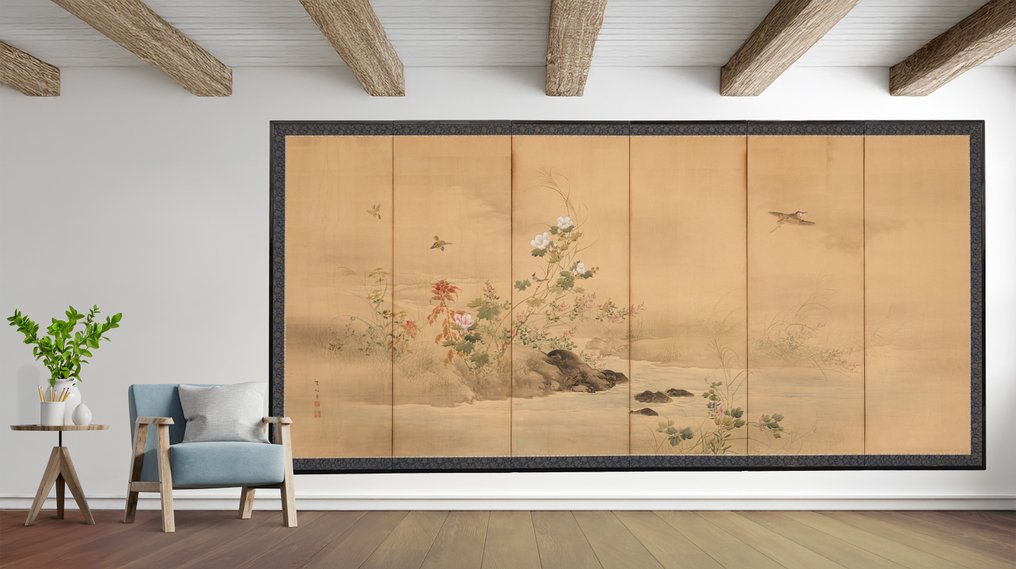
A six-panel byôbu folding screen from around 1900 Meiji Japan by Shimizu Rokushô, painted in colour ink on paper with silk borders and a lacquered wooden frame, measuring 352 cm wide by 173.4 cm high and signed with the inscription “By Rokushô” in the lower left corner.
AI-assisted summary
Description from the seller
A serene tall six-panel byôbu 屏風 (folding screen) by Shimizu Rokushô 清水麓松 (1863–1919), showcasing a Shijô School 四条派 painting of an idyllic landscape.
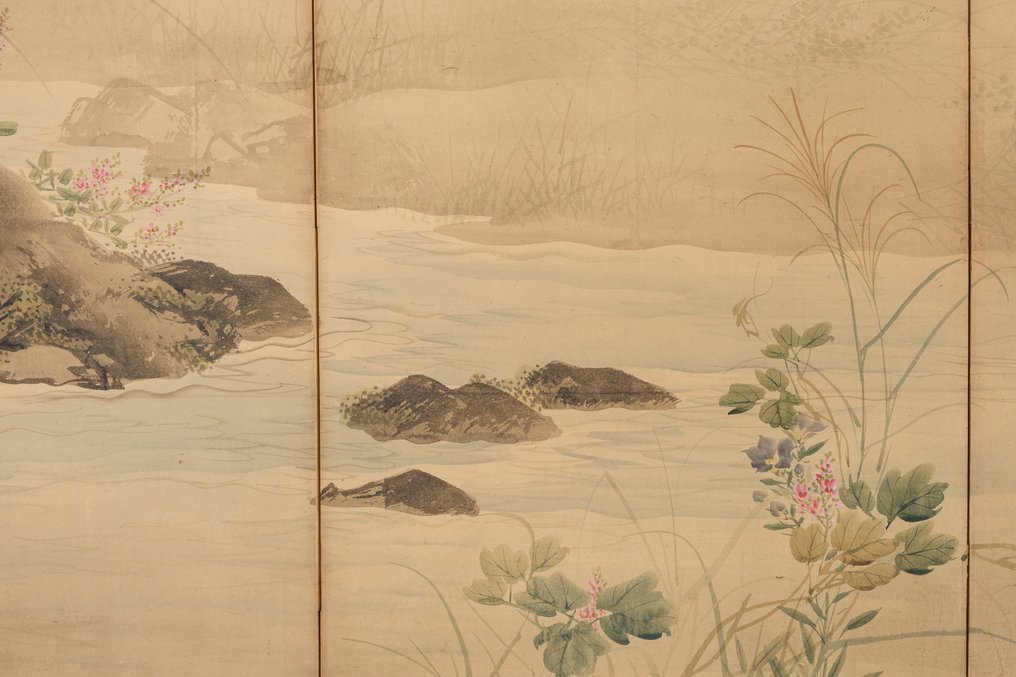
A gentle hill covered with wildflowers rises along the edge of a softly meandering river. Above the scene, sparrows 雀 (suzume) flutter through the air, while a plover 千鳥 (chidori) is shown in flight, leaving the sheltered surroundings. The foreground and slopes are richly planted with blue asters 野菊 (nogiku), long blades of pampas grass 薄 (susuki), white and pink hibiscus 芙蓉 (fuyô), and spreading shrubs of lespedeza 萩 (hagi), creating a calm yet lively seasonal atmosphere.
The painting is signed and sealed in the lower left corner with the inscription “By Rokushô” 麓松素, accompanied by two seals.
Shimizu Rokusho 清水麓松 (1863–1919) was a painter of the Shijô school 四条派 (Kyoto naturalist painting tradition). Born in Ôgaki, Gifu Prefecture, he was the third son of Shimizu Mataichi Masaharu 清水又市正晴, head of the Shimizu family’s main line. Originally named Tatsuo 龍男 and later Shôzô 昌造, he was adopted by his uncle Shôso Masanari 将曹正就 and studied painting under Kôno Bairei 幸野楳嶺 in Kyôto. Renowned for his skill, he rivaled Takeuchi Seihô 竹内栖鳳 during his training years but was later expelled from Bairei’s studio. From the 1890s he worked mainly in Hida-Takayama 飛騨高山, leaving numerous kachôga 花鳥画 (flower-and-bird paintings), including Rôkô 狙公, exhibited at the 2nd Paris Japanese Art Exposition. He died in Takayama in 1919.
Executed in colour and ink on paper, the painting is bordered by two silk bands: a thin ecru inner border and a broad blue outer border. The panels are set within a lacquered wooden frame.
Period: Japan – around 1900 (Meiji period).
Dimensions:
Total width 352 cm (2 × 60 cm, 4 × 58 cm); Height 173.4 cm.
In good restored condition, with some discolouration, traces of age, and old restorations visible on both sides. Please refer to the photos for a clear condition reference.
The folding screen is ideal for mounting flat on a wall and presenting as a single work of art.
When shipped we will add a certificate of authenticity
Seller's Story
Since 1996, Japanese Antique Store has been importing Japanese antiques directly from Japan.
We travel several times a year through Japan and visit auctions, shows, dealers, and collectors.
Besides our physical store in Amsterdam, we are also active on Catawiki. We specialize in Samoeraipantser (Yoroi) and objects, lacquerware, screens, paintings, Buddhist images, and many more Japanese artifacts!
Translated by Google TranslateA serene tall six-panel byôbu 屏風 (folding screen) by Shimizu Rokushô 清水麓松 (1863–1919), showcasing a Shijô School 四条派 painting of an idyllic landscape.
A gentle hill covered with wildflowers rises along the edge of a softly meandering river. Above the scene, sparrows 雀 (suzume) flutter through the air, while a plover 千鳥 (chidori) is shown in flight, leaving the sheltered surroundings. The foreground and slopes are richly planted with blue asters 野菊 (nogiku), long blades of pampas grass 薄 (susuki), white and pink hibiscus 芙蓉 (fuyô), and spreading shrubs of lespedeza 萩 (hagi), creating a calm yet lively seasonal atmosphere.
The painting is signed and sealed in the lower left corner with the inscription “By Rokushô” 麓松素, accompanied by two seals.
Shimizu Rokusho 清水麓松 (1863–1919) was a painter of the Shijô school 四条派 (Kyoto naturalist painting tradition). Born in Ôgaki, Gifu Prefecture, he was the third son of Shimizu Mataichi Masaharu 清水又市正晴, head of the Shimizu family’s main line. Originally named Tatsuo 龍男 and later Shôzô 昌造, he was adopted by his uncle Shôso Masanari 将曹正就 and studied painting under Kôno Bairei 幸野楳嶺 in Kyôto. Renowned for his skill, he rivaled Takeuchi Seihô 竹内栖鳳 during his training years but was later expelled from Bairei’s studio. From the 1890s he worked mainly in Hida-Takayama 飛騨高山, leaving numerous kachôga 花鳥画 (flower-and-bird paintings), including Rôkô 狙公, exhibited at the 2nd Paris Japanese Art Exposition. He died in Takayama in 1919.
Executed in colour and ink on paper, the painting is bordered by two silk bands: a thin ecru inner border and a broad blue outer border. The panels are set within a lacquered wooden frame.
Period: Japan – around 1900 (Meiji period).
Dimensions:
Total width 352 cm (2 × 60 cm, 4 × 58 cm); Height 173.4 cm.
In good restored condition, with some discolouration, traces of age, and old restorations visible on both sides. Please refer to the photos for a clear condition reference.
The folding screen is ideal for mounting flat on a wall and presenting as a single work of art.
When shipped we will add a certificate of authenticity
Seller's Story
Since 1996, Japanese Antique Store has been importing Japanese antiques directly from Japan.
We travel several times a year through Japan and visit auctions, shows, dealers, and collectors.
Besides our physical store in Amsterdam, we are also active on Catawiki. We specialize in Samoeraipantser (Yoroi) and objects, lacquerware, screens, paintings, Buddhist images, and many more Japanese artifacts!
Translated by Google TranslateDetails
Dynastic Style/Period
Around 1900 (Meiji period)
No. of items
1
Artist
Shimizu Rokushô 清水麓松 (1863–1919)
Country of Origin
Japan
Attribution
Original
Material
Silk, Paper, Lacquered wood
Height
173.4 cm
Width
352 cm
Title of artwork
Byôbu 屏風 (folding screen)
Condition
Good condition
Sold by
