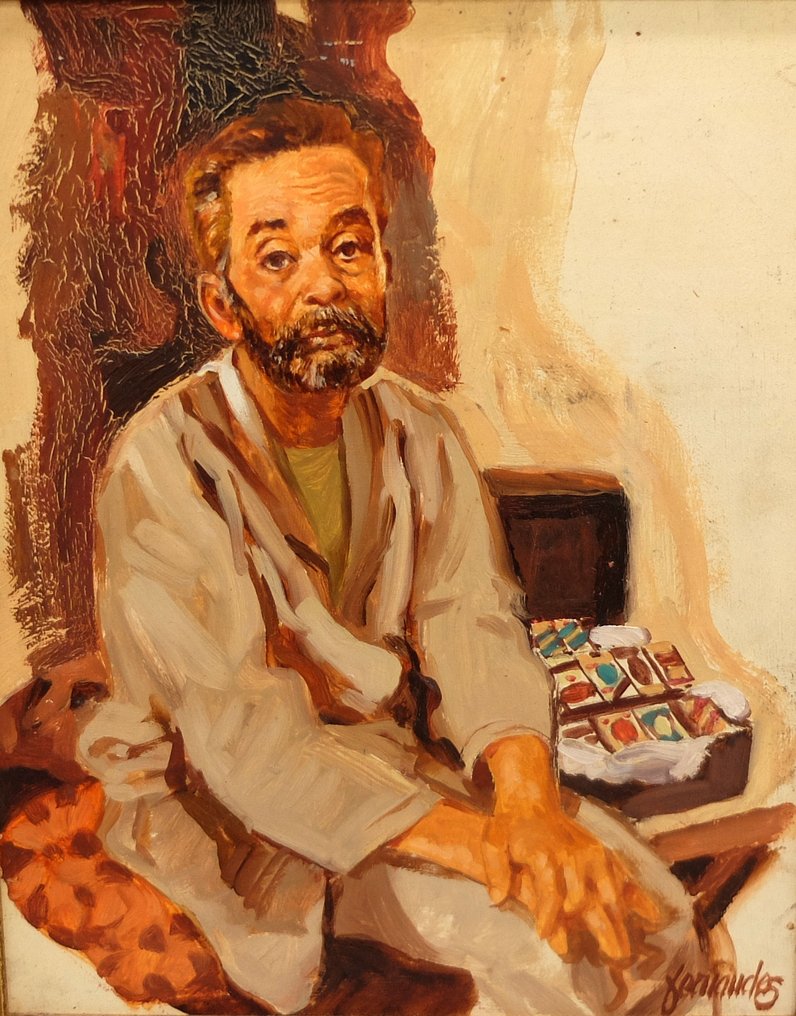
Fernando Fernández Sánchez (1940-2010) - El vendedor de tabaco


05
days
17
hours
27
minutes
45
seconds

No bids placed
Catawiki Buyer Protection
Your payment’s safe with us until you receive your object.View details
Trustpilot 4.4 | 123609 reviews
Rated Excellent on Trustpilot.
El vendedor de tabaco, an original oil portrait painting by Spanish artist Fernando Fernández Sánchez (1940-2010), created in 1970–1980, sold with frame, framed size 40 cm by 34 cm.
AI-assisted summary
Description from the seller
It is signed by the artist at the bottom.
On the back, it is again signed and titled 'vendedor de tabaco'.
The work is well presented in its framing.
Good condition
Work measurements: 26 cm in height x 21 cm in width
Frame measurements: 40 cm high x 34 cm wide
:::::::::::::::::::::::::::::::::::::::::::::::::::::::::::::::::::::::::::::::
Artist biography
Spanish painter and illustrator who has also been a comic artist and has worked as a theorist, popularizer, and teacher of the medium. He began his professional career in the late 1950s drawing comics for the agency Selecciones Ilustradas for the European market. After his stint in advertising and illustration in the mid-1960s, he returned to comics working for Warren magazines, always through SI, in the early 1970s. He continued in this field with titles from Toutain Editor, becoming a reference within the so-called pictorial comic, which he alternated with illustration until the 1990s, finally moving into gallery painting and commissioned portraiture.
Fernando Fernández was born in Barcelona in 1940. At the young age of 13, he started working in a pharmaceutical laboratory office and later in a small textile factory while studying commercial expertise at night. His first artistic steps were taken in 1955, inking backgrounds for Antonio Biosca in the notebooks of Chispita, the son of the Jinete Fantasma from Editorial Grafidea. The following year, he created Ghost Ship!, a science fiction comic strip for which he was both writer and artist, serving as a test to join the agency Selecciones Ilustradas with full dedication, initially inking the work of other artists like Pedro Añaños and continuing to illustrate romantic comics aimed at the English market.
After his stay in Buenos Aires between 1958 and 1960, during which he continued collaborating with SI and took the opportunity to publish comics with his own scripts in Argentine magazines such as Gorrión, Puño Fuerte, and Tótem Gigante, he began his military phase for Fleetway and started learning pictorial and illustration techniques. He also began writing scripts that were illustrated by his own agency colleagues: Auraleón, Buylla, Añaños, among others. During those years, he alternated work as a comic artist with that of an illustrator, creating covers for comics and novels for Spanish publishers such as Toray, Ferma, Molino, Sopena, IMDE, etc. By the mid-1960s, his covers across all genres—romantic, western, war, detective, science fiction, youth—were reproduced throughout much of Europe. During this period, his work diversified into advertising, and he also made his first approaches to painting, receiving several local awards and holding his first solo exhibition in 1969 at the Jaimes gallery in Barcelona. Over these years, he held six solo exhibitions and twelve group shows but stepped away from this promising future to continue in illustration and comics.
Fernando Fernández, after completing his military service, married María Rosa Lleida, also a comic strip artist, illustrator, and painter, and they have two children: Eva in 1965 and Héctor in 1969. To this day, all are involved in the world of art.
In the seventies, he began a fruitful collaboration as a cover artist for the North American market of pocketbooks, working with publishers such as Random House, Dell Publishing, Ace Books, and New American Library. He is an active member and founding partner of the Club DHIN, an association of cartoonists and illustrators led by Francisco Macián, which seeks to legislate and manage the copyright rights of Spanish comic creators. Between 1970 and 1973, he created the satirical strip titled Mosca for the Diario de Barcelona. For the Madrid-based Editorial Rollán, he adapted and directed several photo-novels from the Colección Corín Tellado, featuring family members and friends of the profession. During these years, through mediation by SI, he drew thirteen comics with various experimental styles for Warren Publishing, based on his own scripts, which were published in the United States in magazines such as Eerie and Vampirella. In Spain, they appeared in titles like Garbo: Vampus, Rufus, and Vampirella. His work titled Goodbye, my love (published in Spain in Vampirella issue 7 under the title Adios amor mio) earned him the Warren Award in 1975 for Best Comic.
In 1973, he did not reach an agreement with Rollán to publish a series of educational books, but he did with the publisher Afha, for whom he wrote and illustrated the series Science and Adventure, a total of five books between 1974 and 1979, in which he experimented with pictorial comics, blending juvenile adventure comics with scientific and educational dissemination. This collection was quite successful, co-published with several European countries, and went through multiple reprints, some even with Círculo de Lectores and various Savings Banks. For the second volume of the collection Journey into the World of Insects, he was awarded the A.C.P.F. Award and the National Illustration Award in 1977. Also in 1974, he participated in the Pala Juvenile Encyclopedia, directed by Luis Gasca, creating a 17-page comic in volume nine titled The Theater, with a script by Juan José Sarto.
During the years of the transition, he worked for the magazine Interviú as a photojournalist and published various collaborations of humor and short comics in magazines such as Siesta, Primera Plana, and others. At the same time, he was the scriptwriter for the works drawn by his wife Rosa Lleida in the satirical magazine El Jueves. In 1979, for the Italian publisher Cepim and within the collection Un uomo un’avventura, he created the album L’uomo di Cuba with his own script, which was published a year later in Spain by the publisher Nueva Frontera in issue 10 of the collection Super Tótem.
Already in the 1980s, he continued with graphic experimentation within the comic genre with the series Círculos, which was published in installments in Toutain Editor magazine in 1984 and in the monographic book dedicated to the author within the collection When Comics Are Art by the same publisher. With these same artistic approaches, the baroque, modernist, and Gaudin-inspired Zora and the Hibernauts was born, a science fiction comic published in installments in the magazine 1984 and compiled into an album in 1983. This work was followed by the adaptation of Bram Stoker's Dracula, entirely painted in oil, serialized from issue 36 of Creepy magazine, also by Toutain, in June 1982. The same publisher released it entirely in an album in 1984. During these years, he wrote comic scripts illustrated by his wife Rosa Lleida, for example, the numbered series in the early issues of the magazine Cimoc, published by Riego.
It is in the headers of Toutain where Fernando begins his work in comic book dissemination, initially with the section titled 'In Moderate Frequency' in the magazine 1984 from issue 30 to 46, and continues with Estafeta from issue 47 to 64 inclusive. This work earned him the El Diario de Avisos award in 1982 as the best critic. That same year, together with fellow comic artists Manfred Sommer and Leopoldo Sánchez, he created the T.C.I., a comic and illustration workshop where classes were held for about two years. He teaches at the HHSS Marist College on Paseo San Juan in Barcelona as a drawing teacher for two years, and later, from 1990 to 1993, he taught comics and illustration at Createcnia, a Visual Arts school.
Editorial Bruguera adapts a selection of short stories by science fiction writer Isaac Asimov, which appeared directly in album format in 1983 in the collection Signed by… and were reissued years later in the magazines El Capitán Trueno and Zona 84. The following year, for the magazine Zona 84 by Toutain Editor, and with scripts by Argentine Carlos Trillo, he illustrated in color the comic strip The Legend of the Four Shadows, which appeared in chapters between issues one and nine and has not yet seen a book edition. In 1987, the illustrated youth science fiction book The Crown, the Space Crown, with texts by Albert Carey, was commissioned by Nutrexpa, featuring aesthetics and characters very similar to those seen in the Science and Adventure collection, an album to be completed with holograms. Ediciones B commissioned him in 1989 for more adaptations of Asimov, giving rise to the character Luky Starr, of which he only completed one adventure: The Oceans of Venus, which appeared in the magazine Gran Aventurero in 1989. A project also for Ediciones B, titled Terrific, a script by Víctor Mora, was left unfinished: Fernando completed many pages, but it never reached the public due to editorial problems.
His latest contributions to the world of comics are with Toutain and for their magazines Zona 84 and Tótem el Comix in 1988. In the first, besides the series of illustrations Gallery of Fantastic Characters, there are three short adaptations by A. W. Klimosky and a personal character: Argón, for which he created two long adventures, Argón the Savage and El Summun, the latter scripted by José María Polls and with assistance in graphic realization from his former students, Amadeo Aldavert and Albert Tarragó, after suffering a heart attack. In the second, Zodiaco is published, of which only seven episodes out of the twelve that make up the series appear, and in which he is helped by his son Héctor.
By medical prescription, he decided to give up comics and fully dedicate himself to painting. In 1994, he began collaborating with the Grupo de Arte Escolá as an exclusive portrait artist, creating numerous portraits of important public figures. In recent years, he has held more than one hundred exhibitions in Spain and abroad, both group and solo shows.
Fernando Fernández has not forgotten the world of comics; proof of this is Illustrated Memories, published by Glenat in 2004, an autobiographical book that documents a period, recalling his experiences as a comic artist and being rich in graphic documentation. That same year, Glenat reissued two of his most emblematic works: Zora y los hibernautas and Dracula.
It is signed by the artist at the bottom.
On the back, it is again signed and titled 'vendedor de tabaco'.
The work is well presented in its framing.
Good condition
Work measurements: 26 cm in height x 21 cm in width
Frame measurements: 40 cm high x 34 cm wide
:::::::::::::::::::::::::::::::::::::::::::::::::::::::::::::::::::::::::::::::
Artist biography
Spanish painter and illustrator who has also been a comic artist and has worked as a theorist, popularizer, and teacher of the medium. He began his professional career in the late 1950s drawing comics for the agency Selecciones Ilustradas for the European market. After his stint in advertising and illustration in the mid-1960s, he returned to comics working for Warren magazines, always through SI, in the early 1970s. He continued in this field with titles from Toutain Editor, becoming a reference within the so-called pictorial comic, which he alternated with illustration until the 1990s, finally moving into gallery painting and commissioned portraiture.
Fernando Fernández was born in Barcelona in 1940. At the young age of 13, he started working in a pharmaceutical laboratory office and later in a small textile factory while studying commercial expertise at night. His first artistic steps were taken in 1955, inking backgrounds for Antonio Biosca in the notebooks of Chispita, the son of the Jinete Fantasma from Editorial Grafidea. The following year, he created Ghost Ship!, a science fiction comic strip for which he was both writer and artist, serving as a test to join the agency Selecciones Ilustradas with full dedication, initially inking the work of other artists like Pedro Añaños and continuing to illustrate romantic comics aimed at the English market.
After his stay in Buenos Aires between 1958 and 1960, during which he continued collaborating with SI and took the opportunity to publish comics with his own scripts in Argentine magazines such as Gorrión, Puño Fuerte, and Tótem Gigante, he began his military phase for Fleetway and started learning pictorial and illustration techniques. He also began writing scripts that were illustrated by his own agency colleagues: Auraleón, Buylla, Añaños, among others. During those years, he alternated work as a comic artist with that of an illustrator, creating covers for comics and novels for Spanish publishers such as Toray, Ferma, Molino, Sopena, IMDE, etc. By the mid-1960s, his covers across all genres—romantic, western, war, detective, science fiction, youth—were reproduced throughout much of Europe. During this period, his work diversified into advertising, and he also made his first approaches to painting, receiving several local awards and holding his first solo exhibition in 1969 at the Jaimes gallery in Barcelona. Over these years, he held six solo exhibitions and twelve group shows but stepped away from this promising future to continue in illustration and comics.
Fernando Fernández, after completing his military service, married María Rosa Lleida, also a comic strip artist, illustrator, and painter, and they have two children: Eva in 1965 and Héctor in 1969. To this day, all are involved in the world of art.
In the seventies, he began a fruitful collaboration as a cover artist for the North American market of pocketbooks, working with publishers such as Random House, Dell Publishing, Ace Books, and New American Library. He is an active member and founding partner of the Club DHIN, an association of cartoonists and illustrators led by Francisco Macián, which seeks to legislate and manage the copyright rights of Spanish comic creators. Between 1970 and 1973, he created the satirical strip titled Mosca for the Diario de Barcelona. For the Madrid-based Editorial Rollán, he adapted and directed several photo-novels from the Colección Corín Tellado, featuring family members and friends of the profession. During these years, through mediation by SI, he drew thirteen comics with various experimental styles for Warren Publishing, based on his own scripts, which were published in the United States in magazines such as Eerie and Vampirella. In Spain, they appeared in titles like Garbo: Vampus, Rufus, and Vampirella. His work titled Goodbye, my love (published in Spain in Vampirella issue 7 under the title Adios amor mio) earned him the Warren Award in 1975 for Best Comic.
In 1973, he did not reach an agreement with Rollán to publish a series of educational books, but he did with the publisher Afha, for whom he wrote and illustrated the series Science and Adventure, a total of five books between 1974 and 1979, in which he experimented with pictorial comics, blending juvenile adventure comics with scientific and educational dissemination. This collection was quite successful, co-published with several European countries, and went through multiple reprints, some even with Círculo de Lectores and various Savings Banks. For the second volume of the collection Journey into the World of Insects, he was awarded the A.C.P.F. Award and the National Illustration Award in 1977. Also in 1974, he participated in the Pala Juvenile Encyclopedia, directed by Luis Gasca, creating a 17-page comic in volume nine titled The Theater, with a script by Juan José Sarto.
During the years of the transition, he worked for the magazine Interviú as a photojournalist and published various collaborations of humor and short comics in magazines such as Siesta, Primera Plana, and others. At the same time, he was the scriptwriter for the works drawn by his wife Rosa Lleida in the satirical magazine El Jueves. In 1979, for the Italian publisher Cepim and within the collection Un uomo un’avventura, he created the album L’uomo di Cuba with his own script, which was published a year later in Spain by the publisher Nueva Frontera in issue 10 of the collection Super Tótem.
Already in the 1980s, he continued with graphic experimentation within the comic genre with the series Círculos, which was published in installments in Toutain Editor magazine in 1984 and in the monographic book dedicated to the author within the collection When Comics Are Art by the same publisher. With these same artistic approaches, the baroque, modernist, and Gaudin-inspired Zora and the Hibernauts was born, a science fiction comic published in installments in the magazine 1984 and compiled into an album in 1983. This work was followed by the adaptation of Bram Stoker's Dracula, entirely painted in oil, serialized from issue 36 of Creepy magazine, also by Toutain, in June 1982. The same publisher released it entirely in an album in 1984. During these years, he wrote comic scripts illustrated by his wife Rosa Lleida, for example, the numbered series in the early issues of the magazine Cimoc, published by Riego.
It is in the headers of Toutain where Fernando begins his work in comic book dissemination, initially with the section titled 'In Moderate Frequency' in the magazine 1984 from issue 30 to 46, and continues with Estafeta from issue 47 to 64 inclusive. This work earned him the El Diario de Avisos award in 1982 as the best critic. That same year, together with fellow comic artists Manfred Sommer and Leopoldo Sánchez, he created the T.C.I., a comic and illustration workshop where classes were held for about two years. He teaches at the HHSS Marist College on Paseo San Juan in Barcelona as a drawing teacher for two years, and later, from 1990 to 1993, he taught comics and illustration at Createcnia, a Visual Arts school.
Editorial Bruguera adapts a selection of short stories by science fiction writer Isaac Asimov, which appeared directly in album format in 1983 in the collection Signed by… and were reissued years later in the magazines El Capitán Trueno and Zona 84. The following year, for the magazine Zona 84 by Toutain Editor, and with scripts by Argentine Carlos Trillo, he illustrated in color the comic strip The Legend of the Four Shadows, which appeared in chapters between issues one and nine and has not yet seen a book edition. In 1987, the illustrated youth science fiction book The Crown, the Space Crown, with texts by Albert Carey, was commissioned by Nutrexpa, featuring aesthetics and characters very similar to those seen in the Science and Adventure collection, an album to be completed with holograms. Ediciones B commissioned him in 1989 for more adaptations of Asimov, giving rise to the character Luky Starr, of which he only completed one adventure: The Oceans of Venus, which appeared in the magazine Gran Aventurero in 1989. A project also for Ediciones B, titled Terrific, a script by Víctor Mora, was left unfinished: Fernando completed many pages, but it never reached the public due to editorial problems.
His latest contributions to the world of comics are with Toutain and for their magazines Zona 84 and Tótem el Comix in 1988. In the first, besides the series of illustrations Gallery of Fantastic Characters, there are three short adaptations by A. W. Klimosky and a personal character: Argón, for which he created two long adventures, Argón the Savage and El Summun, the latter scripted by José María Polls and with assistance in graphic realization from his former students, Amadeo Aldavert and Albert Tarragó, after suffering a heart attack. In the second, Zodiaco is published, of which only seven episodes out of the twelve that make up the series appear, and in which he is helped by his son Héctor.
By medical prescription, he decided to give up comics and fully dedicate himself to painting. In 1994, he began collaborating with the Grupo de Arte Escolá as an exclusive portrait artist, creating numerous portraits of important public figures. In recent years, he has held more than one hundred exhibitions in Spain and abroad, both group and solo shows.
Fernando Fernández has not forgotten the world of comics; proof of this is Illustrated Memories, published by Glenat in 2004, an autobiographical book that documents a period, recalling his experiences as a comic artist and being rich in graphic documentation. That same year, Glenat reissued two of his most emblematic works: Zora y los hibernautas and Dracula.
Details
Artist
Fernando Fernández Sánchez (1940-2010)
Sold with frame
Yes
Sold by
Gallery
Edition
Original
Title of artwork
El vendedor de tabaco
Technique
Oil painting
Signature
Hand signed
Country of Origin
Spain
Condition
Good condition
Height
40 cm
Width
34 cm
Depiction/Theme
Portrait
Period
1970-1980
Sold by