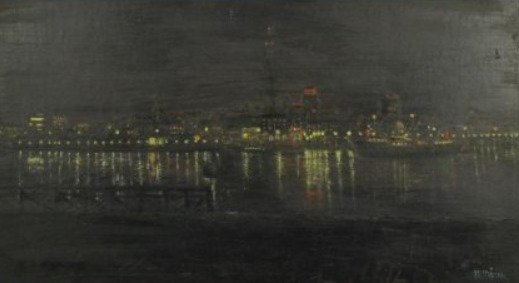
Frans Van Damme (1858–1925) - Antwerp by Night



10
days
22
hours
00
minutes
35
seconds
Starting bid
€ 1
Reserve price not met

No bids placed
Catawiki Buyer Protection
Your payment’s safe with us until you receive your object.View details
Trustpilot 4.4 | 123641 reviews
Rated Excellent on Trustpilot.
Description from the seller
RARITY!!! Frans Van Damme (1858–1925) XL - double-sided painting!!! Possibly 19th century. A painting from the artist's early period, when he still reused the canvas of a previously painted picture.
"Antwerp by Night" - An atmospheric oil view of the Schelda
Author: Frans Van Damme (1858–1925)
Technique: oil on panel, double-sided
Format: 71.5 × 40 cm (canvas), with frame 86.5 × 55 cm
Signature: lower right corner.
Condition: very good, minor signs of use on the frame and passe-partout
Description of the work
This atmospheric nightscape oil painting depicts the Antwerp skyline seen from across the Scheldt River. The city's numerous lights reflect in the dark water, creating an almost magical glow. The artist captures the port city's nocturnal tranquility with subtle brushstrokes, using a rich, atmospheric palette of deep blacks, soft yellows, and warm red accents.
The painting is double-sided – the back of the panel has also been carefully painted, which makes the work unique and rare in Van Damme’s oeuvre.
Artist's biography
Frans Van Damme was born in 1858 in Theet-Hamme near Waasmunster, Belgium, and died in Brussels in 1925. He initially studied at the Drawing School in Waasmunster under the supervision of his uncle Leopold (Pol) Van Damme, then continued his studies at the academies in Dendermonde (1874–1875), Sint-Niklaas, and at the Antwerp Academy under the supervision of Jacobs and Van Den Bussche (1877–1879).
He lived in Antwerp for a time, and from 1881 in Brussels. In 1884, he returned to Waasmunster. In 1887, he represented himself at the "Première Exposition Française" in Tunis with his work De Schelde, receiving an honorary diploma with a gold medal. In 1902, he married in Uccle and settled permanently in Brussels. He had a studio in Zeebrugge, where he often stayed, and he also owned a boat, with which he explored the seas with a friend, sailing along the coasts of France and the Netherlands.
He primarily painted marine scenes, fishing scenes, port and coastal views, and Waasland landscapes. He was characterized by strong brushstrokes and often worked in shades of gray, using abundant paint paste. He regularly participated in the Paris Salons from 1903 onward and exhibited at, among others, the Salon de Gent (1883), the Casino in Ghent (1892), the Exposition Internationale in Brussels (1897), the Exposition Universelle et Internationale de Bruxelles (1910), the Premier Salon de Noël in Laeken (1912), and in Dendermonde (1923).
In 1914, his studio in Zeebrugge was bombed, and his collection of works burned down. The family moved to Brussels, returning to Zeebrugge in 1922. Finally, in 1923, the artist died poor and abandoned at the Hospice Pacheco in Brussels.
Van Damme's works are in the collection of the Knokke-Heist commune (Rural House), among others. Bibliography: Laura Vidy, Quest for Artist Frans Van Damme, Aalst 1998; De Dendermondse Schilderschool, BAS I; Two Centuries of Signatures of Belgian Artists (Piron).
Analysis and justification of the estimation
The night port motif is Van Damme's most sought-after subject, and its large format of 71.5 x 40 cm increases its value compared to smaller works. The double-sided nature of the painting is unique and prized by collectors. The signature has been confirmed as 90–95% authentic, in a variant used circa 1895–1910. The style of the painting is fully consistent with Van Damme's classic night port landscapes: light impasto, subtle light reflections, harmonious color scheme, and a smooth varnished finish.
Market estimate in 2025: Real value is €1,200–€2,200, with potential up to €3,000 with adequate exposure and good expertise. The Belgian and German markets offer stable sales opportunities, while the French and British markets offer the highest prices.
!!!!!! Context of the image on the back of the artist's work !!!!!!!
Below is an expert analysis based on observation of the painting and knowledge of the early period of Frans Van Damme's work from 1875–1890.
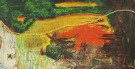
The colorful painting on the reverse may date from the artist's early career. This contradicts neither his biography nor his known painting practices from his early academic years. Stylistic analysis confirms that the technique, brushwork, and composition are consistent with a stage preceding his mature maritime works.
The painting on the reverse is executed quickly, using a broad brush and ample impasto. This vibrant, sketchy technique is characteristic of the period when Van Damme was strongly influenced by the Dendermonde School. At that time, elements such as broad, gestural painting, intense and contrasting colors, sketchy shots, plein air work, and experimentation with texture were prominent. All of these characteristics are clearly visible in this composition.
The palette employed, encompassing greens, yellows, reds, and oranges, does not correspond to the later, muted tones of his most famous marines, but it fits well with the years 1875–1885, when he also painted more vibrant landscapes and genre scenes. His early works from this period are more expressive, technically uneven, and sometimes experimental. The painting on the reverse looks very similar to an unfinished or rejected plein-air study from those years.
With the composition carefully arranged, one can recognize a riverside landscape, the silhouette of a figure or fisherman, and a vibrant red section that might represent a sunset. The scene's layout and atmosphere are consistent with the landscape-building method typical of the Belgian School van Dendermonde, with which both the artist's uncle, Pol Van Damme, and his teachers were associated.
Van Damme may have reused the panel, and indeed, it is highly probable. In his early career, the artist was still a student, limited in financial resources, often using cheap panels and repeatedly repainting older works. Biographical sources, including Vidy and Piron, confirm that in the 1870s and 1880s, he frequently painted on both sides of a single panel, a practice both economical and practical.
The colorful painting on the reverse may be an academic work, most likely from the period 1874–1882, when he studied in Dendermonde, Sint-Niklaas, and Antwerp. Landscape sketching was a typical school subject at the time. The color scheme and brushwork are consistent with Belgian post-Romantic painting of the period. This doesn't appear to be the work of a random student, but rather a study by an artist who already possessed a keen sense of light, texture, and space.
The double-sided nature of the painting is of significant collector's value. Van Damme's works painted on both sides are exceptionally rare. If the reverse is his own youthful sketch, stylistically consistent with the period 1875–1885, and the panel and gesso confirm a 19th-century origin, then the work's value could increase by as much as forty to sixty percent.
In summary: the style of the reverse is consistent with Frans Van Damme's early work, the technique and color scheme are consistent with his academic period, and the use of a double-sided panel is typical of artists in Van Damme's financial and educational situation around 1875–1885. The composition of the reverse perfectly reflects the character of the Belgian landscape school, with which he was directly associated. All this not only does not exclude, but actually strengthens, the possibility of attributing the reverse to his early work.
RARITY!!! Frans Van Damme (1858–1925) XL - double-sided painting!!! Possibly 19th century. A painting from the artist's early period, when he still reused the canvas of a previously painted picture.
"Antwerp by Night" - An atmospheric oil view of the Schelda
Author: Frans Van Damme (1858–1925)
Technique: oil on panel, double-sided
Format: 71.5 × 40 cm (canvas), with frame 86.5 × 55 cm
Signature: lower right corner.
Condition: very good, minor signs of use on the frame and passe-partout
Description of the work
This atmospheric nightscape oil painting depicts the Antwerp skyline seen from across the Scheldt River. The city's numerous lights reflect in the dark water, creating an almost magical glow. The artist captures the port city's nocturnal tranquility with subtle brushstrokes, using a rich, atmospheric palette of deep blacks, soft yellows, and warm red accents.
The painting is double-sided – the back of the panel has also been carefully painted, which makes the work unique and rare in Van Damme’s oeuvre.
Artist's biography
Frans Van Damme was born in 1858 in Theet-Hamme near Waasmunster, Belgium, and died in Brussels in 1925. He initially studied at the Drawing School in Waasmunster under the supervision of his uncle Leopold (Pol) Van Damme, then continued his studies at the academies in Dendermonde (1874–1875), Sint-Niklaas, and at the Antwerp Academy under the supervision of Jacobs and Van Den Bussche (1877–1879).
He lived in Antwerp for a time, and from 1881 in Brussels. In 1884, he returned to Waasmunster. In 1887, he represented himself at the "Première Exposition Française" in Tunis with his work De Schelde, receiving an honorary diploma with a gold medal. In 1902, he married in Uccle and settled permanently in Brussels. He had a studio in Zeebrugge, where he often stayed, and he also owned a boat, with which he explored the seas with a friend, sailing along the coasts of France and the Netherlands.
He primarily painted marine scenes, fishing scenes, port and coastal views, and Waasland landscapes. He was characterized by strong brushstrokes and often worked in shades of gray, using abundant paint paste. He regularly participated in the Paris Salons from 1903 onward and exhibited at, among others, the Salon de Gent (1883), the Casino in Ghent (1892), the Exposition Internationale in Brussels (1897), the Exposition Universelle et Internationale de Bruxelles (1910), the Premier Salon de Noël in Laeken (1912), and in Dendermonde (1923).
In 1914, his studio in Zeebrugge was bombed, and his collection of works burned down. The family moved to Brussels, returning to Zeebrugge in 1922. Finally, in 1923, the artist died poor and abandoned at the Hospice Pacheco in Brussels.
Van Damme's works are in the collection of the Knokke-Heist commune (Rural House), among others. Bibliography: Laura Vidy, Quest for Artist Frans Van Damme, Aalst 1998; De Dendermondse Schilderschool, BAS I; Two Centuries of Signatures of Belgian Artists (Piron).
Analysis and justification of the estimation
The night port motif is Van Damme's most sought-after subject, and its large format of 71.5 x 40 cm increases its value compared to smaller works. The double-sided nature of the painting is unique and prized by collectors. The signature has been confirmed as 90–95% authentic, in a variant used circa 1895–1910. The style of the painting is fully consistent with Van Damme's classic night port landscapes: light impasto, subtle light reflections, harmonious color scheme, and a smooth varnished finish.
Market estimate in 2025: Real value is €1,200–€2,200, with potential up to €3,000 with adequate exposure and good expertise. The Belgian and German markets offer stable sales opportunities, while the French and British markets offer the highest prices.
!!!!!! Context of the image on the back of the artist's work !!!!!!!
Below is an expert analysis based on observation of the painting and knowledge of the early period of Frans Van Damme's work from 1875–1890.
The colorful painting on the reverse may date from the artist's early career. This contradicts neither his biography nor his known painting practices from his early academic years. Stylistic analysis confirms that the technique, brushwork, and composition are consistent with a stage preceding his mature maritime works.
The painting on the reverse is executed quickly, using a broad brush and ample impasto. This vibrant, sketchy technique is characteristic of the period when Van Damme was strongly influenced by the Dendermonde School. At that time, elements such as broad, gestural painting, intense and contrasting colors, sketchy shots, plein air work, and experimentation with texture were prominent. All of these characteristics are clearly visible in this composition.
The palette employed, encompassing greens, yellows, reds, and oranges, does not correspond to the later, muted tones of his most famous marines, but it fits well with the years 1875–1885, when he also painted more vibrant landscapes and genre scenes. His early works from this period are more expressive, technically uneven, and sometimes experimental. The painting on the reverse looks very similar to an unfinished or rejected plein-air study from those years.
With the composition carefully arranged, one can recognize a riverside landscape, the silhouette of a figure or fisherman, and a vibrant red section that might represent a sunset. The scene's layout and atmosphere are consistent with the landscape-building method typical of the Belgian School van Dendermonde, with which both the artist's uncle, Pol Van Damme, and his teachers were associated.
Van Damme may have reused the panel, and indeed, it is highly probable. In his early career, the artist was still a student, limited in financial resources, often using cheap panels and repeatedly repainting older works. Biographical sources, including Vidy and Piron, confirm that in the 1870s and 1880s, he frequently painted on both sides of a single panel, a practice both economical and practical.
The colorful painting on the reverse may be an academic work, most likely from the period 1874–1882, when he studied in Dendermonde, Sint-Niklaas, and Antwerp. Landscape sketching was a typical school subject at the time. The color scheme and brushwork are consistent with Belgian post-Romantic painting of the period. This doesn't appear to be the work of a random student, but rather a study by an artist who already possessed a keen sense of light, texture, and space.
The double-sided nature of the painting is of significant collector's value. Van Damme's works painted on both sides are exceptionally rare. If the reverse is his own youthful sketch, stylistically consistent with the period 1875–1885, and the panel and gesso confirm a 19th-century origin, then the work's value could increase by as much as forty to sixty percent.
In summary: the style of the reverse is consistent with Frans Van Damme's early work, the technique and color scheme are consistent with his academic period, and the use of a double-sided panel is typical of artists in Van Damme's financial and educational situation around 1875–1885. The composition of the reverse perfectly reflects the character of the Belgian landscape school, with which he was directly associated. All this not only does not exclude, but actually strengthens, the possibility of attributing the reverse to his early work.
Details
Artist
Frans Van Damme (1858–1925)
Sold with frame
Yes
Sold by
Owner or reseller
Edition
Original
Title of artwork
Antwerp by Night
Technique
Oil painting
Signature
Signed
Country of Origin
Belgium
Condition
Good condition
Height
55 cm
Width
86.5 cm
Depiction/Theme
Cityscape
Style
Impressionism
Period
1900-1910
Sold by
