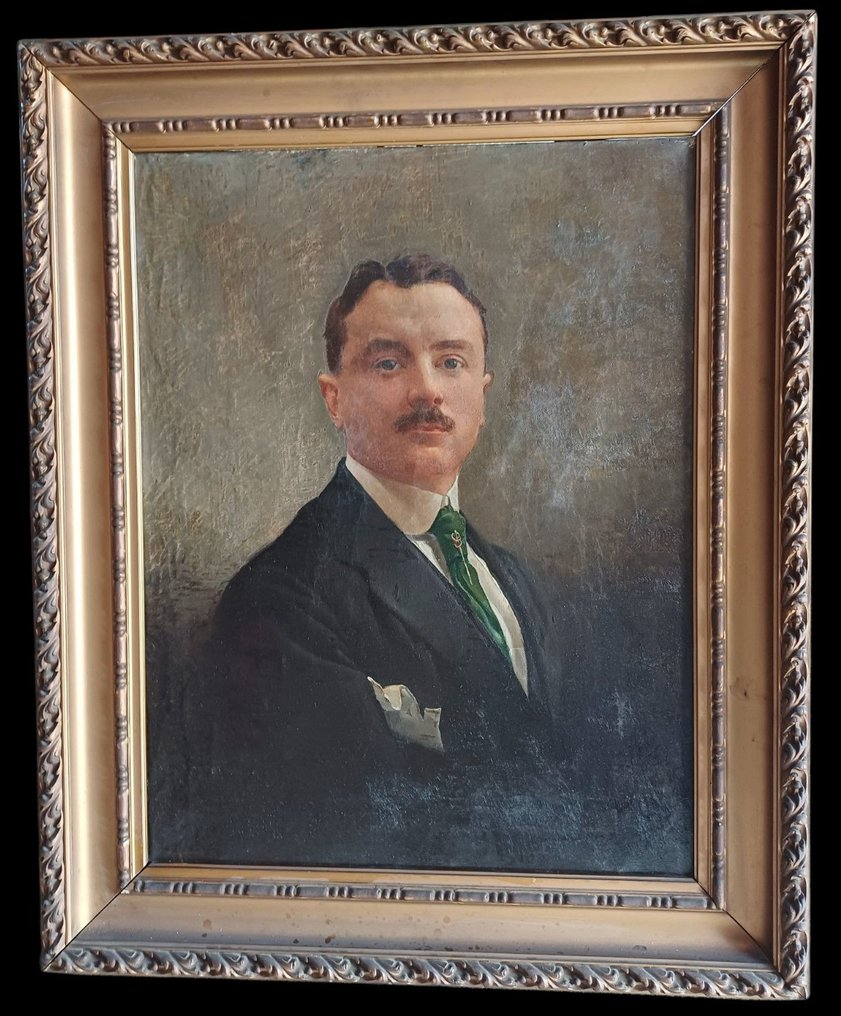
Ezechiele Acerbi (1850-1920) - Ritratto dell'Ingegnere Peppino Franchi Maggi


09
days
04
hours
08
minutes
59
seconds
Starting bid
€ 1
Reserve price not met

No bids placed
Catawiki Buyer Protection
Your payment’s safe with us until you receive your object.View details
Trustpilot 4.4 | 123759 reviews
Rated Excellent on Trustpilot.
Oil on canvas portrait by Ezechiele Acerbi (1850–1920), Ritratto dell'Ingegnere Peppino Franchi Maggi, dated 1900–1910, 83 × 68 cm, Italy, sold with frame, signed by hand, sold by Galleria.
AI-assisted summary
Description from the seller
Interesting work by the Pavia-born painter Ezechiele Acerbi (Pavia, April 10, 1850 – Pavia, February 20, 1920), masterfully painted in oil on canvas and in good condition.
The artwork measures 66x50 cm.
The frame is original from the period.
The painting depicts Peppino Franchi Maggi, born in Pavia on September 15, 1890, son of Emilio and Bianca Casorati. He studied at the Ugo Foscolo Classical High School and graduated in Engineering from the Royal Higher Technical Institute (the future Polytechnic University of Milan) in September 1912. He later became a topography assistant at the same Polytechnic, before being called up for military service in the Royal Army, assigned to the Engineering Corps, on July 20, 1913. In December of the same year, he was placed on indefinite provisional leave. As Italy prepared to enter the war, he was recalled to active duty during the general mobilization of May 1915, with the rank of second lieutenant of reserve, assigned to the 16th Sappers Company of the 1st Engineering Regiment. His unit was deployed on the Trentino front, where he participated in numerous actions to open gaps in enemy trenches using wire cutters and gelatin tubes. During an operation at Bosco di Varagna on August 25, he sustained a severe injury to his left arm, resulting in partial amputation of the limb, for which he was awarded a Bronze Medal for Military Valor. Although no longer fit for front-line service, he refused leave and requested to return to duty at the front lines. Promoted to the rank of lieutenant in May 1916, he was assigned to command the 100th Company of the 1st Engineering Regiment, fighting in Carnia, on the Isonzo front, and at Bainsizza until November, when he was hospitalized.
Reinstated to active service in March 1917, he remained in the rear areas until April 1918, when he departed for France as part of the II Corps of General Alberico Albricci. Called to serve at the command of the 8th Division, he distinguished himself during the German offensive of the following July, when he carried out a daring reconnaissance for which he was awarded the Croix de guerre by the French government. Assigned as a liaison officer with the 20th Infantry Regiment, he was tasked with verifying whether the enemy troops had abandoned their positions on the left bank of the Aisne River. At dawn on September 29, he moved to the front line and, leading a unit of assault troops from the 3rd Company of the I Battalion, positioned himself on the bank east of Pont-Arcy in search of a ford to cross the river. While standing and looking for the best crossing point, he was struck down and killed by a machine gun burst. On September 30, his body was buried in a solemn ceremony at the Ferme de Chery-Chartreuve cemetery. In his memory, he was first awarded the Silver Medal for Military Valor, which was later converted into the Gold Medal.
Work of historical and artistic significance.
Provenance of the Ing. Franchi Maggi collection
Fast shipping with secure packaging
Seller's Story
Art dealer specializing in old master paintings and 19th century works
In collaboration with ART & INVESTIGATION historical and artistic investigations on works of art
Translated by Google TranslateInteresting work by the Pavia-born painter Ezechiele Acerbi (Pavia, April 10, 1850 – Pavia, February 20, 1920), masterfully painted in oil on canvas and in good condition.
The artwork measures 66x50 cm.
The frame is original from the period.
The painting depicts Peppino Franchi Maggi, born in Pavia on September 15, 1890, son of Emilio and Bianca Casorati. He studied at the Ugo Foscolo Classical High School and graduated in Engineering from the Royal Higher Technical Institute (the future Polytechnic University of Milan) in September 1912. He later became a topography assistant at the same Polytechnic, before being called up for military service in the Royal Army, assigned to the Engineering Corps, on July 20, 1913. In December of the same year, he was placed on indefinite provisional leave. As Italy prepared to enter the war, he was recalled to active duty during the general mobilization of May 1915, with the rank of second lieutenant of reserve, assigned to the 16th Sappers Company of the 1st Engineering Regiment. His unit was deployed on the Trentino front, where he participated in numerous actions to open gaps in enemy trenches using wire cutters and gelatin tubes. During an operation at Bosco di Varagna on August 25, he sustained a severe injury to his left arm, resulting in partial amputation of the limb, for which he was awarded a Bronze Medal for Military Valor. Although no longer fit for front-line service, he refused leave and requested to return to duty at the front lines. Promoted to the rank of lieutenant in May 1916, he was assigned to command the 100th Company of the 1st Engineering Regiment, fighting in Carnia, on the Isonzo front, and at Bainsizza until November, when he was hospitalized.
Reinstated to active service in March 1917, he remained in the rear areas until April 1918, when he departed for France as part of the II Corps of General Alberico Albricci. Called to serve at the command of the 8th Division, he distinguished himself during the German offensive of the following July, when he carried out a daring reconnaissance for which he was awarded the Croix de guerre by the French government. Assigned as a liaison officer with the 20th Infantry Regiment, he was tasked with verifying whether the enemy troops had abandoned their positions on the left bank of the Aisne River. At dawn on September 29, he moved to the front line and, leading a unit of assault troops from the 3rd Company of the I Battalion, positioned himself on the bank east of Pont-Arcy in search of a ford to cross the river. While standing and looking for the best crossing point, he was struck down and killed by a machine gun burst. On September 30, his body was buried in a solemn ceremony at the Ferme de Chery-Chartreuve cemetery. In his memory, he was first awarded the Silver Medal for Military Valor, which was later converted into the Gold Medal.
Work of historical and artistic significance.
Provenance of the Ing. Franchi Maggi collection
Fast shipping with secure packaging
Seller's Story
Art dealer specializing in old master paintings and 19th century works
In collaboration with ART & INVESTIGATION historical and artistic investigations on works of art
Translated by Google TranslateDetails
Artist
Ezechiele Acerbi (1850-1920)
Sold with frame
Yes
Sold by
Gallery
Title of artwork
Ritratto dell'Ingegnere Peppino Franchi Maggi
Signature
Hand signed
Country of Origin
Italy
Condition
Good condition
Height
83 cm
Width
68 cm
Period
1900-1910
Sold by