Attributed to Juan Navarro (1939) - Material landscape


04
days
04
hours
56
minutes
30
seconds
Current bid
€ 110
No reserve price

22 other people are watching this object
 Bidder 3211 Bidder 3211 | €110 | |
|---|---|---|
| Bidder 7053 | €100 | |
 Bidder 7113 Bidder 7113 | €3 | |
Catawiki Buyer Protection
Your payment’s safe with us until you receive your object.View details
Trustpilot 4.4 | 124722 reviews
Rated Excellent on Trustpilot.
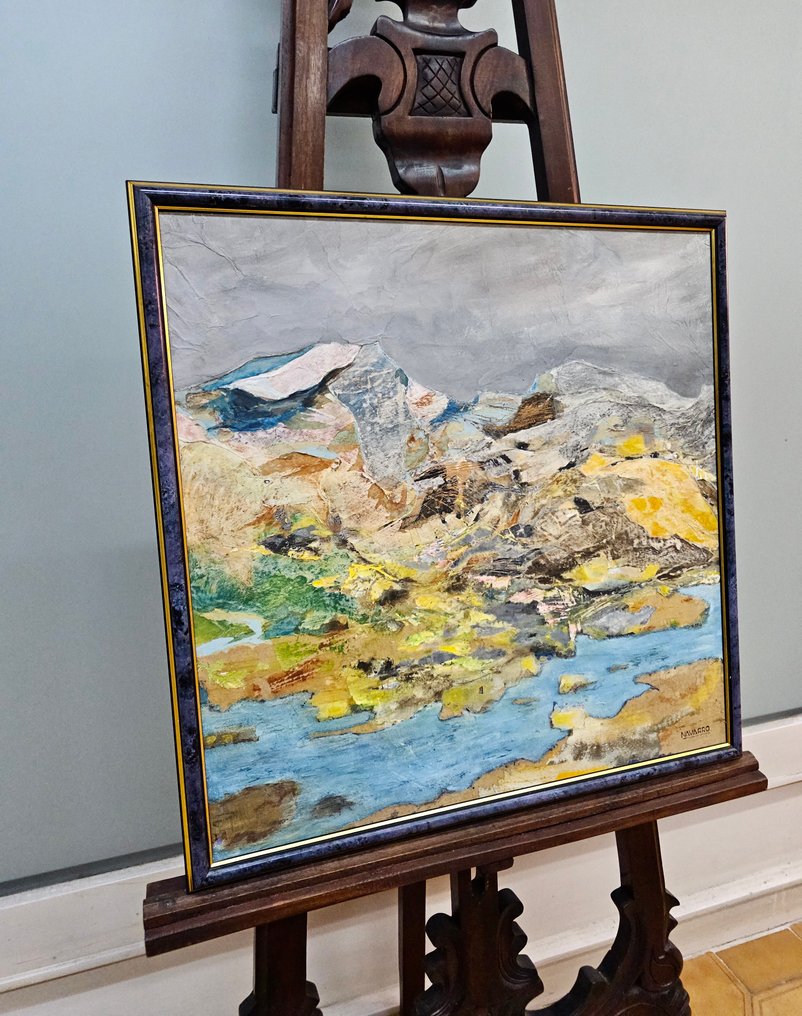
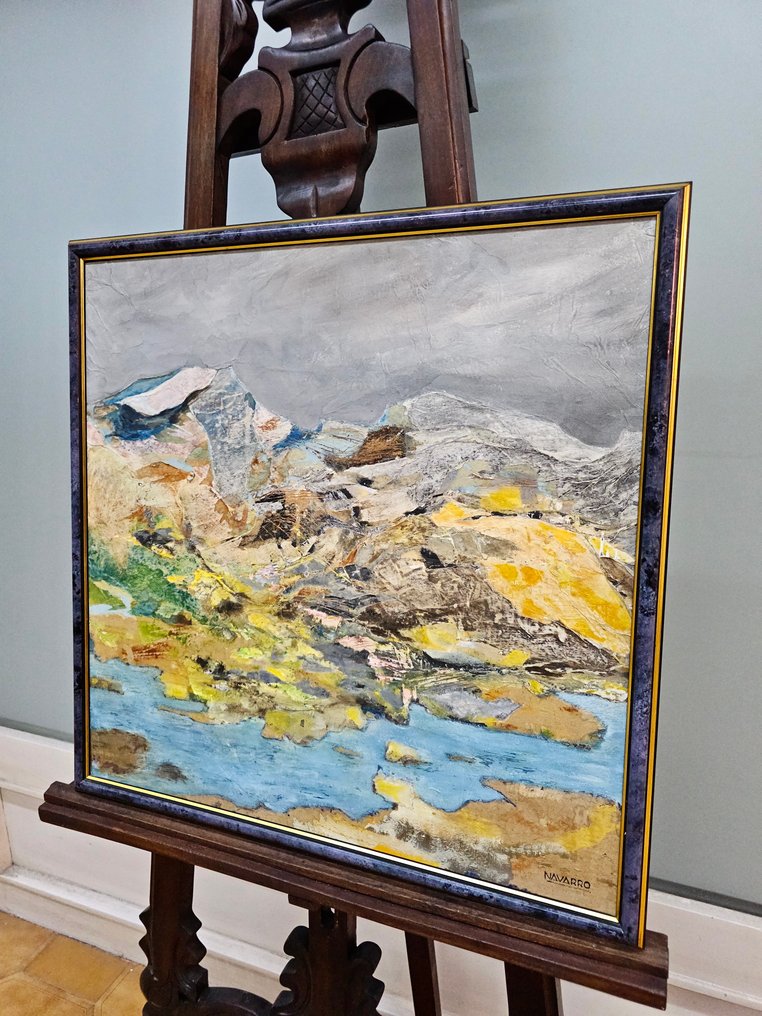
Material landscape, an oil painting from the 19th century in Spain, depicting a landscape, attributed to Juan Navarro (1939) and sold with a frame.
AI-assisted summary
Description from the seller
Material Landscape (September 1997)
Style: lyrical abstraction · conceptual landscape
Pictorial School: Contemporary Catalan School (second half of the 20th century)
Technical sheet
Attributed to Juan NAVARRO BALDEWEG (1939)
Chronology: 1997 (dated and signed on the reverse)
Mixed technique on a rigid support
Measurements: 60 × 60 cm
Measurements with frame: 65 × 65 cm
Signature: Signed 'NAVARRO' on the front; text and signature 'Juan' on the back.
Condition: Very good
Frame: A quality frame, made of dark lacquered wood with clean lines and balanced proportions, featuring a contemporary character and perfectly integrated into the work.
2. Compositional and iconographic description
The work is articulated as a non-figurative landscape, constructed through layers of material, chromatic glazes, and graphic fragments that evoke territory, atmosphere, and depth without resorting to literal representation.
The square format reinforces the idea of an autonomous visual field, closed upon itself, where color and texture act as carriers of meaning.
The palette — earthy tones, muted greens, ochres, and grays — alludes to an essentialized nature, almost eroded by time.
The presence of graphic and collage elements introduces a reflective dimension, moving the work away from spontaneous gesture to place it within a space of pictorial thought, where the landscape becomes a metaphor for the passage of time and the transformation of perception.
3. Manuscript Text, Attribution, and Context
Transcription of the handwritten text in Catalan (reverse side)
The original spelling is respected; brackets indicate parts of doubtful or incomplete reading.
The liquid area
the diversity of colors
the spring of the landscape
before civilization
he/she transforms it / he/she destroys it
Looking is also
a way of expressing time
September 1997
Juan
This text does not act as an independent poem but as a poetic declaration of the creative process, fully coherent with the work. The language — ecological, phenomenological, and reflective — is characteristic of the Catalan artistic discourse of the 80s–90s, especially among authors linked to lyrical abstraction and conceptual landscape art.
The attribution to Juan Navarro is supported by a solid set of clues: matching signature on the obverse and reverse, precise date, autograph text in Catalan, mixed technique with a strong conceptual charge, and provenance from the contemporary Catalan circuit.
Although a closed institutional identification is not proposed, the work fully fits the profile of a Catalan artist active in the nineties, with his own training, discourse, and language, close — in sensitivity, not imitation — to environments related to Hernández Pijuan, Ràfols-Casamada, or late Catalan post-informalism.
It is an authentic, reflective, and defensible work, suitable for presentation with reasoned attribution, especially attractive to collectors interested in contemporary Catalan painting with intellectual and poetic content.
Seller's Story
At Barcelona Art Gallery, we are a large family of art collectors in Barcelona who have been acquiring all kinds of paintings for 2 centuries.
Headquartered in the Les Corts neighborhood of Barcelona.
We offer part of our private collection for auction: high period and modern paintings that we have been acquiring over time, mainly from art galleries, antique dealers, auctions, private collections and very diverse origins.
Translated by Google TranslateMaterial Landscape (September 1997)
Style: lyrical abstraction · conceptual landscape
Pictorial School: Contemporary Catalan School (second half of the 20th century)
Technical sheet
Attributed to Juan NAVARRO BALDEWEG (1939)
Chronology: 1997 (dated and signed on the reverse)
Mixed technique on a rigid support
Measurements: 60 × 60 cm
Measurements with frame: 65 × 65 cm
Signature: Signed 'NAVARRO' on the front; text and signature 'Juan' on the back.
Condition: Very good
Frame: A quality frame, made of dark lacquered wood with clean lines and balanced proportions, featuring a contemporary character and perfectly integrated into the work.
2. Compositional and iconographic description
The work is articulated as a non-figurative landscape, constructed through layers of material, chromatic glazes, and graphic fragments that evoke territory, atmosphere, and depth without resorting to literal representation.
The square format reinforces the idea of an autonomous visual field, closed upon itself, where color and texture act as carriers of meaning.
The palette — earthy tones, muted greens, ochres, and grays — alludes to an essentialized nature, almost eroded by time.
The presence of graphic and collage elements introduces a reflective dimension, moving the work away from spontaneous gesture to place it within a space of pictorial thought, where the landscape becomes a metaphor for the passage of time and the transformation of perception.
3. Manuscript Text, Attribution, and Context
Transcription of the handwritten text in Catalan (reverse side)
The original spelling is respected; brackets indicate parts of doubtful or incomplete reading.
The liquid area
the diversity of colors
the spring of the landscape
before civilization
he/she transforms it / he/she destroys it
Looking is also
a way of expressing time
September 1997
Juan
This text does not act as an independent poem but as a poetic declaration of the creative process, fully coherent with the work. The language — ecological, phenomenological, and reflective — is characteristic of the Catalan artistic discourse of the 80s–90s, especially among authors linked to lyrical abstraction and conceptual landscape art.
The attribution to Juan Navarro is supported by a solid set of clues: matching signature on the obverse and reverse, precise date, autograph text in Catalan, mixed technique with a strong conceptual charge, and provenance from the contemporary Catalan circuit.
Although a closed institutional identification is not proposed, the work fully fits the profile of a Catalan artist active in the nineties, with his own training, discourse, and language, close — in sensitivity, not imitation — to environments related to Hernández Pijuan, Ràfols-Casamada, or late Catalan post-informalism.
It is an authentic, reflective, and defensible work, suitable for presentation with reasoned attribution, especially attractive to collectors interested in contemporary Catalan painting with intellectual and poetic content.
Seller's Story
At Barcelona Art Gallery, we are a large family of art collectors in Barcelona who have been acquiring all kinds of paintings for 2 centuries.
Headquartered in the Les Corts neighborhood of Barcelona.
We offer part of our private collection for auction: high period and modern paintings that we have been acquiring over time, mainly from art galleries, antique dealers, auctions, private collections and very diverse origins.
Translated by Google TranslateDetails
Artist
Attributed to Juan Navarro (1939)
Sold with frame
Yes
Title of artwork
Material landscape
Technique
Oil painting
Signature
Not signed
Country of Origin
Spain
Condition
Good condition
Height
43 cm
Width
39 cm
Weight
2 kg
Depiction/Theme
Landscape
Style
Post-Impressionism
Period
19th century
Sold by
