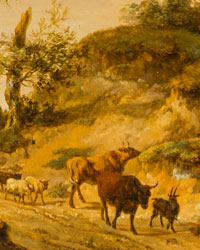
Spanish school (XX) - NO RESERVE - Popular scene


10
days
03
hours
35
minutes
44
seconds

No bids placed
Catawiki Buyer Protection
Your payment’s safe with us until you receive your object.View details
Trustpilot 4.4 | 128017 reviews
Rated Excellent on Trustpilot.
NO RESERVE - Popular scene is an oil on canvas by the Spanish school (XX), dated to 1950–1960, produced in France in Fauvism style, framed and hand-signed, with the framed dimensions 80 × 100 cm.
AI-assisted summary
Description from the seller
POPULAR SCENE – MARKET OR ROMERÍA
Oil on canvas
Spanish School, 20th century
Signature illegible
65 × 82 cm
80 × 100 cm (with frame)
1. IDENTIFICATION
1.1 Author
Signature illegible.
Basque School, 20th century.
1.2 Title
Basque Popular Scene – Market or Romería.
1.3 Chronology
20th century (probably 1940–1960).
1.4 Technique and support
Oil on canvas.
1.5 Dimensions
65 × 82 cm (work).
80 × 100 cm (with frame).
1.6 Observations
Signed composition (caligraphic study pending).
Canvas in good structural condition. Frame functional.
2. ARTISTIC DESCRIPTION
The scene depicts a group of male and female figures gathered in what appears to be a traditional market or romería. The women, dressed with light scarves and green skirts, form a central chromatic band that contrasts with the dark-toned male figures in the foreground.
The treatment is decidedly expressionist. The brushwork is broad, loose, and vibrant. The figures are not academically modeled but constructed through color masses and energetic strokes.
Deep blacks and browns dominate the frontal area, while greens, blues, and violets shape the background. The wet-looking ground suggests a rainy atmosphere or an outdoor scene after rain, a common resource in Basque painting of the 20th century to intensify reflections and drama.
The composition, closed and compact, conveys introspection and gravity, a characteristic feature of the modern Basque imagination.
3. HISTORICAL CONTEXT AND SCHOOL
Basque painting of the 20th century developed its own language based on:
- Popular and rural themes
- Compact figures with strong presence
- Moderate chromaticism with expressive accents
- Psychological charge in collective scenes
The work shows affinities with the aesthetic environment following the generation of Zuloaga and Regoyos, evolving toward social expressionism.
Although direct attribution is not asserted, the formal sensibility sits within the mid-20th century Basque school, where the human figure and popular scenes acquire almost symbolic dimension.
The signature warrants specific study for possible identification.
4. CONDITION
Good overall condition.
Painted surface stable with slight textural materiality.
No relevant structural damage evident in the provided images.
Frame in good decorative condition.
5. GUARANTEE AND TRANSPARENCY
Presented as an original 20th-century oil, Basque school, signed.
The signature is visible but not conclusively legible at this stage.
Images show the front and back, allowing basic technical analysis.
6. COLLECTING OPPORTUNITY
20th-century Basque painting maintains constant demand in national and international markets, especially mid-large format works with traditional figurative scenes.
Seller's Story
At Barcelona Art Gallery, we are a large family of art collectors in Barcelona who have been acquiring all kinds of paintings for 2 centuries.
Headquartered in the Les Corts neighborhood of Barcelona.
We offer part of our private collection for auction: high period and modern paintings that we have been acquiring over time, mainly from art galleries, antique dealers, auctions, private collections and very diverse origins.
Translated by Google TranslatePOPULAR SCENE – MARKET OR ROMERÍA
Oil on canvas
Spanish School, 20th century
Signature illegible
65 × 82 cm
80 × 100 cm (with frame)
1. IDENTIFICATION
1.1 Author
Signature illegible.
Basque School, 20th century.
1.2 Title
Basque Popular Scene – Market or Romería.
1.3 Chronology
20th century (probably 1940–1960).
1.4 Technique and support
Oil on canvas.
1.5 Dimensions
65 × 82 cm (work).
80 × 100 cm (with frame).
1.6 Observations
Signed composition (caligraphic study pending).
Canvas in good structural condition. Frame functional.
2. ARTISTIC DESCRIPTION
The scene depicts a group of male and female figures gathered in what appears to be a traditional market or romería. The women, dressed with light scarves and green skirts, form a central chromatic band that contrasts with the dark-toned male figures in the foreground.
The treatment is decidedly expressionist. The brushwork is broad, loose, and vibrant. The figures are not academically modeled but constructed through color masses and energetic strokes.
Deep blacks and browns dominate the frontal area, while greens, blues, and violets shape the background. The wet-looking ground suggests a rainy atmosphere or an outdoor scene after rain, a common resource in Basque painting of the 20th century to intensify reflections and drama.
The composition, closed and compact, conveys introspection and gravity, a characteristic feature of the modern Basque imagination.
3. HISTORICAL CONTEXT AND SCHOOL
Basque painting of the 20th century developed its own language based on:
- Popular and rural themes
- Compact figures with strong presence
- Moderate chromaticism with expressive accents
- Psychological charge in collective scenes
The work shows affinities with the aesthetic environment following the generation of Zuloaga and Regoyos, evolving toward social expressionism.
Although direct attribution is not asserted, the formal sensibility sits within the mid-20th century Basque school, where the human figure and popular scenes acquire almost symbolic dimension.
The signature warrants specific study for possible identification.
4. CONDITION
Good overall condition.
Painted surface stable with slight textural materiality.
No relevant structural damage evident in the provided images.
Frame in good decorative condition.
5. GUARANTEE AND TRANSPARENCY
Presented as an original 20th-century oil, Basque school, signed.
The signature is visible but not conclusively legible at this stage.
Images show the front and back, allowing basic technical analysis.
6. COLLECTING OPPORTUNITY
20th-century Basque painting maintains constant demand in national and international markets, especially mid-large format works with traditional figurative scenes.
Seller's Story
At Barcelona Art Gallery, we are a large family of art collectors in Barcelona who have been acquiring all kinds of paintings for 2 centuries.
Headquartered in the Les Corts neighborhood of Barcelona.
We offer part of our private collection for auction: high period and modern paintings that we have been acquiring over time, mainly from art galleries, antique dealers, auctions, private collections and very diverse origins.
Translated by Google TranslateDetails
Artist
Spanish school (XX)
Sold with frame
Yes
Sold by
Gallery
Edition
Original
Title of artwork
NO RESERVE - Popular scene
Technique
Oil painting
Signature
Hand signed
Country of origin
France
Condition
Excellent condition
Height
80 cm
Width
100 cm
Weight
4 kg
Depiction/theme
Landscape
Style
Fauvism
Period
1950-1960
Sold by