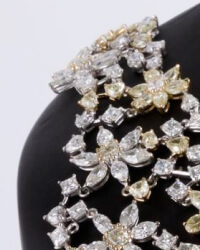
Ring - 18 kt. Yellow gold - 0.47ct. tw.


03
days
04
hours
12
minutes
52
seconds
Starting bid
€ 1
Reserve price not met

Expert
Selected by Laura Trevino
She has 15 years' auction experience, specialising in vintage jewellery from 1920 to 2000.
Estimate € 600 - € 700
No bids placed
Catawiki Buyer Protection
Your payment’s safe with us until you receive your object.View details
Trustpilot 4.4 | 131192 reviews
Rated Excellent on Trustpilot.
An 18 carat yellow gold vintage Art Nouveau cocktail ring dating from 1850–1900, EU size 59, with a rose-cut main pink sapphire of 0.15 ct and 16 surrounding rose-cut white sapphires of 0.02 ct each (total 0.47 ct), no laboratory report, unbranded, with signs of wear.
AI-assisted summary
Description from the seller
This refined yellow-gold cocktail ring, from the Art Nouveau period, captivates with its delicacy and its design evoking natural forms.
It features 16 white rose-cut sapphires of 0.02 ct each, accompanied by a main stone of 0.15 ct, also rose-cut, which contribute a soft, romantic shine characteristic of this cut.
Its elongated oval head, so fashionable in cocktail rings of the era, stylizes the piece and enhances its elegance, while the pierced, intricate, and organic details evoke swirls and motifs inspired by nature.
The ring’s shoulders and part of the band are also adorned with white sapphires, creating exquisite visual harmony.
The craftsmanship is fine, with detailed filigree work that demonstrates great skill in piercing. The Art Nouveau movement aimed to break with traditional styles, drawing inspiration from the flowing forms of nature, which makes this jewelry piece a true work of art full of sensitivity and distinction.
A unique piece that enchants with its history, design, and undeniable elegance.
The gemstones are commonly treated to enhance color or clarity. This has not been investigated for this specific item.
The piece does not show a distinctive hallmark; the gold has been previously examined by a professional.
It is shipped perfectly packed, by registered mail and insured.
The piece ships with standard packaging.
It can be collected in Madrid or Barcelona, by prior notice.
Seller's Story
KILATES IS THE TRADE BRAND OF THE LEADING COMPANY IN THE SALE OF SECOND-HAND JEWELRY PRODUCTS, WHICH TRIES TO BRING UNIQUE PIECES TO CUSTOMERS WHO APPRECIATE THE WORK OF GOOD JEWELRY OF NOW OR OF YES.
Translated by Google TranslateThis refined yellow-gold cocktail ring, from the Art Nouveau period, captivates with its delicacy and its design evoking natural forms.
It features 16 white rose-cut sapphires of 0.02 ct each, accompanied by a main stone of 0.15 ct, also rose-cut, which contribute a soft, romantic shine characteristic of this cut.
Its elongated oval head, so fashionable in cocktail rings of the era, stylizes the piece and enhances its elegance, while the pierced, intricate, and organic details evoke swirls and motifs inspired by nature.
The ring’s shoulders and part of the band are also adorned with white sapphires, creating exquisite visual harmony.
The craftsmanship is fine, with detailed filigree work that demonstrates great skill in piercing. The Art Nouveau movement aimed to break with traditional styles, drawing inspiration from the flowing forms of nature, which makes this jewelry piece a true work of art full of sensitivity and distinction.
A unique piece that enchants with its history, design, and undeniable elegance.
The gemstones are commonly treated to enhance color or clarity. This has not been investigated for this specific item.
The piece does not show a distinctive hallmark; the gold has been previously examined by a professional.
It is shipped perfectly packed, by registered mail and insured.
The piece ships with standard packaging.
It can be collected in Madrid or Barcelona, by prior notice.
Seller's Story
KILATES IS THE TRADE BRAND OF THE LEADING COMPANY IN THE SALE OF SECOND-HAND JEWELRY PRODUCTS, WHICH TRIES TO BRING UNIQUE PIECES TO CUSTOMERS WHO APPRECIATE THE WORK OF GOOD JEWELRY OF NOW OR OF YES.
Translated by Google TranslateDetails
Era
1400-1900
Laboratory report
No laboratory report
Total carat weight of all stones
0.47
Estimated period
1850-1900
Metal
Yellow gold
Brand jewellery
No
Fineness
18 kt.
Total weight
1.7 g
Condition
Vintage - used with visible signs of wear
Gender
Women
Ring size
59 (EU) / 19 (IT) / 8 ¾ (US)
Disclaimer
Catawiki always aims to offer you the best possible buying experience. Our experts virtually review and select every object in line with our submission guidelines. While we strive to provide a detailed description and photographs of each jewellery object, discrepancies or inaccuracies may occur. It is your responsibility to review all of the information provided about an object, including the condition and description, before placing an order. Sellers are responsible for the information, pictures and description provided, including the quality, quantity and nature of the jewelry supplied. A small imperfection that cannot be seen in the photo but is included in the description is not a non-conformity. A Lab Report is not a guarantee, valuation or appraisal regarding the articles described therein. A Lab Report contains only the characteristics of an article described after it has been graded, tested, examined, and analyzed using the techniques and equipment used at the time of the examination from that specific Lab. The results of any other examination performed on the article may differ depending when, how, by whom and with which grading standard the article is examined. In addition, any changes and improvements in techniques and equipment that may have occurred which may enable the examiner to detect, among other things, the use of processes for altering the characteristics of an article which use was previously undetectable, does not automatically mean the object does not conform to its description.
Catawiki always aims to offer you the best possible buying experience. Our experts virtually review and select every object in line with our submission guidelines. While we strive to provide a detailed description and photographs of each jewellery object, discrepancies or inaccuracies may occur. It is your responsibility to review all of the information provided about an object, including the condition and description, before placing an order. Sellers are responsible for the information, pictures and description provided, including the quality, quantity and nature of the jewelry supplied. A small imperfection that cannot be seen in the photo but is included in the description is not a non-conformity. A Lab Report is not a guarantee, valuation or appraisal regarding the articles described therein. A Lab Report contains only the characteristics of an article described after it has been graded, tested, examined, and analyzed using the techniques and equipment used at the time of the examination from that specific Lab. The results of any other examination performed on the article may differ depending when, how, by whom and with which grading standard the article is examined. In addition, any changes and improvements in techniques and equipment that may have occurred which may enable the examiner to detect, among other things, the use of processes for altering the characteristics of an article which use was previously undetectable, does not automatically mean the object does not conform to its description.