Engagement ring - 18 kt. Yellow gold


€2 | ||
|---|---|---|
€1 |
Catawiki Buyer Protection
Your payment’s safe with us until you receive your object.View details
Trustpilot 4.4 | 133960 reviews
Rated Excellent on Trustpilot.
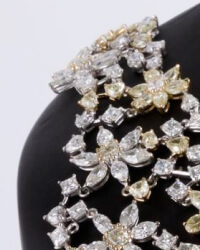
French vintage ring in 18 carat yellow and white gold (750/1000) weighing 5.17 g, set with old diamonds including a larger central stone and several smaller diamonds in a chain-inspired design, hallmarks 117 and owl, dating to c. 1920–1930 with Art Deco style and signs of wear.
Description from the seller
French antique ring in 18K yellow and white gold – diamonds – interlaced chain motif – maker's mark 117 & owl – circa 1920–1930
Magnificent French vintage ring from the 1910s–1930s (fin de Belle Époque / early Art Deco).
Metals: 18 carat gold (750/1000) yellow and white gold (or platinum for the light parts). Total weight: 5.17 g.
Stones: Several antique diamonds (rose cut or old mine cut) – a larger central diamond plus several small stones on the scrolls and side motifs. The diamonds are vintage and natural (untreated, typical of the period).
Design: Very decorative central motif of interlaced chains (large yellow-gold links forming a stylized “C” or clasp), surrounded by scrolls and leaves in white metal. An elegant and sculptural style highly representative of Parisian jewelry of the Jazz Age.
Hallmarks:
- Master mark 117 (Parisian jeweler at 117 Boulevard Richard-Lenoir, workshop active from 1919 – likely Germain or French Parisian).
- Owl hallmark (French guarantee for 18K gold on pieces that are tested or imported secondhand).
Condition: Good overall for a century-old piece, with a beautiful patina of the era. Minor wear on the prongs and the inside of the band (visible in photos).
This ring is a beautiful collector’s piece, worn as a cocktail ring or elegant jewelry. It perfectly blends the organic charm of the Belle Époque with the early geometric motifs of Art Deco.
French antique ring in 18K yellow and white gold – diamonds – interlaced chain motif – maker's mark 117 & owl – circa 1920–1930
Magnificent French vintage ring from the 1910s–1930s (fin de Belle Époque / early Art Deco).
Metals: 18 carat gold (750/1000) yellow and white gold (or platinum for the light parts). Total weight: 5.17 g.
Stones: Several antique diamonds (rose cut or old mine cut) – a larger central diamond plus several small stones on the scrolls and side motifs. The diamonds are vintage and natural (untreated, typical of the period).
Design: Very decorative central motif of interlaced chains (large yellow-gold links forming a stylized “C” or clasp), surrounded by scrolls and leaves in white metal. An elegant and sculptural style highly representative of Parisian jewelry of the Jazz Age.
Hallmarks:
- Master mark 117 (Parisian jeweler at 117 Boulevard Richard-Lenoir, workshop active from 1919 – likely Germain or French Parisian).
- Owl hallmark (French guarantee for 18K gold on pieces that are tested or imported secondhand).
Condition: Good overall for a century-old piece, with a beautiful patina of the era. Minor wear on the prongs and the inside of the band (visible in photos).
This ring is a beautiful collector’s piece, worn as a cocktail ring or elegant jewelry. It perfectly blends the organic charm of the Belle Époque with the early geometric motifs of Art Deco.
Details
Disclaimer
Catawiki always aims to offer you the best possible buying experience. Our experts virtually review and select every object in line with our submission guidelines. While we strive to provide a detailed description and photographs of each jewellery object, discrepancies or inaccuracies may occur. It is your responsibility to review all of the information provided about an object, including the condition and description, before placing an order. Sellers are responsible for the information, pictures and description provided, including the quality, quantity and nature of the jewelry supplied. A small imperfection that cannot be seen in the photo but is included in the description is not a non-conformity. A Lab Report is not a guarantee, valuation or appraisal regarding the articles described therein. A Lab Report contains only the characteristics of an article described after it has been graded, tested, examined, and analyzed using the techniques and equipment used at the time of the examination from that specific Lab. The results of any other examination performed on the article may differ depending when, how, by whom and with which grading standard the article is examined. In addition, any changes and improvements in techniques and equipment that may have occurred which may enable the examiner to detect, among other things, the use of processes for altering the characteristics of an article which use was previously undetectable, does not automatically mean the object does not conform to its description.