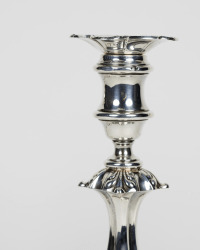
Teapot - .925 silver


07
days
11
hours
17
minutes
26
seconds
Starting bid
€ 1
Reserve price not met

Expert
Selected by Chiara Scotto Pasanisi dei Foscarini
Holds master’s in art business and decorative arts; exhibited at TEFAF Maastricht.
Estimate € 1,800 - € 2,200
No bids placed
Catawiki Buyer Protection
Your payment’s safe with us until you receive your object.View details
Trustpilot 4.4 | 132661 reviews
Rated Excellent on Trustpilot.
Antique 925 sterling silver teapot from the George III period in London, England, dating to 1750–1800, weighing 374 g, with a perforated tea strainer inside and a 24k gold-plated interior; measures 14.8 cm high, 25 cm wide, and 8.3 cm in diameter, made by H C, in excellent condition.
AI-assisted summary
Description from the seller
An antique 925 sterling silver teapot from the reign of King George III, London, England. Beautiful from every angle, featuring intricate relief carvings. The interior has a perforated filter that functions as a tea strainer. The inner wall is 24k gold-plated, giving it a luxurious and opulent appearance.
The letter "u" represents the year: 1795. Portrait of King George III paying his taxes.
Manufacturer: H C.
Spout to handle distance: 27.3 cm.
Top height: 14.8 cm.
Spout height: 10 cm.
Handle height: 15.2 cm.
Spout to handle distance: 25 cm.
Base dimensions: 12.5 x 8.3 cm.
Weight: 374 grams.
I don't know which noble family it belongs to. Below it is "ALTA PETO," which is Latin and means "I pursue the sublime" or "I seek the highest goal."
This is a rare masterpiece of Georgian-era British silverware, combining exquisite craftsmanship, historical significance, and artistic value, making it extremely valuable to collectors.
It is a prime example of 18th-century British silversmithing. This teapot, themed around rural forests and animals, evokes a sense of time travel, transporting one back over 200 years to the tranquil and peaceful English countryside. The animals and natural scenery blend seamlessly, creating a powerfully artistic image. The narrative is strong, with a well-balanced and visually appealing composition. The sides feature coats of arms of European royalty, representing the highest quality silverware.
This teapot, crafted during the golden age of British silversmithing, is made of high-quality materials, boasts exquisite craftsmanship, and features a rare theme. Having been remarkably well-preserved for over two centuries, it embodies the social culture and craftsmanship of 18th-century England and possesses unique commemorative value. It is a rare and exquisite piece of 18th-century British antique silverware, highly valuable for private collections, museum displays, and investment.
Seller's Story
I am a middle-aged man living in Italy, born in the 1970s. I love life, sports, collecting, and visiting European antique fairs and shops. I collect old and medieval objects from the East and Europe, including porcelain, silverware, bronzeware, banknotes, and stamps. This is my life.
Translated by Google TranslateAn antique 925 sterling silver teapot from the reign of King George III, London, England. Beautiful from every angle, featuring intricate relief carvings. The interior has a perforated filter that functions as a tea strainer. The inner wall is 24k gold-plated, giving it a luxurious and opulent appearance.
The letter "u" represents the year: 1795. Portrait of King George III paying his taxes.
Manufacturer: H C.
Spout to handle distance: 27.3 cm.
Top height: 14.8 cm.
Spout height: 10 cm.
Handle height: 15.2 cm.
Spout to handle distance: 25 cm.
Base dimensions: 12.5 x 8.3 cm.
Weight: 374 grams.
I don't know which noble family it belongs to. Below it is "ALTA PETO," which is Latin and means "I pursue the sublime" or "I seek the highest goal."
This is a rare masterpiece of Georgian-era British silverware, combining exquisite craftsmanship, historical significance, and artistic value, making it extremely valuable to collectors.
It is a prime example of 18th-century British silversmithing. This teapot, themed around rural forests and animals, evokes a sense of time travel, transporting one back over 200 years to the tranquil and peaceful English countryside. The animals and natural scenery blend seamlessly, creating a powerfully artistic image. The narrative is strong, with a well-balanced and visually appealing composition. The sides feature coats of arms of European royalty, representing the highest quality silverware.
This teapot, crafted during the golden age of British silversmithing, is made of high-quality materials, boasts exquisite craftsmanship, and features a rare theme. Having been remarkably well-preserved for over two centuries, it embodies the social culture and craftsmanship of 18th-century England and possesses unique commemorative value. It is a rare and exquisite piece of 18th-century British antique silverware, highly valuable for private collections, museum displays, and investment.
Seller's Story
I am a middle-aged man living in Italy, born in the 1970s. I love life, sports, collecting, and visiting European antique fairs and shops. I collect old and medieval objects from the East and Europe, including porcelain, silverware, bronzeware, banknotes, and stamps. This is my life.
Translated by Google TranslateDetails
Era
1400-1900
Silver type
.925 silver
Number of objects
1
Material
Silver
Country of origin
United Kingdom
Condition
Excellent condition: barely used with minimal signs of wear
Height
14.8 cm
Width
25 cm
Diameter
8.3 cm
Estimated period
1750-1800
Sold by