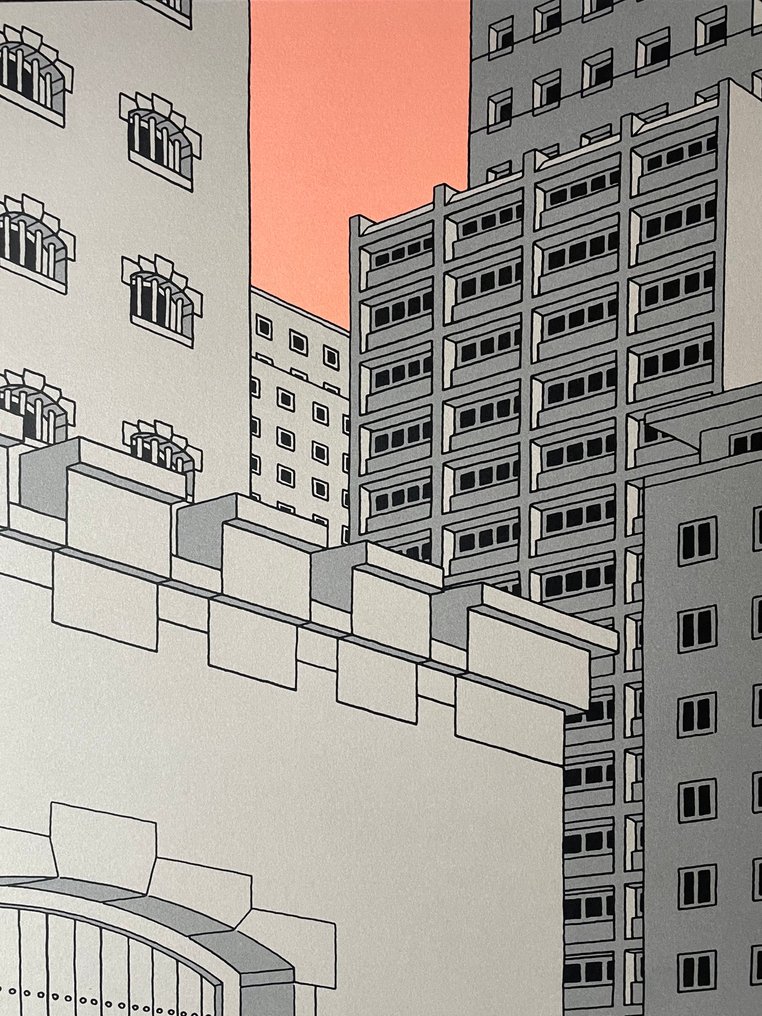
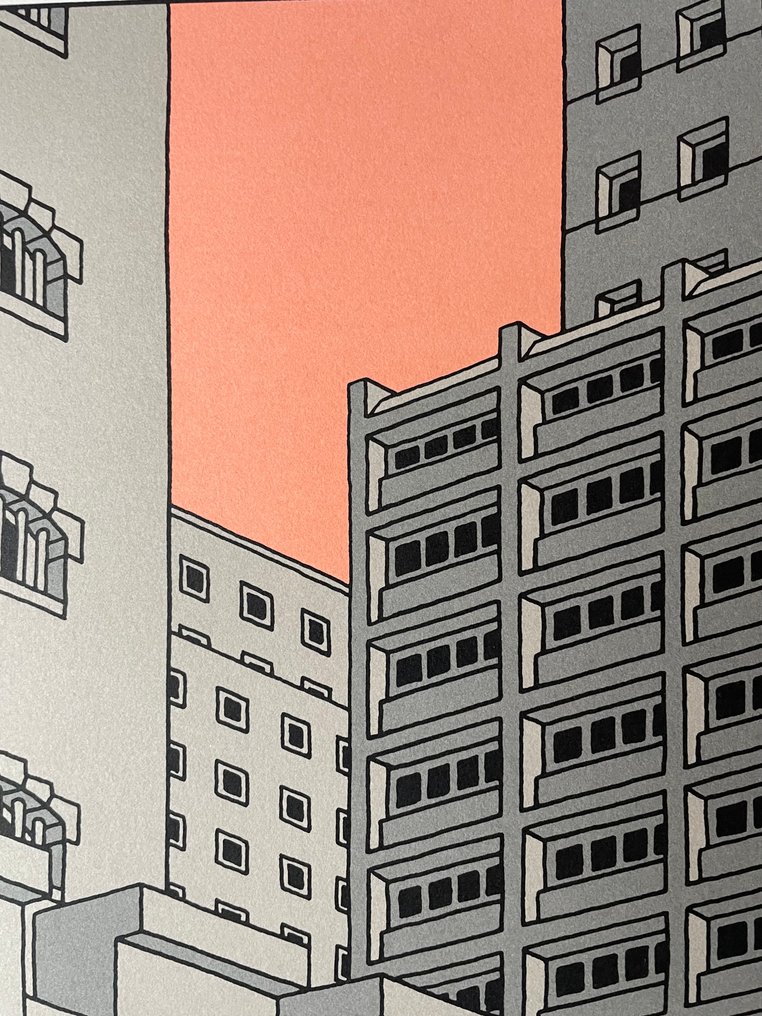
Joost Swarte - Eindelijk vrijheid - Silkscreen ** HANDSIGNED+COA **



Opens 23 May
Starting bid
€ 1
Add to your favourites to get an alert when the auction starts.

Expert
Selected by Juan Antonio Rodríguez
Eight years experience valuing posters, previously valuer at Balclis, Barcelona.
Estimate € 150 - € 200
Catawiki Buyer Protection
Your payment’s safe with us until you receive your object.View details
Trustpilot 4.4 | 133362 reviews
Rated Excellent on Trustpilot.
Description from the seller
Joost Swarte silkscreen (*)
Titled “Eindelijk vrijheid”.
Luxurious edition on heavyweight cotton vellum paper (300 g/m2).
Hand-signed by the artist.
Includes Certificate of Authenticity (COA).
Specifications:
Dimensions: 70 x 50 cm
Year: 1988
Publisher: Atelier Swarte, Haarlem.
Condition: Excellent (this work has never been framed or exhibited, and has always been kept in a professional art portfolio, therefore offered in perfect condition).
Provenance: Private Collection.
The work will be carefully handled and packaged in reinforced cardboard. The shipment will be sent with tracking (UPS / DPD / DHL / FedEx).
The shipment will also include transport insurance for the final value of the artwork with full reimbursement in case of loss or damage, at no cost to the buyer.
(*) Joost Swarte, born December 24, 1947, in Heemstede, is one of the most famous Dutch comic artists. He studied at the Design Academy Eindhoven and began publishing in his own magazine Modern Papier. He has not limited himself to comics, having proven himself as a successful designer, architect, and stained-glass artist, always recognizable by his clear line. As co-owner of the Oog & Blik publishing company, he is responsible for the design of many Dutch award-winning books. He was one of the founders of the Haarlem International Comics Day, and has established himself as an advocate for comics in the art world.
Undoubtedly, Joost Swarte is one of those emblematic modern comic artists; his style, at first glance, bears similarities to Hergé and his creations, and it makes sense because nothing better to guarantee the success of characters and stories than making them appealing with preexisting models. In this sense, Swarte, who still lives today, was born in 1947, is not a contemporary of Hergé, and his creations emerged with a delay of a couple of decades, with Tintin already a fully established product.
Swarte creates some of his characters with certain aesthetic similarities to Hergé's offerings, and he also endows some of them with adventure backstories, perhaps less sophisticated than Tintin, but which allowed, as a veiled objective of many 20th-century cartoonists, to transport children, even if only in imagination, to places they would hardly visit in reality.
The distinctive value of this brilliant Dutch draughtsman, which his drawings particularly reflect, is that his academic background is industrial design, and that makes the characters in his panels stand out more against the background, furniture, and landscapes that surround them. He does not draw to build a story; his drawings are the story itself, his characters are more credible, fictionally speaking, because his panels have great expressive richness.
That academic training is an investment with which Swarte gifts us with a feast for the eyes; it’s as if he occasionally returns to being a designer, because when he has to draw a machine, it is not a simple object—quite the opposite, he tries to sophisticated it, it’s a colorfully drawn catalog of products—furniture stores, tools, machines, cars, buildings, and even fashion.
When given the chance to draw them, his mechanisms come to life, as if he were sketching or prototyping something that could become real, something that, following his instructions, could be set in motion. I don’t know what knowledge about mechanics Swarte might have, but surely his designs wouldn’t stay mere fantasies.
And then there are his characters; to begin with, reading his comics is somewhat erratic, surreal, perhaps eccentric, but certain characters are as surreal as they are humanoid animals, two-legged dogs dressed as humans, or animals that speak and reason perfectly like you and me.
It’s no surprise that some of his most famous characters are hard to define; take Jopo de Pojo, a mischievous young fellow with no malice who gets into trouble without really wanting to, all the result of puns, misunderstandings, and coincidences… For the iconic Jopo de Pojo is a boy who could be Black, could be a monkey, and has a crest that’s hard to fit into an animal figure.
Another character, entirely human, is Anton Makassar, a kind of mad researcher (designer) who, in a way, evokes Professor Bacterio (Mortadelo y Filemón) from our renowned and under-recognized Ibáñez (he deserves an important lifetime award, and he hasn’t received it).
There is also an interesting transgressive element in Swarte, given his broad body of work and maturity in the 70s and 80s; he conveys a Central European culture where there were no reticences about sex and pornography; in this sense, his characters have no modesty or issue appearing nude (fully naked) and with bedroom scenes, without being interpreted as an encouragement to promiscuity toward the youth. And it’s true, because nothing is worse for sexual perversions than wanting to see something pernicious in something as natural as the human body; those repressions have created many sexual predators throughout recent history.
One aspect that stands out in any biography you see of Joost Swarte is a dimension that goes beyond the cartoonist and that I mentioned at the start; he had the opportunity to truly design and execute, as he designed the Toneelschuur Theatre in Haarlem. Haarlem, Netherlands, is one of those cities—don’t ask me why; personal reasons that I would like to visit someday, and I fear I won’t reach. His design is, at the very least, curious, and I perceive it as a continuation of his comics. He has also designed apartment buildings.
Swarte is more, much more than a comics author; his designs span a bit of everything—stained glass, murals, posters and placards (which today are genuine collector’s items), playing cards, rugs, wrap paper… Without a doubt a necessary illustrator to conceive the evolution of contemporary comics.
Seller's Story
EsKobARTE carefully selects artworks and posters from recognized and emerging artists worldwide to offer them here at affordable prices.*** AUTHENTIC WORKS *** We only sell genuine artworks and posters, as well as officially authorized prints.*** WE ARE PROFESSIONALS *** You can bid on your items with complete confidence. Over 1,000 positive reviews from our clients attest to our experience and professionalism on Catawiki.*** PROTECTED, CERTIFIED, AND INSURED SHIPPING *** All our items are carefully packaged in eco-friendly cardboard packaging. We work with the best shipping companies (UPS-DPD-DHL-FEDEX) to ensure the best service and tracking. Additionally, our shipments include insurance against damage or loss at no cost to the buyer.*** IF YOU PURCHASE MORE THAN ONE ITEM, WE COMBINE SHIPPING *** Even if they come from different auctions, you'll only have to pay the shipping cost for a single item.*** ANY QUESTIONS? CONTACT US *** You can use the chat to talk to us; we will be happy to assist you as soon as possible.*** THANK YOU AND GOOD LUCK WITH YOUR BIDS! ***
Translated by Google TranslateJoost Swarte silkscreen (*)
Titled “Eindelijk vrijheid”.
Luxurious edition on heavyweight cotton vellum paper (300 g/m2).
Hand-signed by the artist.
Includes Certificate of Authenticity (COA).
Specifications:
Dimensions: 70 x 50 cm
Year: 1988
Publisher: Atelier Swarte, Haarlem.
Condition: Excellent (this work has never been framed or exhibited, and has always been kept in a professional art portfolio, therefore offered in perfect condition).
Provenance: Private Collection.
The work will be carefully handled and packaged in reinforced cardboard. The shipment will be sent with tracking (UPS / DPD / DHL / FedEx).
The shipment will also include transport insurance for the final value of the artwork with full reimbursement in case of loss or damage, at no cost to the buyer.
(*) Joost Swarte, born December 24, 1947, in Heemstede, is one of the most famous Dutch comic artists. He studied at the Design Academy Eindhoven and began publishing in his own magazine Modern Papier. He has not limited himself to comics, having proven himself as a successful designer, architect, and stained-glass artist, always recognizable by his clear line. As co-owner of the Oog & Blik publishing company, he is responsible for the design of many Dutch award-winning books. He was one of the founders of the Haarlem International Comics Day, and has established himself as an advocate for comics in the art world.
Undoubtedly, Joost Swarte is one of those emblematic modern comic artists; his style, at first glance, bears similarities to Hergé and his creations, and it makes sense because nothing better to guarantee the success of characters and stories than making them appealing with preexisting models. In this sense, Swarte, who still lives today, was born in 1947, is not a contemporary of Hergé, and his creations emerged with a delay of a couple of decades, with Tintin already a fully established product.
Swarte creates some of his characters with certain aesthetic similarities to Hergé's offerings, and he also endows some of them with adventure backstories, perhaps less sophisticated than Tintin, but which allowed, as a veiled objective of many 20th-century cartoonists, to transport children, even if only in imagination, to places they would hardly visit in reality.
The distinctive value of this brilliant Dutch draughtsman, which his drawings particularly reflect, is that his academic background is industrial design, and that makes the characters in his panels stand out more against the background, furniture, and landscapes that surround them. He does not draw to build a story; his drawings are the story itself, his characters are more credible, fictionally speaking, because his panels have great expressive richness.
That academic training is an investment with which Swarte gifts us with a feast for the eyes; it’s as if he occasionally returns to being a designer, because when he has to draw a machine, it is not a simple object—quite the opposite, he tries to sophisticated it, it’s a colorfully drawn catalog of products—furniture stores, tools, machines, cars, buildings, and even fashion.
When given the chance to draw them, his mechanisms come to life, as if he were sketching or prototyping something that could become real, something that, following his instructions, could be set in motion. I don’t know what knowledge about mechanics Swarte might have, but surely his designs wouldn’t stay mere fantasies.
And then there are his characters; to begin with, reading his comics is somewhat erratic, surreal, perhaps eccentric, but certain characters are as surreal as they are humanoid animals, two-legged dogs dressed as humans, or animals that speak and reason perfectly like you and me.
It’s no surprise that some of his most famous characters are hard to define; take Jopo de Pojo, a mischievous young fellow with no malice who gets into trouble without really wanting to, all the result of puns, misunderstandings, and coincidences… For the iconic Jopo de Pojo is a boy who could be Black, could be a monkey, and has a crest that’s hard to fit into an animal figure.
Another character, entirely human, is Anton Makassar, a kind of mad researcher (designer) who, in a way, evokes Professor Bacterio (Mortadelo y Filemón) from our renowned and under-recognized Ibáñez (he deserves an important lifetime award, and he hasn’t received it).
There is also an interesting transgressive element in Swarte, given his broad body of work and maturity in the 70s and 80s; he conveys a Central European culture where there were no reticences about sex and pornography; in this sense, his characters have no modesty or issue appearing nude (fully naked) and with bedroom scenes, without being interpreted as an encouragement to promiscuity toward the youth. And it’s true, because nothing is worse for sexual perversions than wanting to see something pernicious in something as natural as the human body; those repressions have created many sexual predators throughout recent history.
One aspect that stands out in any biography you see of Joost Swarte is a dimension that goes beyond the cartoonist and that I mentioned at the start; he had the opportunity to truly design and execute, as he designed the Toneelschuur Theatre in Haarlem. Haarlem, Netherlands, is one of those cities—don’t ask me why; personal reasons that I would like to visit someday, and I fear I won’t reach. His design is, at the very least, curious, and I perceive it as a continuation of his comics. He has also designed apartment buildings.
Swarte is more, much more than a comics author; his designs span a bit of everything—stained glass, murals, posters and placards (which today are genuine collector’s items), playing cards, rugs, wrap paper… Without a doubt a necessary illustrator to conceive the evolution of contemporary comics.
Seller's Story
EsKobARTE carefully selects artworks and posters from recognized and emerging artists worldwide to offer them here at affordable prices.*** AUTHENTIC WORKS *** We only sell genuine artworks and posters, as well as officially authorized prints.*** WE ARE PROFESSIONALS *** You can bid on your items with complete confidence. Over 1,000 positive reviews from our clients attest to our experience and professionalism on Catawiki.*** PROTECTED, CERTIFIED, AND INSURED SHIPPING *** All our items are carefully packaged in eco-friendly cardboard packaging. We work with the best shipping companies (UPS-DPD-DHL-FEDEX) to ensure the best service and tracking. Additionally, our shipments include insurance against damage or loss at no cost to the buyer.*** IF YOU PURCHASE MORE THAN ONE ITEM, WE COMBINE SHIPPING *** Even if they come from different auctions, you'll only have to pay the shipping cost for a single item.*** ANY QUESTIONS? CONTACT US *** You can use the chat to talk to us; we will be happy to assist you as soon as possible.*** THANK YOU AND GOOD LUCK WITH YOUR BIDS! ***
Translated by Google TranslateDetails
Era
1900-2000
Designer/artist
Joost Swarte
Poster title
Eindelijk vrijheid - Silkscreen ** HANDSIGNED+COA **
Subject
Art, Original artwork
Country of origin
Belgium
Condition
A (excellent - mint condition)
Height
70 cm
Width
50 cm