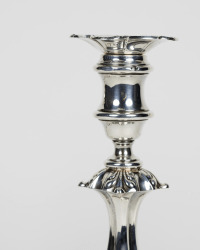
Cardeilhac - Tea service (3) - .950 silver


03
days
19
hours
00
minutes
04
seconds
Current bid
€ 1,400
Reserve price not met

Expert
Selected by Chiara Scotto Pasanisi dei Foscarini
Holds master’s in art business and decorative arts; exhibited at TEFAF Maastricht.
Estimate € 3,100 - € 3,500
13 other people are watching this object
 | €1,400 | |
|---|---|---|
| €1,000 | |
| €1 |
Catawiki Buyer Protection
Your payment’s safe with us until you receive your object.View details
Trustpilot 4.4 | 134364 reviews
Rated Excellent on Trustpilot.
A three-piece French silver service in 950/1000 argent, made in Paris and dating to 1819, comprising a milk jug, a tea pot and a creamer, each about 30 cm in its three dimensions, with a total gross weight of 925 g in excellent condition.
AI-assisted summary
Description from the seller
Master’s Service!!!
Cardeillac, Paris !!! 950 MASSIF SILVER
A service consisting of three pieces, a milk jug, a teapot, and a cream pitcher.
A service with a total weight of 920 g in French 950/1000 solid silver.
Year 1819 RARE !!!
Extremely rare pieces and complete service, extreme, extremely rare, unique and elegant.
Stamps used from August 16, 1819 to May 10, 1838 – large Guarantee mark, Paris left: female "Cérès"
Provenance from a royal family, pieces originating from the Château de Tournay in Switzerland.
This silver set is said to originate from the prestigious Château de Tournay, one of the historic noble estates overlooking the Geneva countryside near Lake Léman.
The château, whose origins likely date back to the Middle Ages and which was rebuilt in its present form around 1601, has long been associated with aristocratic families, enlightened intellectuals, and collectors of fine decorative arts. (Wikipedia)
Over the centuries, the estate belonged to several important noble Genevan and Savoyard families. Among the known proprietors were:
• The noble family of Aguières (Anières) until 1384
• The family de Genthod (1384–1536)
• Jacques de Viry, Seigneur de Tournay (1536–1546)
• Nicolas de Flert and Antoine Calvin (1546)
• Adrien de Pergrimand / Briquemanet
• The Lullin family, an important Genevan patrician lineage
• The distinguished de Brosses family, who owned the château from 1573 onward for more than two centuries (Wikipedia)
The château became especially famous in the Age of Enlightenment when François-Marie Arouet, known worldwide as Voltaire, acquired a life lease on the estate in 1758 while preparing the construction of his residence in nearby Ferney. During his stay at Tournay, Voltaire organized theatrical performances, transformed parts of the château, renovated the staircases and bridges, and entertained intellectual and aristocratic guests. (Wikipedia)
After Voltaire’s death in 1778, the estate returned to the de Brosses family according to the terms of the agreement. In the 19th century, the château passed into the hands of the Panissod family, who owned it for four generations. It was later acquired in 1915 by the renowned collector Alfred Baur, founder of the Baur Foundation in Geneva, celebrated for his refined taste and important art collections. (Wikipedia)
Given the château’s long aristocratic history and its association with cultivated families of Geneva and with Voltaire himself, objects originating from Château de Tournay carry a distinguished provenance linked to the refined lifestyle of the Enlightenment and the great Genevan estates of the 18th and 19th centuries.
Rare heraldic piece featuring a British aristocratic coat of arms, most likely of Scottish origin, dating from the 17th–18th century. The shield is supported by two wild men holding clubs — classic Scottish heraldic supporters strongly associated with noble families registered under the Lord Lyon tradition.
The composition includes:
- an impaled dynastic/marital shield,
- central chevron with mullets (stars),
- a noble coronet,
all characteristic of high-ranking British aristocratic heraldry.
The closest heraldic attribution is likely the Brodie of Brodie family of Scotland, whose arms and supporters closely match the present composition.
Given its association with the Château de Tournay and the later ownership of the estate by the renowned collector Alfred Baur, the piece was likely preserved through aristocratic collecting circles and may originally have been a diplomatic, dynastic, or noble gift.
Master’s Service!!!
Cardeillac, Paris !!! 950 MASSIF SILVER
A service consisting of three pieces, a milk jug, a teapot, and a cream pitcher.
A service with a total weight of 920 g in French 950/1000 solid silver.
Year 1819 RARE !!!
Extremely rare pieces and complete service, extreme, extremely rare, unique and elegant.
Stamps used from August 16, 1819 to May 10, 1838 – large Guarantee mark, Paris left: female "Cérès"
Provenance from a royal family, pieces originating from the Château de Tournay in Switzerland.
This silver set is said to originate from the prestigious Château de Tournay, one of the historic noble estates overlooking the Geneva countryside near Lake Léman.
The château, whose origins likely date back to the Middle Ages and which was rebuilt in its present form around 1601, has long been associated with aristocratic families, enlightened intellectuals, and collectors of fine decorative arts. (Wikipedia)
Over the centuries, the estate belonged to several important noble Genevan and Savoyard families. Among the known proprietors were:
• The noble family of Aguières (Anières) until 1384
• The family de Genthod (1384–1536)
• Jacques de Viry, Seigneur de Tournay (1536–1546)
• Nicolas de Flert and Antoine Calvin (1546)
• Adrien de Pergrimand / Briquemanet
• The Lullin family, an important Genevan patrician lineage
• The distinguished de Brosses family, who owned the château from 1573 onward for more than two centuries (Wikipedia)
The château became especially famous in the Age of Enlightenment when François-Marie Arouet, known worldwide as Voltaire, acquired a life lease on the estate in 1758 while preparing the construction of his residence in nearby Ferney. During his stay at Tournay, Voltaire organized theatrical performances, transformed parts of the château, renovated the staircases and bridges, and entertained intellectual and aristocratic guests. (Wikipedia)
After Voltaire’s death in 1778, the estate returned to the de Brosses family according to the terms of the agreement. In the 19th century, the château passed into the hands of the Panissod family, who owned it for four generations. It was later acquired in 1915 by the renowned collector Alfred Baur, founder of the Baur Foundation in Geneva, celebrated for his refined taste and important art collections. (Wikipedia)
Given the château’s long aristocratic history and its association with cultivated families of Geneva and with Voltaire himself, objects originating from Château de Tournay carry a distinguished provenance linked to the refined lifestyle of the Enlightenment and the great Genevan estates of the 18th and 19th centuries.
Rare heraldic piece featuring a British aristocratic coat of arms, most likely of Scottish origin, dating from the 17th–18th century. The shield is supported by two wild men holding clubs — classic Scottish heraldic supporters strongly associated with noble families registered under the Lord Lyon tradition.
The composition includes:
- an impaled dynastic/marital shield,
- central chevron with mullets (stars),
- a noble coronet,
all characteristic of high-ranking British aristocratic heraldry.
The closest heraldic attribution is likely the Brodie of Brodie family of Scotland, whose arms and supporters closely match the present composition.
Given its association with the Château de Tournay and the later ownership of the estate by the renowned collector Alfred Baur, the piece was likely preserved through aristocratic collecting circles and may originally have been a diplomatic, dynastic, or noble gift.
Details
Era
1400-1900
Gross weight
925 g
Silver type
.950 silver
Specific region of origin
Paris
Number of objects
3
Country of origin
France
Manufacturer/brand
Cardeilhac
Material
Silver
Style
Art Deco
Condition
As new - unused
Height
30 cm
Width
30 cm
Depth
30 cm
Estimated period
1819, 1800-1850
Sold by