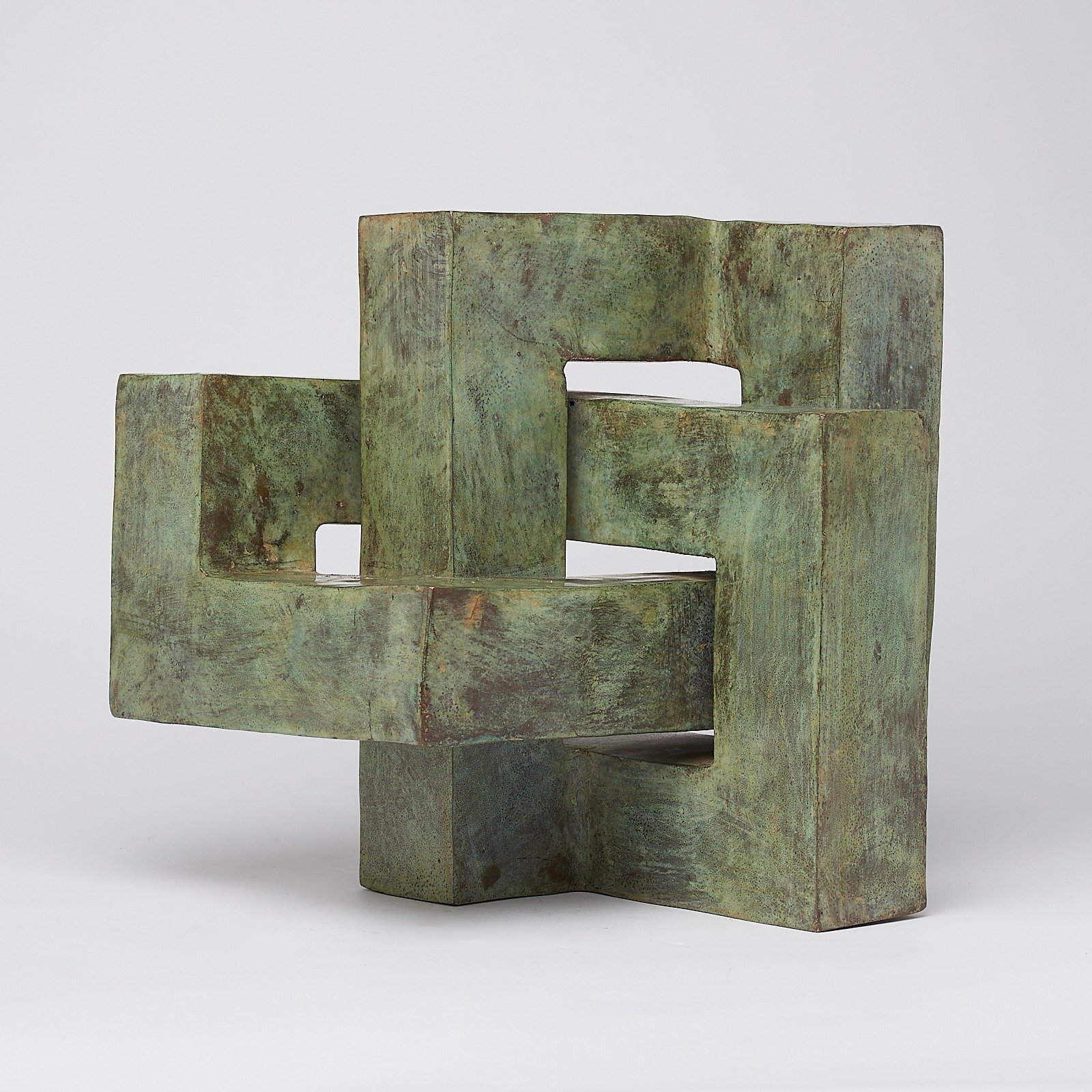
Candelabrum Spool - Ormolu - Liturgical with Chrismon


Has 20 years of experience trading curios, including 15 years with a leading French dealer.
Catawiki Buyer Protection
Your payment’s safe with us until you receive your object.View details
Trustpilot 4.4 | 133284 reviews
Rated Excellent on Trustpilot.
Description from the seller
It is a candelabrum that gathers all one might expect from a 20th-century liturgical piece: presence, symbolic weight, and metalworking that does not settle for functionality but aspires to solemnity. The body is cast in bronze with an ormolu finish, that deep, velvet gold used to give pieces an almost palatial finish, typical of late Baroque and its nineteenth-century reinterpretations.
The scroll-form — that profile that narrows and widens with architectural rhythm — gives it visual stability and a classical air, as if it were a small fragment of an altar turned into an autonomous object. In the center, the Christogram in relief stands out, sharp and well modeled, turning the candelabrum into an unmistakably sacred object. It is not a mere ornament: it is a sign of Christian identity that, in this type of piece, functioned as a spiritual seal and as an aesthetic declaration.
The gilding, worked with care, highlights the volumes and curves of the Baroque design: sinuous lines, polished surfaces, a play of light that changes with the intensity of the flame or with electric lighting. It is a piece designed to accompany ceremonies, to occupy a prominent place on an altar or in a chapel, and its workmanship reveals the hand of a workshop that knew the decorative language of the era.
Taken together, it is a candelabrum that combines devotion, craftsmanship, and historical elegance. A work that not only illuminates but conveys the continuity of an aesthetic and spiritual tradition that has survived the centuries.
Tracked shipping and careful packaging.
Seller's Story
Translated by Google TranslateIt is a candelabrum that gathers all one might expect from a 20th-century liturgical piece: presence, symbolic weight, and metalworking that does not settle for functionality but aspires to solemnity. The body is cast in bronze with an ormolu finish, that deep, velvet gold used to give pieces an almost palatial finish, typical of late Baroque and its nineteenth-century reinterpretations.
The scroll-form — that profile that narrows and widens with architectural rhythm — gives it visual stability and a classical air, as if it were a small fragment of an altar turned into an autonomous object. In the center, the Christogram in relief stands out, sharp and well modeled, turning the candelabrum into an unmistakably sacred object. It is not a mere ornament: it is a sign of Christian identity that, in this type of piece, functioned as a spiritual seal and as an aesthetic declaration.
The gilding, worked with care, highlights the volumes and curves of the Baroque design: sinuous lines, polished surfaces, a play of light that changes with the intensity of the flame or with electric lighting. It is a piece designed to accompany ceremonies, to occupy a prominent place on an altar or in a chapel, and its workmanship reveals the hand of a workshop that knew the decorative language of the era.
Taken together, it is a candelabrum that combines devotion, craftsmanship, and historical elegance. A work that not only illuminates but conveys the continuity of an aesthetic and spiritual tradition that has survived the centuries.
Tracked shipping and careful packaging.