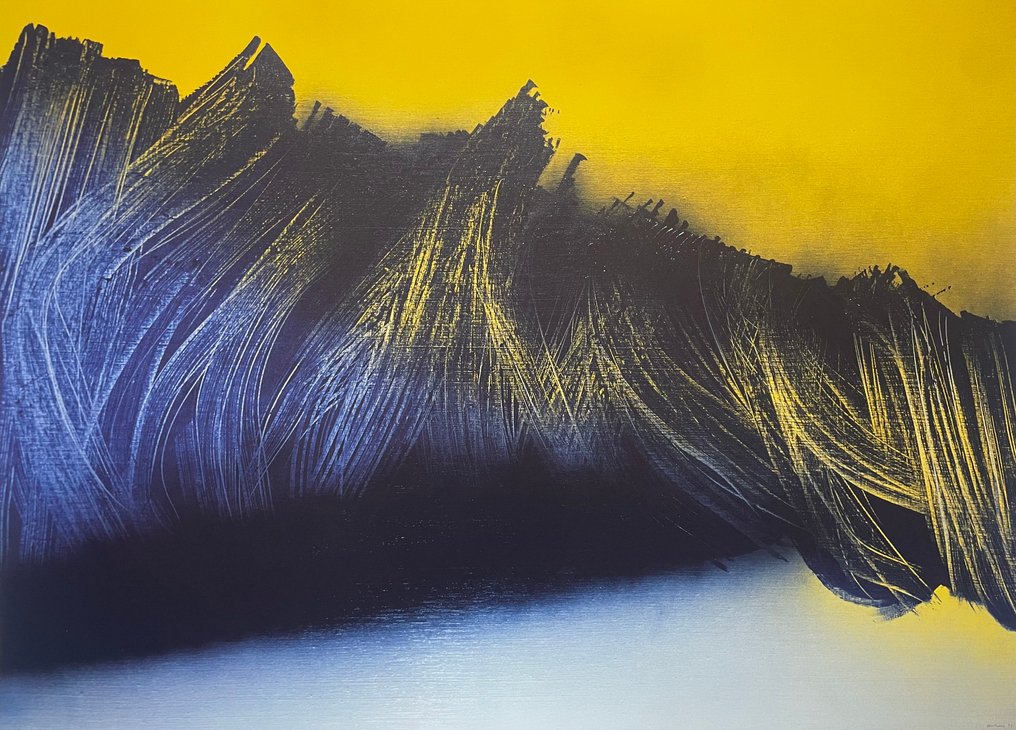
Hans Hartung - T1971-R30 - Offset lithography - Licensed print 2008 - COA



05
days
19
hours
47
minutes
17
seconds
Current bid
€ 35
Reserve price not met

Expert
Selected by Juan Antonio Rodríguez
Eight years experience valuing posters, previously valuer at Balclis, Barcelona.
Estimate € 150 - € 200
3 other people are watching this object
 | €35 | |
|---|---|---|
| €1 |
Catawiki Buyer Protection
Your payment’s safe with us until you receive your object.View details
Trustpilot 4.4 | 135391 reviews
Rated Excellent on Trustpilot.
Description from the seller
Hans Hartung Offset Lithography (*).
Reproduction of the work “T1971-R30,” made by Hartung in 1971.
Printed on high grammage Vellum paper (220g).
Edited by Arte-Paris.
Legally authorized print by the Hartung-Bergman Foundation
Signed on the plate by the artist.
Specifications:
Dimensions: 65 x 85 cm
Year: 2008
Condition: Excellent (this work has never been framed or exhibited, and has always been kept in a professional art folder, therefore offered in perfect condition).
Provenance: Private Collection.
The work will be carefully handled and packaged in reinforced cardboard. The shipment will be certified with a tracking number.
The shipment will also include transport insurance for the final value of the work with full reimbursement in case of loss or damage, at no cost to the buyer.
(*) Hans Hartung is a major German-born French painter, known for his abstract works of black calligraphic strokes on a colored background.
He was born in Leipzig into a family of physicists. His grandfather was also a self-taught painter and composer. Between 1915 and 1926 he studied classical languages at the Dresden Gymnasium and philosophy and art history at the university and at the Leipzig Academy of Fine Arts. Later he entered the Dresden Academy of Fine Arts.
During the summer of 1926 he cycled through France, Italy and Spain. In 1931 he exhibited for the first time in Dresden. In 1937, at a joint exhibition at the Jeu de Paume, Paris (France), he met the great Spanish sculptor Julio González, who would have a profound influence on him. González offered him all kinds of help and encouraged him to embark on his own artistic path.
During the pre-war period Hartung settled in Paris to avoid the Nazi regime, and he exhibited in several galleries. In 1938 he participated in an anti-Nazi exhibition at the New Burlington Gallery in London (Great Britain).
In 1939, he was imprisoned in Spain and later enlisted in the Foreign Legion in North Africa. In 1944 he was gravely injured during the Siege of Belfort and lost a leg. After the war he became French and in 1947 held an important solo exhibition in Paris.
From the beginning he stayed away from the Bauhaus movement, which he regarded as merely a passing fashion. His paintings, purely abstract, reflect his view of representing reality: free and pure expression must transcend reality. The quick brushstroke became a fundamental feature of his working method.
Speed in the creative process was, in his own words, a spiritual necessity. He received several awards, including the Guggenheim Prize in 1956 and in 1960 the Grand International Prize of the Venice Biennale.
Seller's Story
EsKobARTE carefully selects works and posters from renowned and emerging artists from around the world, to offer them here at affordable prices.
___*** AUTHENTIC WORKS *** We only sell authentic works and posters and legally authorized prints__*** WE ARE PROFESSIONALS ***__You can bid on your items with total confidence. More than 1000 positive reviews from our customers endorse our track record and professionalism on Catawiki__*** PROTECTED, CERTIFIED AND INSURED SHIPMENTS ***__All our items are carefully packed in eco-friendly cardboard packaging. We work with the best shipping companies (UPS-DPD-DHL-FEDEX) to guarantee the best service and tracking. In addition, our shipments include insurance against damage or loss, at no cost to the buyer.__*** IF YOU ACQUIRE MORE THAN ONE ITEM, WE COMBINE SHIPPING ***__Even if they come from different auctions, you will only have to pay the shipping for a single item.__*** ANY DOUBT? CONTACT US ***__You can use the chat to talk to us, we will be happy to assist you as soon as possible.__*** THANKS AND GOOD LUCK WITH YOUR BIDS! ***
Translated by Google TranslateHans Hartung Offset Lithography (*).
Reproduction of the work “T1971-R30,” made by Hartung in 1971.
Printed on high grammage Vellum paper (220g).
Edited by Arte-Paris.
Legally authorized print by the Hartung-Bergman Foundation
Signed on the plate by the artist.
Specifications:
Dimensions: 65 x 85 cm
Year: 2008
Condition: Excellent (this work has never been framed or exhibited, and has always been kept in a professional art folder, therefore offered in perfect condition).
Provenance: Private Collection.
The work will be carefully handled and packaged in reinforced cardboard. The shipment will be certified with a tracking number.
The shipment will also include transport insurance for the final value of the work with full reimbursement in case of loss or damage, at no cost to the buyer.
(*) Hans Hartung is a major German-born French painter, known for his abstract works of black calligraphic strokes on a colored background.
He was born in Leipzig into a family of physicists. His grandfather was also a self-taught painter and composer. Between 1915 and 1926 he studied classical languages at the Dresden Gymnasium and philosophy and art history at the university and at the Leipzig Academy of Fine Arts. Later he entered the Dresden Academy of Fine Arts.
During the summer of 1926 he cycled through France, Italy and Spain. In 1931 he exhibited for the first time in Dresden. In 1937, at a joint exhibition at the Jeu de Paume, Paris (France), he met the great Spanish sculptor Julio González, who would have a profound influence on him. González offered him all kinds of help and encouraged him to embark on his own artistic path.
During the pre-war period Hartung settled in Paris to avoid the Nazi regime, and he exhibited in several galleries. In 1938 he participated in an anti-Nazi exhibition at the New Burlington Gallery in London (Great Britain).
In 1939, he was imprisoned in Spain and later enlisted in the Foreign Legion in North Africa. In 1944 he was gravely injured during the Siege of Belfort and lost a leg. After the war he became French and in 1947 held an important solo exhibition in Paris.
From the beginning he stayed away from the Bauhaus movement, which he regarded as merely a passing fashion. His paintings, purely abstract, reflect his view of representing reality: free and pure expression must transcend reality. The quick brushstroke became a fundamental feature of his working method.
Speed in the creative process was, in his own words, a spiritual necessity. He received several awards, including the Guggenheim Prize in 1956 and in 1960 the Grand International Prize of the Venice Biennale.
Seller's Story
EsKobARTE carefully selects works and posters from renowned and emerging artists from around the world, to offer them here at affordable prices.
___*** AUTHENTIC WORKS *** We only sell authentic works and posters and legally authorized prints__*** WE ARE PROFESSIONALS ***__You can bid on your items with total confidence. More than 1000 positive reviews from our customers endorse our track record and professionalism on Catawiki__*** PROTECTED, CERTIFIED AND INSURED SHIPMENTS ***__All our items are carefully packed in eco-friendly cardboard packaging. We work with the best shipping companies (UPS-DPD-DHL-FEDEX) to guarantee the best service and tracking. In addition, our shipments include insurance against damage or loss, at no cost to the buyer.__*** IF YOU ACQUIRE MORE THAN ONE ITEM, WE COMBINE SHIPPING ***__Even if they come from different auctions, you will only have to pay the shipping for a single item.__*** ANY DOUBT? CONTACT US ***__You can use the chat to talk to us, we will be happy to assist you as soon as possible.__*** THANKS AND GOOD LUCK WITH YOUR BIDS! ***
Translated by Google TranslateDetails
Era
1900-2000
Designer/artist
Hans Hartung
Poster title
T1971-R30 - Offset lithography - Licensed print 2008 - COA
Subject
Art
Country of origin
Germany
Condition
A (excellent - mint condition)
Height
85 cm
Width
65 cm