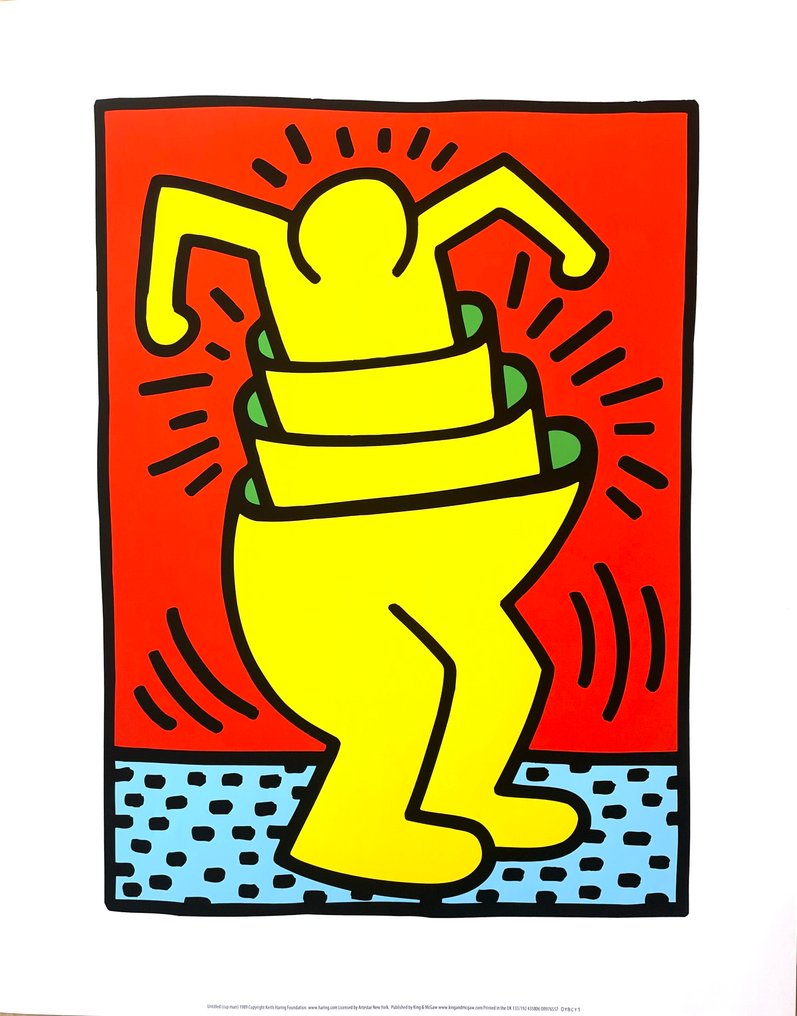
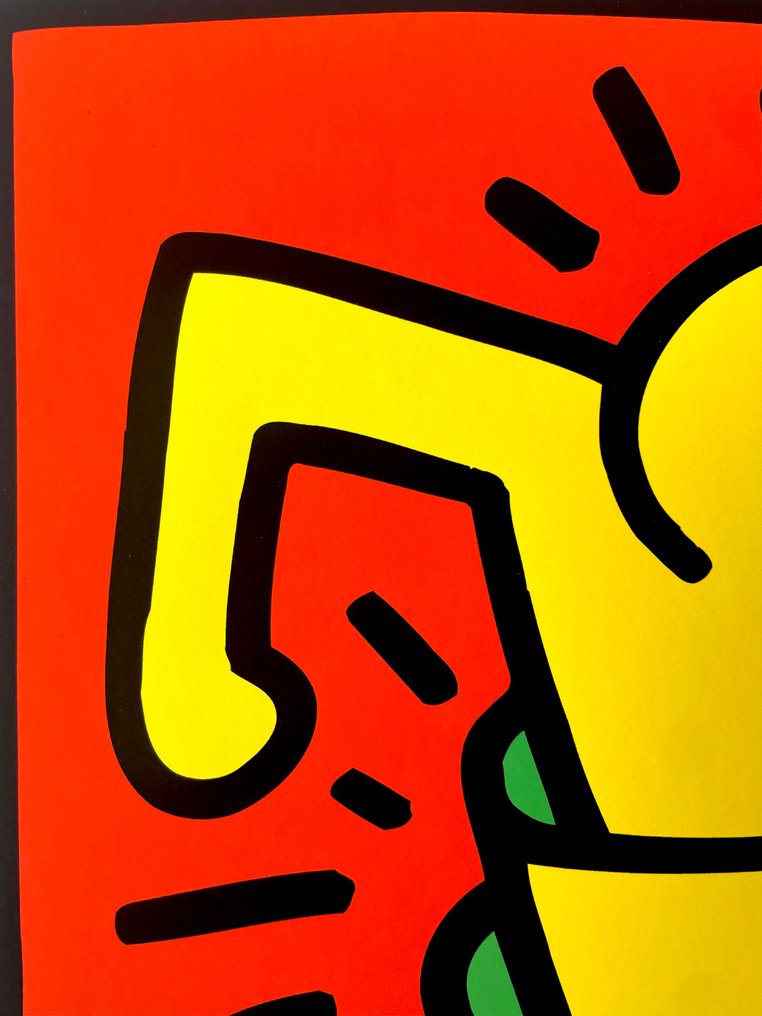
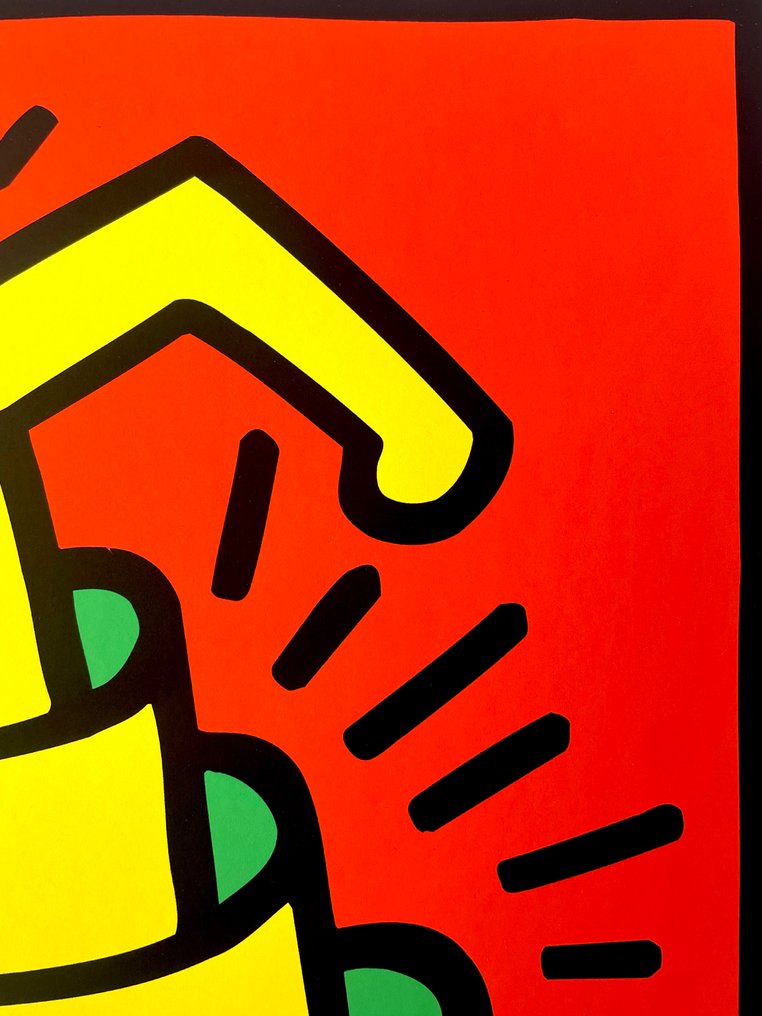
Keith Haring - Untitled (cup man) - Giclée - Artestar licensed print
Starting bid
€ 1
Add to your favourites to get an alert when the auction starts.

Expert
Selected by Juan Antonio Rodríguez
Eight years experience valuing posters, previously valuer at Balclis, Barcelona.
Estimate € 150 - € 200
Catawiki Buyer Protection
Your payment’s safe with us until you receive your object.View details
Trustpilot 4.4 | 137154 reviews
Rated Excellent on Trustpilot.
Description from the seller
Giclée (*) print of Keith Haring (**)
Reproduction of the work “Untitled,” screen print created by Haring in 1989.
Luxurious edition on matte conservation-grade digital paper with a high weight (250 g/m²). A versatile, high-quality paper made in Germany from acid-free, chlorine-free wood pulp.
Authorized print by Artestar New York. Copyright: Keith Haring Foundation
- Sheet dimensions: 60 x 47 cm
- Image dimensions: 50 x 37 cm
- Condition: Excellent (this work has never been framed or exhibited, always kept in a professional art folder, and is offered in pristine condition).
The work will be carefully handled and packed in reinforced cardboard packaging. The shipment will be sent with a tracking number (UPS DPD DHL FedEx).
The shipment will also include transit insurance for the final value of the work with full reimbursement in case of loss or damage, at no cost to the buyer.
(*) Giclée is a term referring to a high-quality fine art printing process, created digitally with inkjet printers. This process uses pigment-based inks and specialized papers to achieve sharpness, color accuracy, and durability, ideal for art reproductions and photographs.
(**) Keith Haring was born in 1958 in Reading, Pennsylvania, United States.
He grew up in Kutztown and from a young age showed a strong interest in art. He studied graphic design at The Ivy School of Professional Art in Pittsburgh, and at 19, already openly gay, he moved to New York, where he found inspiration in graffiti art and enrolled at the School of Visual Arts, where he was influenced by Keith Sonnler and Joseph Kossuth, who encouraged him to train as a conceptual artist after experimenting with form and color.
Haring drew public attention in 1980 when he began sketching cartoon-like images with markers in New York subways, and later drew white chalk cartoons on black panels used for advertising, which earned him several arrests. His clean lines, vivid colors, and active figures carried strong messages about life and unity, and his exhibitions were filmed by photographer Tseng Kwong Chi.
Around that time, he organized an exhibition at Club 57 and participated in a show in Times Square, where he first drew animals and human faces.
His first solo exhibition was at Tony Shafrazi Gallery in 1981, the same year he took part in Documenta 7 in Kassel, Germany.
In 1982 he befriended emerging artists of the era such as Kenny Scharf, Madonna, and Jean-Michel Basquiat, and even met the famous Andy Warhol.
In 1984 Haring traveled to Australia and painted several murals in Melbourne and Sydney, and even received money for his work from the National Gallery of Victoria and the Australian Centre for Contemporary Art.
He also visited and painted in Rio de Janeiro, the Paris Modern Art Museum (Centre Georges Pompidou), Minneapolis, and Manhattan.
During this period he even designed a pink jacket worn by Madonna to perform her song “Like a Virgin” on the program “Solid Gold.”
In 1985, the Museum of Modern Art in Bordeaux organized a retrospective of his work, and he also participated in the Paris Biennale.
He appeared in November of that year on MTV, painting on a program hosted by his friend Nick Rhodes of Duran Duran.
In 1986 he painted murals in Amsterdam, Paris, Phoenix, and Berlin, also painted Grace Jones’s body for her music video for the song “I’m Not Perfect,” and opened a shop to sell his works in SOHO.
By then, his works began to reflect the socio-political issues of the era such as anti-Apartheid, AIDS, and drugs.
He also created pop art pieces for brands like Absolut Vodka, Lucky Strike and Coca-Cola, and even designed the cover of the benefit album “A Very Special Christmas,” on which his friend Madonna was included.
In 1988 he was included on a select list of artists whose works appeared on Chateau Mouton Rothschild wine labels, and that same year he was diagnosed with AIDS, so the following year he founded the Keith Haring Foundation whose aim was to combat social issues related to the disease and to publicize the artist’s work through exhibitions, publications, and licenses of his works.
In June 1989 he painted his last public work on a wall of the Church of San Antonio in Pisa. This work was titled “Tuttomondo.”
Keith Haring died on February 16, 1990 at the early age of 32, a victim of AIDS.
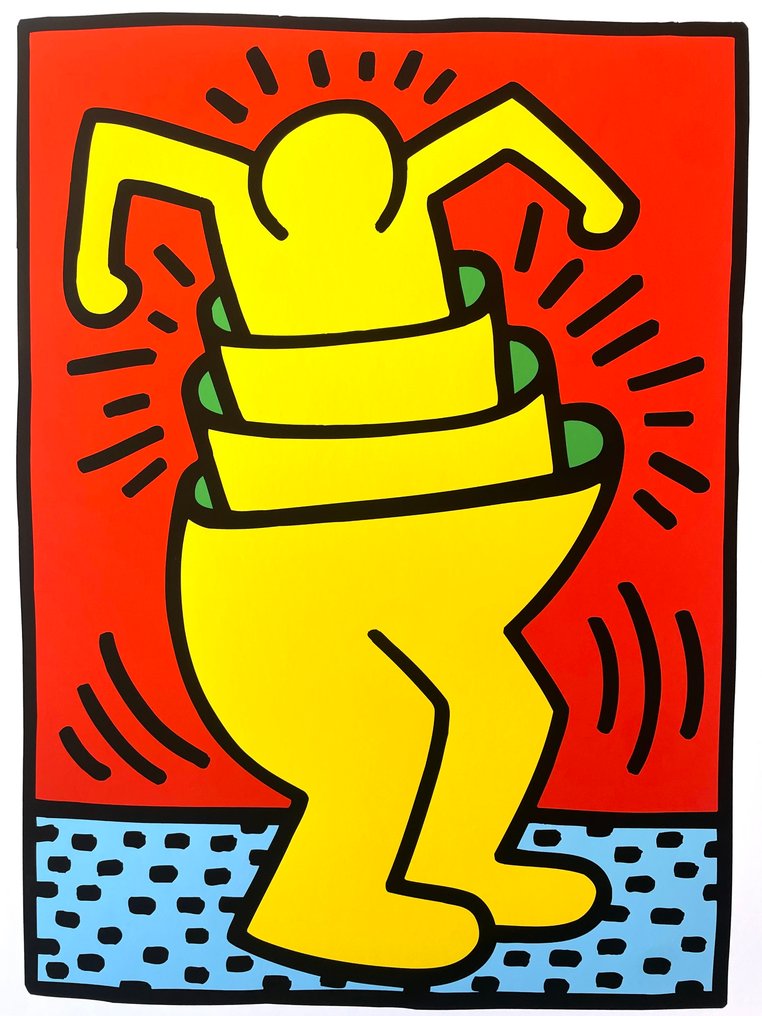
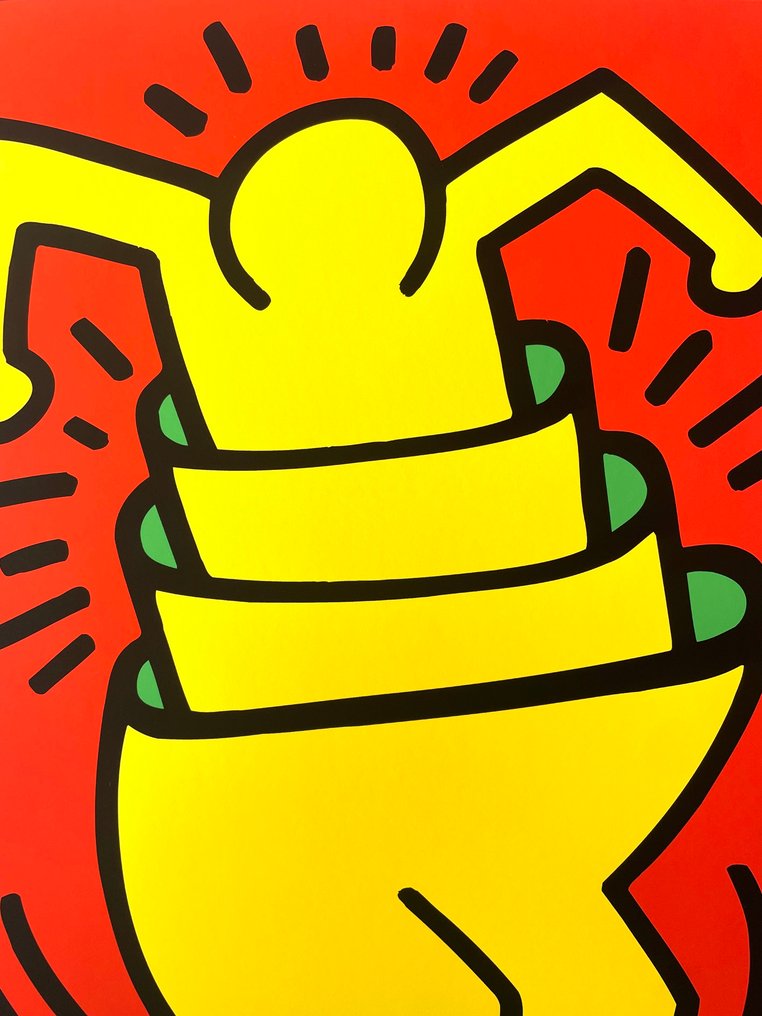
(**) “The Man with the Cup,” 1989, is a vivid testament to the artist’s ability to combine playful images with deep symbolic depth. This screen print captures Haring’s characteristic energy, using bold lines, vibrant color planes, and a dynamic composition to create a figure that is at once whimsical and captivating. The central figure, whose segmented torso suggests a layered structure, almost like a matryoshka, is depicted in full motion, with arms raised in an exuberant gesture, radiating vitality and movement. The surrounding lines and shapes amplify this sense of kinetic energy, turning the figure into a beacon of life and animation.
On a striking greenish-blue background with a purple dotted backdrop, the work showcases Haring’s masterful use of contrast and rhythm. The interaction of color, form, and movement embodies Haring’s interest in the universality of human expression, translating joy, vitality, and connectedness into a visual language recognizable at a glance. The figure of the “Man with the Cup” encapsulates Haring’s exploration of transformation, multiplicity, and the interaction between individual and collective experience, reflecting his lifelong commitment to social issues through accessible imagery.
This work exemplifies Haring’s enduring legacy: his ability to create visually captivating, socially resonant, and deeply human art. It is at once a celebration of movement and energy and a moving reflection of Haring’s innovative vision in late-20th-century contemporary art.
Seller's Story
EsKobARTE carefully selects works and posters from renowned and emerging artists from around the world, to offer them here at affordable prices.
___*** AUTHENTIC WORKS *** We only sell authentic works and posters and legally authorized prints__*** WE ARE PROFESSIONALS ***__You can bid on your items with total confidence. More than 1000 positive reviews from our customers endorse our track record and professionalism on Catawiki__*** PROTECTED, CERTIFIED AND INSURED SHIPMENTS ***__All our items are carefully packed in eco-friendly cardboard packaging. We work with the best shipping companies (UPS-DPD-DHL-FEDEX) to guarantee the best service and tracking. In addition, our shipments include insurance against damage or loss, at no cost to the buyer.__*** IF YOU ACQUIRE MORE THAN ONE ITEM, WE COMBINE SHIPPING ***__Even if they come from different auctions, you will only have to pay the shipping for a single item.__*** ANY DOUBT? CONTACT US ***__You can use the chat to talk to us, we will be happy to assist you as soon as possible.__*** THANKS AND GOOD LUCK WITH YOUR BIDS! ***
Translated by Google TranslateGiclée (*) print of Keith Haring (**)
Reproduction of the work “Untitled,” screen print created by Haring in 1989.
Luxurious edition on matte conservation-grade digital paper with a high weight (250 g/m²). A versatile, high-quality paper made in Germany from acid-free, chlorine-free wood pulp.
Authorized print by Artestar New York. Copyright: Keith Haring Foundation
- Sheet dimensions: 60 x 47 cm
- Image dimensions: 50 x 37 cm
- Condition: Excellent (this work has never been framed or exhibited, always kept in a professional art folder, and is offered in pristine condition).
The work will be carefully handled and packed in reinforced cardboard packaging. The shipment will be sent with a tracking number (UPS DPD DHL FedEx).
The shipment will also include transit insurance for the final value of the work with full reimbursement in case of loss or damage, at no cost to the buyer.
(*) Giclée is a term referring to a high-quality fine art printing process, created digitally with inkjet printers. This process uses pigment-based inks and specialized papers to achieve sharpness, color accuracy, and durability, ideal for art reproductions and photographs.
(**) Keith Haring was born in 1958 in Reading, Pennsylvania, United States.
He grew up in Kutztown and from a young age showed a strong interest in art. He studied graphic design at The Ivy School of Professional Art in Pittsburgh, and at 19, already openly gay, he moved to New York, where he found inspiration in graffiti art and enrolled at the School of Visual Arts, where he was influenced by Keith Sonnler and Joseph Kossuth, who encouraged him to train as a conceptual artist after experimenting with form and color.
Haring drew public attention in 1980 when he began sketching cartoon-like images with markers in New York subways, and later drew white chalk cartoons on black panels used for advertising, which earned him several arrests. His clean lines, vivid colors, and active figures carried strong messages about life and unity, and his exhibitions were filmed by photographer Tseng Kwong Chi.
Around that time, he organized an exhibition at Club 57 and participated in a show in Times Square, where he first drew animals and human faces.
His first solo exhibition was at Tony Shafrazi Gallery in 1981, the same year he took part in Documenta 7 in Kassel, Germany.
In 1982 he befriended emerging artists of the era such as Kenny Scharf, Madonna, and Jean-Michel Basquiat, and even met the famous Andy Warhol.
In 1984 Haring traveled to Australia and painted several murals in Melbourne and Sydney, and even received money for his work from the National Gallery of Victoria and the Australian Centre for Contemporary Art.
He also visited and painted in Rio de Janeiro, the Paris Modern Art Museum (Centre Georges Pompidou), Minneapolis, and Manhattan.
During this period he even designed a pink jacket worn by Madonna to perform her song “Like a Virgin” on the program “Solid Gold.”
In 1985, the Museum of Modern Art in Bordeaux organized a retrospective of his work, and he also participated in the Paris Biennale.
He appeared in November of that year on MTV, painting on a program hosted by his friend Nick Rhodes of Duran Duran.
In 1986 he painted murals in Amsterdam, Paris, Phoenix, and Berlin, also painted Grace Jones’s body for her music video for the song “I’m Not Perfect,” and opened a shop to sell his works in SOHO.
By then, his works began to reflect the socio-political issues of the era such as anti-Apartheid, AIDS, and drugs.
He also created pop art pieces for brands like Absolut Vodka, Lucky Strike and Coca-Cola, and even designed the cover of the benefit album “A Very Special Christmas,” on which his friend Madonna was included.
In 1988 he was included on a select list of artists whose works appeared on Chateau Mouton Rothschild wine labels, and that same year he was diagnosed with AIDS, so the following year he founded the Keith Haring Foundation whose aim was to combat social issues related to the disease and to publicize the artist’s work through exhibitions, publications, and licenses of his works.
In June 1989 he painted his last public work on a wall of the Church of San Antonio in Pisa. This work was titled “Tuttomondo.”
Keith Haring died on February 16, 1990 at the early age of 32, a victim of AIDS.
(**) “The Man with the Cup,” 1989, is a vivid testament to the artist’s ability to combine playful images with deep symbolic depth. This screen print captures Haring’s characteristic energy, using bold lines, vibrant color planes, and a dynamic composition to create a figure that is at once whimsical and captivating. The central figure, whose segmented torso suggests a layered structure, almost like a matryoshka, is depicted in full motion, with arms raised in an exuberant gesture, radiating vitality and movement. The surrounding lines and shapes amplify this sense of kinetic energy, turning the figure into a beacon of life and animation.
On a striking greenish-blue background with a purple dotted backdrop, the work showcases Haring’s masterful use of contrast and rhythm. The interaction of color, form, and movement embodies Haring’s interest in the universality of human expression, translating joy, vitality, and connectedness into a visual language recognizable at a glance. The figure of the “Man with the Cup” encapsulates Haring’s exploration of transformation, multiplicity, and the interaction between individual and collective experience, reflecting his lifelong commitment to social issues through accessible imagery.
This work exemplifies Haring’s enduring legacy: his ability to create visually captivating, socially resonant, and deeply human art. It is at once a celebration of movement and energy and a moving reflection of Haring’s innovative vision in late-20th-century contemporary art.
Seller's Story
EsKobARTE carefully selects works and posters from renowned and emerging artists from around the world, to offer them here at affordable prices.
___*** AUTHENTIC WORKS *** We only sell authentic works and posters and legally authorized prints__*** WE ARE PROFESSIONALS ***__You can bid on your items with total confidence. More than 1000 positive reviews from our customers endorse our track record and professionalism on Catawiki__*** PROTECTED, CERTIFIED AND INSURED SHIPMENTS ***__All our items are carefully packed in eco-friendly cardboard packaging. We work with the best shipping companies (UPS-DPD-DHL-FEDEX) to guarantee the best service and tracking. In addition, our shipments include insurance against damage or loss, at no cost to the buyer.__*** IF YOU ACQUIRE MORE THAN ONE ITEM, WE COMBINE SHIPPING ***__Even if they come from different auctions, you will only have to pay the shipping for a single item.__*** ANY DOUBT? CONTACT US ***__You can use the chat to talk to us, we will be happy to assist you as soon as possible.__*** THANKS AND GOOD LUCK WITH YOUR BIDS! ***
Translated by Google TranslateDetails
Era
1900-2000
Designer/artist
Keith Haring
Poster title
Untitled (cup man) - Giclée - Artestar licensed print
Condition
A (excellent - mint condition)
Height
47 cm
Width
60 cm