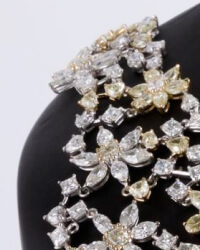
Pendant - 18 kt. White gold - Diamond


Starting bid
€ 1
Add to your favourites to get an alert when the auction starts.

Expert
Selected by Laura Trevino
She has 15 years' auction experience, specialising in vintage jewellery from 1920 to 2000.
Estimate € 8,500 - € 10,200
Catawiki Buyer Protection
Your payment’s safe with us until you receive your object.View details
Trustpilot 4.4 | 137663 reviews
Rated Excellent on Trustpilot.
Description from the seller
Vintage convertible brooch-pendant from the late 19th / early 20th century (late Victorian or Edwardian style, circa 1890-1910). The piece is entirely crafted with natural diamonds of various sizes, set in a refined combination of brilliant-cut (especially in the main and central stones) and rose-cut (typical of the era for the smaller stones, which give a soft, velvety glow).
Central motif
The heart of the jewel is a large central brilliant-cut diamond (or old European cut transitional), surrounded by a corona of diamonds arranged in a daisy or sunflower shape. The “petals” are created with a dense arrangement of rose-cut and brilliant-cut diamonds radiating outward, producing a light and movement effect that is very elegant. The setting is openwork and lightweight, typical of jewelry from this period, to allow light to pass through the stones and increase brilliance.
Drop pendant
From the central body hangs a large articulated drop, pear/teardrop-shaped, set with numerous brilliant-cut and rose-cut diamonds. At the center of the drop is a small cluster of larger diamonds, surrounded by a bezel of smaller stones that follows precisely the contour of the drop. The pendant swings freely, giving the piece a beautiful movement.
Upper details
At the top there is a small drop or shuttle element, also in diamonds, which serves as the link to the chain ring, making the jewelry wearable also as a pendant.
Back and mechanisms
The reverse shows the classic pin with safety clasp. Particularly interesting is the large open circular framework with spokes and a central decorative element in the shape of a heart or stylized bow: this is a construction feature typical of convertible high-jewelry pieces of the era, allowing the piece to be worn in several different ways.
Material and finish
The mount is made of 18-karat white gold (as suggested by the “18” mark visible in some details), with a slight oxidation that gives the piece that sought-after antique patina. The contrast between the tarnished metal and the diamond sparkle is deliberately dramatic and very elegant.
Overall impression
It is a jewel of great visual impact, luminous and refined, uniting the opulence of diamonds with the elegance of floral design. The mix of brilliant-cut and rose-cut creates a very characteristic play of light of the era: the brilliants give fire and sparkle, while the rose-cut diamonds provide a softer and more romantic reflection. Perfect both as a collectible piece and to wear on special occasions.
Vintage convertible brooch-pendant from the late 19th / early 20th century (late Victorian or Edwardian style, circa 1890-1910). The piece is entirely crafted with natural diamonds of various sizes, set in a refined combination of brilliant-cut (especially in the main and central stones) and rose-cut (typical of the era for the smaller stones, which give a soft, velvety glow).
Central motif
The heart of the jewel is a large central brilliant-cut diamond (or old European cut transitional), surrounded by a corona of diamonds arranged in a daisy or sunflower shape. The “petals” are created with a dense arrangement of rose-cut and brilliant-cut diamonds radiating outward, producing a light and movement effect that is very elegant. The setting is openwork and lightweight, typical of jewelry from this period, to allow light to pass through the stones and increase brilliance.
Drop pendant
From the central body hangs a large articulated drop, pear/teardrop-shaped, set with numerous brilliant-cut and rose-cut diamonds. At the center of the drop is a small cluster of larger diamonds, surrounded by a bezel of smaller stones that follows precisely the contour of the drop. The pendant swings freely, giving the piece a beautiful movement.
Upper details
At the top there is a small drop or shuttle element, also in diamonds, which serves as the link to the chain ring, making the jewelry wearable also as a pendant.
Back and mechanisms
The reverse shows the classic pin with safety clasp. Particularly interesting is the large open circular framework with spokes and a central decorative element in the shape of a heart or stylized bow: this is a construction feature typical of convertible high-jewelry pieces of the era, allowing the piece to be worn in several different ways.
Material and finish
The mount is made of 18-karat white gold (as suggested by the “18” mark visible in some details), with a slight oxidation that gives the piece that sought-after antique patina. The contrast between the tarnished metal and the diamond sparkle is deliberately dramatic and very elegant.
Overall impression
It is a jewel of great visual impact, luminous and refined, uniting the opulence of diamonds with the elegance of floral design. The mix of brilliant-cut and rose-cut creates a very characteristic play of light of the era: the brilliants give fire and sparkle, while the rose-cut diamonds provide a softer and more romantic reflection. Perfect both as a collectible piece and to wear on special occasions.
Details
Era
1400-1900
Laboratory report
No laboratory report
Diamond type of surrounding stones
Natural
Shape of surrounding stones
Mixed shape
Estimated period
1850-1900
Metal
White gold
Number of diamonds surrounding stones
50
Brand jewellery
No
Fineness
18 kt.
Cutting style of surrounding stones
Mixed cut
Total carat weight of surrounding stones
5.25
Total weight
30.9 g
Surrounding stones
Diamond
Condition
Vintage - used with visible signs of wear
Gender
Unisex
Country of origin
Unknown
Sold by
Disclaimer
Catawiki always aims to offer you the best possible buying experience. Our experts virtually review and select every object in line with our submission guidelines. While we strive to provide a detailed description and photographs of each jewellery object, discrepancies or inaccuracies may occur. It is your responsibility to review all of the information provided about an object, including the condition and description, before placing an order. Sellers are responsible for the information, pictures and description provided, including the quality, quantity and nature of the jewelry supplied. A small imperfection that cannot be seen in the photo but is included in the description is not a non-conformity. A Lab Report is not a guarantee, valuation or appraisal regarding the articles described therein. A Lab Report contains only the characteristics of an article described after it has been graded, tested, examined, and analyzed using the techniques and equipment used at the time of the examination from that specific Lab. The results of any other examination performed on the article may differ depending when, how, by whom and with which grading standard the article is examined. In addition, any changes and improvements in techniques and equipment that may have occurred which may enable the examiner to detect, among other things, the use of processes for altering the characteristics of an article which use was previously undetectable, does not automatically mean the object does not conform to its description.
Catawiki always aims to offer you the best possible buying experience. Our experts virtually review and select every object in line with our submission guidelines. While we strive to provide a detailed description and photographs of each jewellery object, discrepancies or inaccuracies may occur. It is your responsibility to review all of the information provided about an object, including the condition and description, before placing an order. Sellers are responsible for the information, pictures and description provided, including the quality, quantity and nature of the jewelry supplied. A small imperfection that cannot be seen in the photo but is included in the description is not a non-conformity. A Lab Report is not a guarantee, valuation or appraisal regarding the articles described therein. A Lab Report contains only the characteristics of an article described after it has been graded, tested, examined, and analyzed using the techniques and equipment used at the time of the examination from that specific Lab. The results of any other examination performed on the article may differ depending when, how, by whom and with which grading standard the article is examined. In addition, any changes and improvements in techniques and equipment that may have occurred which may enable the examiner to detect, among other things, the use of processes for altering the characteristics of an article which use was previously undetectable, does not automatically mean the object does not conform to its description.