Frans Van Damme (1858–1925) - Antwerp by Night



08
days
20
hours
47
minutes
11
seconds
Starting bid
€ 1
Reserve price not met

Expert
Selected by Leo Setz
Over 30 years’ experience as art dealer, appraiser and restorer.
Estimate € 350 - € 400
No bids placed
Catawiki Buyer Protection
Your payment’s safe with us until you receive your object.View details
Trustpilot 4.4 | 137313 reviews
Rated Excellent on Trustpilot.
Description from the seller
Antwerp by Night
Double-sided oil on panel from the 19th and early 20th century
Author: Frans Van Damme (1858–1925)
Technique: oil on panel, double-sided painting
Dimensions: 71.5 × 40 cm
Dimensions with frame: 86.5 × 55 cm
Signature: lower right corner
Condition: very good
Attribution: fully confirmed by an expert and professor of art history
This work represents an exceptional example of the oeuvre of Frans Van Damme, a Belgian academic painter of international renown, professor at the academy of fine arts, medalist, and participant in the most prestigious European exhibitions of the late 19th and early 20th centuries.
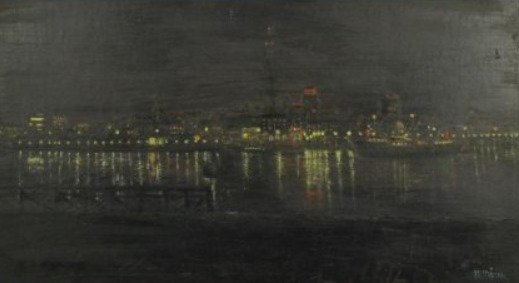
The front of the painting depicts a moody night-time port landscape with a panoramic view of Antwerp seen from the Scheldt River. This motif is recognized as the most representative and most sought-after in the artist’s oeuvre. The flickering city lights reflected in the calm water create an atmosphere of silence, focus, and contemplation. Van Damme employs a mature technique, skillfully using light, subtle tonal transitions, and his characteristic impasto. The composition demonstrates balance, depth, and a masterful understanding of the nocturnal illumination of the port city.
The painting is executed in an above-average, collector’s format, clearly larger than the artist’s standard works, which significantly increases its museum-grade status and market value. The signature in the lower right corner fully corresponds to authentic variants used by Frans Van Damme during his mature period.
The uniqueness of this object also lies in its double-sided nature. On the reverse of the panel is a second, fully autonomous oil painting, an expressive landscape study from the early period of the artist’s career, dated circa 1875–1885. This was during his academic training in Dendermonde, Sint Niklaas, and Antwerp. It shows a free, sketch-like technique, broad brushstrokes, an intense and vibrant color palette, and pronounced impasto. This style corresponds to the Belgian landscape school associated with the Dendermonde circle, to which Van Damme was directly connected through his teachers and family.
The double-sided panel is neither incidental nor secondary. It constitutes historical evidence of academic and workshop practices of the young artist, who frequently reused panels during his studies. Here we have an extremely rare combination of two stages of a single artist’s work in one object: an early academic study and a mature, fully developed port composition.
Frans Van Damme was an artist with an established institutional position. He studied at the academies of Dendermonde, Sint Niklaas, and the Royal Academy of Fine Arts in Antwerp. He then served as a professor at the Academies of Fine Arts in Antwerp and Brussels, confirming his high rank in the art world of the period. He regularly participated in the official exhibition and academic circuit.
The artist was the recipient of prestigious international awards. In 1887, he received a gold medal at the Première Exposition Française in Tunis for a work devoted to the Scheldt River. His work was also awarded and presented in France and St. Petersburg, demonstrating his recognition on a European scale. From 1903 onwards, he regularly exhibited at the Paris Salon, the Salon des Artistes Français, which at that time was the most important exhibition institution in Europe. He also participated in the Salon de Gand, the Exposition Internationale in Brussels, the Exposition Universelle et Internationale de Bruxelles, and the Premier Salon de Noël in Laeken.
Frans Van Damme’s works are held in public collections, including the municipality of Knokke-Heist in Belgium. The artist appears in the literature and museum catalogues, and his name is listed in key references on 19th-century Belgian landscape and marine painting.
The highest auction record of Van Damme, The River Scheldt near Bergen op Zoom, achieved at the De Vuyst auction on 6 March 2021, was estimated at 8.000–12.000 EUR and finally sold for approximately 10.885 EUR! This remains the highest known price for a Van Damme work at auction to date. A significant result: Villas dans les Dunes, sold at PBA Auctions, achieved 1.548 EUR, demonstrating that large and representative seascapes perform significantly better than smaller decorative works.
Awards and distinctions of the artist:
• Prix de Rome – French art prize of the 19th century with the highest prestige
• Gold medal at the Première Exposition Française in Tunis, 1887
• Gold medals in France and St. Petersburg, confirming the artist’s European recognition
Exhibitions and institutional presence:
• Paris Salons from 1903 (Salon des Artistes Français)
• Salon in Ghent, Casino Ghent, 1892
• Exposition Internationale in Brussels, 1897
• Exposition Universelle et Internationale de Bruxelles, 1910
• Premier Salon de Noël in Laeken, 1912
• Local exhibition in Dendermonde, 1923
Public collections:
• Musée d’Orsay – art documentation
• Knokke-Heist municipality collection (Rural House)
On the auction market, Frans Van Damme’s works reach museum-level standards. The highest documented auction sale of his work reached around 10,000 EUR and concerned a large river landscape by the Scheldt, i.e., exactly the same thematic circle as the offered work. This result clearly confirms that works of such theme, scale, and quality operate in the highest segment of his market, not in the realm of secondary pieces.
The offered painting is a museum-class work. It combines the rarity of a double-sided panel, full biographical continuity of the artist tied to life on the water, the most valued iconographic motif, and confirmed academic and exhibition prestige. It is an object intended for a discerning collector, private or institutional collection, seeking not only aesthetic value but also historical and museum value.
VALUATION AND EXPERT JUSTIFICATION
Frans Van Damme (1858–1925)
Double-sided oil on panel, XL format
Subject: Night view of Antwerp on the Scheldt
Current market value of the work (2025)
The real market value of the object is 2,800–4,200 EUR, while with proper auction exposure, biographical narrative, and positioning in the premium segment, the auction potential reaches approximately 5,000 EUR.
FULL VALUE JUSTIFICATION
The presented work belongs to the highest and most collectible segment of Frans Van Damme’s oeuvre, Belgian academic painter, professor of art, gold medal laureate, and regular participant in the international exhibition circuit at the end of the 19th and the beginning of the 20th century.
The motif of the night-time port on the Scheldt, view of Antwerp after dark, is the most recognizable and most valued subject in his oeuvre. These compositions built his artistic position and brought him recognition at the salons in Belgium, France, and beyond Western Europe. The painting demonstrates a mature, fully developed artistic language, based on subtle play of light, water reflections, harmony of dark tones, and precisely dosed color accents.
The format of the work is clearly above average for Van Damme’s works, giving it a museum and exhibition character. A large, vertical panel combined with the night-time port landscape makes the painting a representative work rather than a mere cabinet piece.
The uniqueness of the object is enhanced by the fact that it is double-sided, with both sides executed by the same artist, representing two different stages of his creative development. The front is a mature, exhibition-ready work fully consistent with his period of greatest recognition. The reverse is an early academic landscape study from 1875–1885, executed during his studies in Dendermonde, Sint-Niklaas, and Antwerp. Such a combination of two phases of creative work in one object is extremely rare and has high documentary and collectible value.
The biographical context is also crucial, directly connecting to the subject of the painting. Frans Van Damme was not only a painter of ports and rivers from imagination. He owned his own boat and actively sailed along the coasts of Belgium, France, and the Netherlands for years, exploring the sea with a friend. Long stays in Zeebrugge, life in direct contact with water, ports, and sea light fundamentally influenced his painting. Views of the Scheldt River and ports were for him not only a subject but a life experience, which clearly translates into authenticity and emotional depth of his works.
The fate of the artist further strengthens the significance of the work. In 1914, his studio in Zeebrugge was bombed, and a significant part of his oeuvre was destroyed. Despite previous exhibition successes, awards, and academic prestige, Van Damme ended his life in solitude and poverty at Hospice Pacheco in Brussels. This tragic ending makes preserved, high-quality works even more historically and emotionally significant.
AUCTION CONTEXT AND MARKET POSITION
The highest confirmed auction result of Frans Van Damme’s works is approximately 10.000 EUR, concerning a large river landscape on the Scheldt, exactly the same thematic circle as the offered painting. This result clearly confirms that works of this theme, scale, and quality operate in the highest segment of his market, not in the secondary works area.
SUMMARY
The presented painting is of museum-class quality, combining the most valued motif of Frans Van Damme’s work, the rare double-sided panel, the full biographical context of an artist associated with life on the water, and confirmed academic and exhibition status. It is an object intended for a discerning collector or institution seeking not only aesthetic value but also deep historical, documentary, and emotional significance.
Antwerp by Night
Double-sided oil on panel from the 19th and early 20th century
Author: Frans Van Damme (1858–1925)
Technique: oil on panel, double-sided painting
Dimensions: 71.5 × 40 cm
Dimensions with frame: 86.5 × 55 cm
Signature: lower right corner
Condition: very good
Attribution: fully confirmed by an expert and professor of art history
This work represents an exceptional example of the oeuvre of Frans Van Damme, a Belgian academic painter of international renown, professor at the academy of fine arts, medalist, and participant in the most prestigious European exhibitions of the late 19th and early 20th centuries.
The front of the painting depicts a moody night-time port landscape with a panoramic view of Antwerp seen from the Scheldt River. This motif is recognized as the most representative and most sought-after in the artist’s oeuvre. The flickering city lights reflected in the calm water create an atmosphere of silence, focus, and contemplation. Van Damme employs a mature technique, skillfully using light, subtle tonal transitions, and his characteristic impasto. The composition demonstrates balance, depth, and a masterful understanding of the nocturnal illumination of the port city.
The painting is executed in an above-average, collector’s format, clearly larger than the artist’s standard works, which significantly increases its museum-grade status and market value. The signature in the lower right corner fully corresponds to authentic variants used by Frans Van Damme during his mature period.
The uniqueness of this object also lies in its double-sided nature. On the reverse of the panel is a second, fully autonomous oil painting, an expressive landscape study from the early period of the artist’s career, dated circa 1875–1885. This was during his academic training in Dendermonde, Sint Niklaas, and Antwerp. It shows a free, sketch-like technique, broad brushstrokes, an intense and vibrant color palette, and pronounced impasto. This style corresponds to the Belgian landscape school associated with the Dendermonde circle, to which Van Damme was directly connected through his teachers and family.
The double-sided panel is neither incidental nor secondary. It constitutes historical evidence of academic and workshop practices of the young artist, who frequently reused panels during his studies. Here we have an extremely rare combination of two stages of a single artist’s work in one object: an early academic study and a mature, fully developed port composition.
Frans Van Damme was an artist with an established institutional position. He studied at the academies of Dendermonde, Sint Niklaas, and the Royal Academy of Fine Arts in Antwerp. He then served as a professor at the Academies of Fine Arts in Antwerp and Brussels, confirming his high rank in the art world of the period. He regularly participated in the official exhibition and academic circuit.
The artist was the recipient of prestigious international awards. In 1887, he received a gold medal at the Première Exposition Française in Tunis for a work devoted to the Scheldt River. His work was also awarded and presented in France and St. Petersburg, demonstrating his recognition on a European scale. From 1903 onwards, he regularly exhibited at the Paris Salon, the Salon des Artistes Français, which at that time was the most important exhibition institution in Europe. He also participated in the Salon de Gand, the Exposition Internationale in Brussels, the Exposition Universelle et Internationale de Bruxelles, and the Premier Salon de Noël in Laeken.
Frans Van Damme’s works are held in public collections, including the municipality of Knokke-Heist in Belgium. The artist appears in the literature and museum catalogues, and his name is listed in key references on 19th-century Belgian landscape and marine painting.
The highest auction record of Van Damme, The River Scheldt near Bergen op Zoom, achieved at the De Vuyst auction on 6 March 2021, was estimated at 8.000–12.000 EUR and finally sold for approximately 10.885 EUR! This remains the highest known price for a Van Damme work at auction to date. A significant result: Villas dans les Dunes, sold at PBA Auctions, achieved 1.548 EUR, demonstrating that large and representative seascapes perform significantly better than smaller decorative works.
Awards and distinctions of the artist:
• Prix de Rome – French art prize of the 19th century with the highest prestige
• Gold medal at the Première Exposition Française in Tunis, 1887
• Gold medals in France and St. Petersburg, confirming the artist’s European recognition
Exhibitions and institutional presence:
• Paris Salons from 1903 (Salon des Artistes Français)
• Salon in Ghent, Casino Ghent, 1892
• Exposition Internationale in Brussels, 1897
• Exposition Universelle et Internationale de Bruxelles, 1910
• Premier Salon de Noël in Laeken, 1912
• Local exhibition in Dendermonde, 1923
Public collections:
• Musée d’Orsay – art documentation
• Knokke-Heist municipality collection (Rural House)
On the auction market, Frans Van Damme’s works reach museum-level standards. The highest documented auction sale of his work reached around 10,000 EUR and concerned a large river landscape by the Scheldt, i.e., exactly the same thematic circle as the offered work. This result clearly confirms that works of such theme, scale, and quality operate in the highest segment of his market, not in the realm of secondary pieces.
The offered painting is a museum-class work. It combines the rarity of a double-sided panel, full biographical continuity of the artist tied to life on the water, the most valued iconographic motif, and confirmed academic and exhibition prestige. It is an object intended for a discerning collector, private or institutional collection, seeking not only aesthetic value but also historical and museum value.
VALUATION AND EXPERT JUSTIFICATION
Frans Van Damme (1858–1925)
Double-sided oil on panel, XL format
Subject: Night view of Antwerp on the Scheldt
Current market value of the work (2025)
The real market value of the object is 2,800–4,200 EUR, while with proper auction exposure, biographical narrative, and positioning in the premium segment, the auction potential reaches approximately 5,000 EUR.
FULL VALUE JUSTIFICATION
The presented work belongs to the highest and most collectible segment of Frans Van Damme’s oeuvre, Belgian academic painter, professor of art, gold medal laureate, and regular participant in the international exhibition circuit at the end of the 19th and the beginning of the 20th century.
The motif of the night-time port on the Scheldt, view of Antwerp after dark, is the most recognizable and most valued subject in his oeuvre. These compositions built his artistic position and brought him recognition at the salons in Belgium, France, and beyond Western Europe. The painting demonstrates a mature, fully developed artistic language, based on subtle play of light, water reflections, harmony of dark tones, and precisely dosed color accents.
The format of the work is clearly above average for Van Damme’s works, giving it a museum and exhibition character. A large, vertical panel combined with the night-time port landscape makes the painting a representative work rather than a mere cabinet piece.
The uniqueness of the object is enhanced by the fact that it is double-sided, with both sides executed by the same artist, representing two different stages of his creative development. The front is a mature, exhibition-ready work fully consistent with his period of greatest recognition. The reverse is an early academic landscape study from 1875–1885, executed during his studies in Dendermonde, Sint-Niklaas, and Antwerp. Such a combination of two phases of creative work in one object is extremely rare and has high documentary and collectible value.
The biographical context is also crucial, directly connecting to the subject of the painting. Frans Van Damme was not only a painter of ports and rivers from imagination. He owned his own boat and actively sailed along the coasts of Belgium, France, and the Netherlands for years, exploring the sea with a friend. Long stays in Zeebrugge, life in direct contact with water, ports, and sea light fundamentally influenced his painting. Views of the Scheldt River and ports were for him not only a subject but a life experience, which clearly translates into authenticity and emotional depth of his works.
The fate of the artist further strengthens the significance of the work. In 1914, his studio in Zeebrugge was bombed, and a significant part of his oeuvre was destroyed. Despite previous exhibition successes, awards, and academic prestige, Van Damme ended his life in solitude and poverty at Hospice Pacheco in Brussels. This tragic ending makes preserved, high-quality works even more historically and emotionally significant.
AUCTION CONTEXT AND MARKET POSITION
The highest confirmed auction result of Frans Van Damme’s works is approximately 10.000 EUR, concerning a large river landscape on the Scheldt, exactly the same thematic circle as the offered painting. This result clearly confirms that works of this theme, scale, and quality operate in the highest segment of his market, not in the secondary works area.
SUMMARY
The presented painting is of museum-class quality, combining the most valued motif of Frans Van Damme’s work, the rare double-sided panel, the full biographical context of an artist associated with life on the water, and confirmed academic and exhibition status. It is an object intended for a discerning collector or institution seeking not only aesthetic value but also deep historical, documentary, and emotional significance.
Details
Artist
Frans Van Damme (1858–1925)
Sold with frame
Yes
Sold by
Owner or reseller
Edition
Original
Title of artwork
Antwerp by Night
Technique
Oil painting
Signature
Signed
Country of origin
Belgium
Condition
Good condition
Height
55 cm
Width
86.5 cm
Depiction/theme
Cityscape
Style
Impressionism
Period
1900-1910
Sold by
