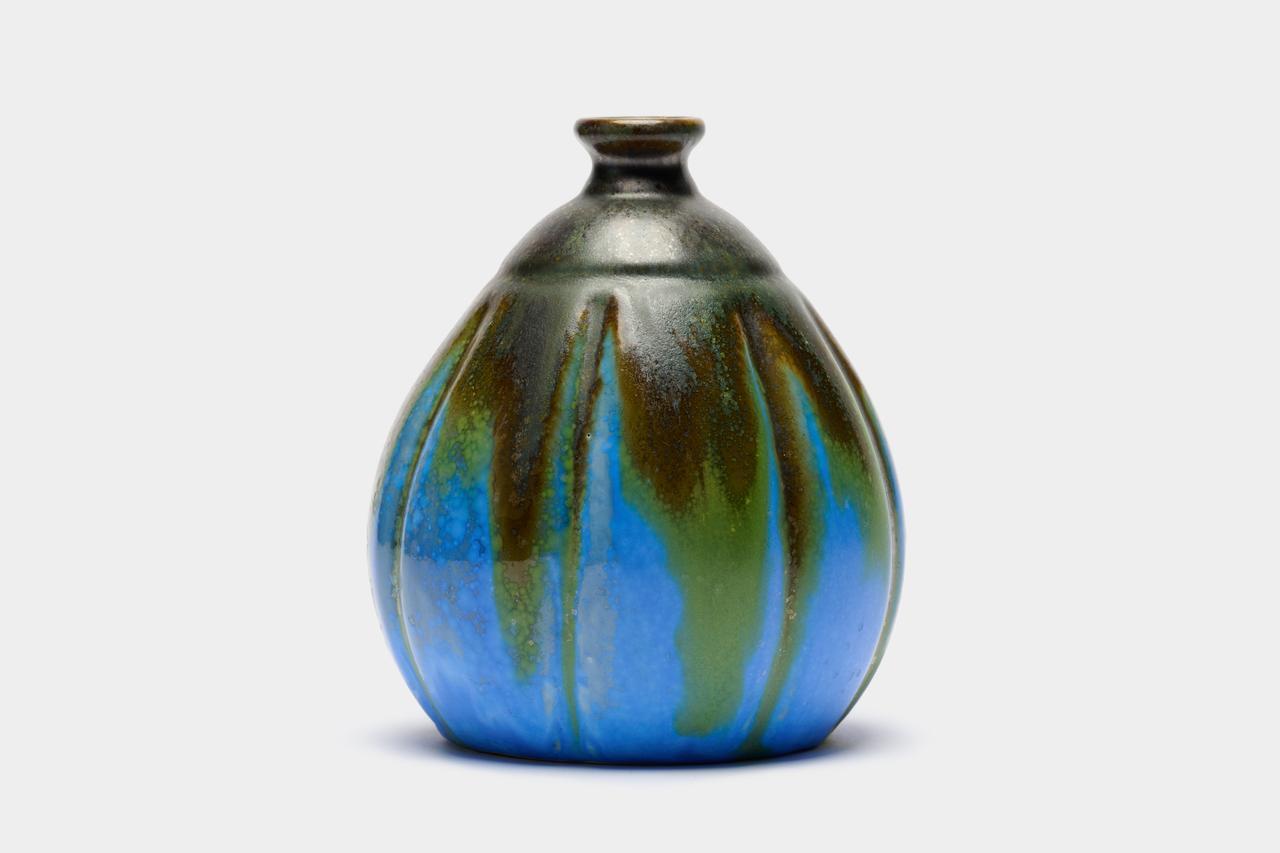
Josef Kuba - Vase - Porcelain


05
days
23
hours
59
minutes
56
seconds
Starting bid
€ 1
No reserve price

Expert
Selected by Florentin Brunz Gaborieau
Holds a master’s in Art History, specialising in Second French Empire and Dutch Golden Age.
Estimate € 150 - € 180
No bids placed
Catawiki Buyer Protection
Your payment’s safe with us until you receive your object.View details
Trustpilot 4.4 | 137914 reviews
Rated Excellent on Trustpilot.
A porcelain vase by Josef Kuba, Carlsbad, dating to circa 1930–1940, with a green shoulder band, a central polychrome scene and gilded detailing, measuring 28.5 cm high and 24.5 cm in diameter, in good used condition with minor signs of age and stains.
AI-assisted summary
Description from the seller
A vase presenting itself as a large ovoid or bombé porcelain vessel, characterized by a very capacious, rounded belly that tapers to a stable circular base. The shoulder is soft and blends into a short neck ending with a flared mouth with a gilded edge. The overall style recalls late 19th- to early 20th-century European production (e.g., Neoclassical style, historicism, or Vienna/German porcelain molds). The vase is divided horizontally into three main bands: The neck is a light/white shade. Along the shoulder runs a band of intense emerald green or imperial green, decorated at the upper edge with stylized leaf motifs in newsprint-gold (gold leaf) and bounded below by a thin gilded line. The central band has a wide white stripe serving as the background for a continuous polychrome figurative scene, painted with great detail and soft shading reminiscent of academic painting. The background of the scene shows a slight hint of mountains and a sky gradient in pink and blue tones. The lower half of the vase repeats the dark emerald green, enriched at the top with a rich and intricate grammar (grafter) in newsprint gold, worked in a lace-like pattern, with geometric, floral, and hanging motifs (garlands and festoons). The painted scene depicts a Dionysian triumph (or Bacchanal), a classical theme of Greek and Roman mythology connected to the cult of Dionysus (Bacchus), god of wine, festivity, and wantonness. From left to right, several characters typical of this procession (the thiasos) are distinguishable: Silenus and the Maenad on the donkey: A female figure (perhaps a Maenad or bacchant) crowned with branches is seated on the donkey’s back covered by a leopard skin. The woman holds a wine vessel (oinochoe). The animal is led by an elderly bearded man, probably identifiable as Silenus, the wise but often drunken guardian of Dionysus. In the center, two male figures advance joyfully: one plays a long curved brass horn, while the other, semi-nude with an animal skin girded at the waist and a crown of ivy or grape on the head, dances while holding plates or small bells. On the right, a female figure dances, shaking a tambourine (tympanum). Next to her are two small satyrs (fauns), mythological creatures with goat legs: one is a standing child faun, the other a small satyr lying on the ground on his back in a playful pose. The work stands out for its high level of craftsmanship, evident in the anatomical rendering of the bodies, the fluid drapery of the garments, and the precision of the glossy gilding that contrasts starkly with the dark green background. The overall composition evokes a sense of movement, festivity, and classical elegance. At the base’s bottom, there is a mark with a green and gold oval shield, a five-point crown, and the letters “J.K.” (sometimes listed as J.K.W. or J.W.K.), belonging to the famous manufactory and decoration workshop of Josef Kuba (Josef Kuba Porzellanmalerei / Werkstätte). Kuba was renowned for decorating high-quality porcelains in the
A vase presenting itself as a large ovoid or bombé porcelain vessel, characterized by a very capacious, rounded belly that tapers to a stable circular base. The shoulder is soft and blends into a short neck ending with a flared mouth with a gilded edge. The overall style recalls late 19th- to early 20th-century European production (e.g., Neoclassical style, historicism, or Vienna/German porcelain molds). The vase is divided horizontally into three main bands: The neck is a light/white shade. Along the shoulder runs a band of intense emerald green or imperial green, decorated at the upper edge with stylized leaf motifs in newsprint-gold (gold leaf) and bounded below by a thin gilded line. The central band has a wide white stripe serving as the background for a continuous polychrome figurative scene, painted with great detail and soft shading reminiscent of academic painting. The background of the scene shows a slight hint of mountains and a sky gradient in pink and blue tones. The lower half of the vase repeats the dark emerald green, enriched at the top with a rich and intricate grammar (grafter) in newsprint gold, worked in a lace-like pattern, with geometric, floral, and hanging motifs (garlands and festoons). The painted scene depicts a Dionysian triumph (or Bacchanal), a classical theme of Greek and Roman mythology connected to the cult of Dionysus (Bacchus), god of wine, festivity, and wantonness. From left to right, several characters typical of this procession (the thiasos) are distinguishable: Silenus and the Maenad on the donkey: A female figure (perhaps a Maenad or bacchant) crowned with branches is seated on the donkey’s back covered by a leopard skin. The woman holds a wine vessel (oinochoe). The animal is led by an elderly bearded man, probably identifiable as Silenus, the wise but often drunken guardian of Dionysus. In the center, two male figures advance joyfully: one plays a long curved brass horn, while the other, semi-nude with an animal skin girded at the waist and a crown of ivy or grape on the head, dances while holding plates or small bells. On the right, a female figure dances, shaking a tambourine (tympanum). Next to her are two small satyrs (fauns), mythological creatures with goat legs: one is a standing child faun, the other a small satyr lying on the ground on his back in a playful pose. The work stands out for its high level of craftsmanship, evident in the anatomical rendering of the bodies, the fluid drapery of the garments, and the precision of the glossy gilding that contrasts starkly with the dark green background. The overall composition evokes a sense of movement, festivity, and classical elegance. At the base’s bottom, there is a mark with a green and gold oval shield, a five-point crown, and the letters “J.K.” (sometimes listed as J.K.W. or J.W.K.), belonging to the famous manufactory and decoration workshop of Josef Kuba (Josef Kuba Porzellanmalerei / Werkstätte). Kuba was renowned for decorating high-quality porcelains in the
Details
Era
1900-2000
Weight
0 g
Number of objects
1
Country of origin
Czechia
Material
Porcelain
Manufacturer/brand
Josef Kuba
Condition
Good condition - used with small signs of aging & blemishes
Height
0 cm
Width
0 cm
Depth
0 cm
Estimated period
1930-1940
Sold by