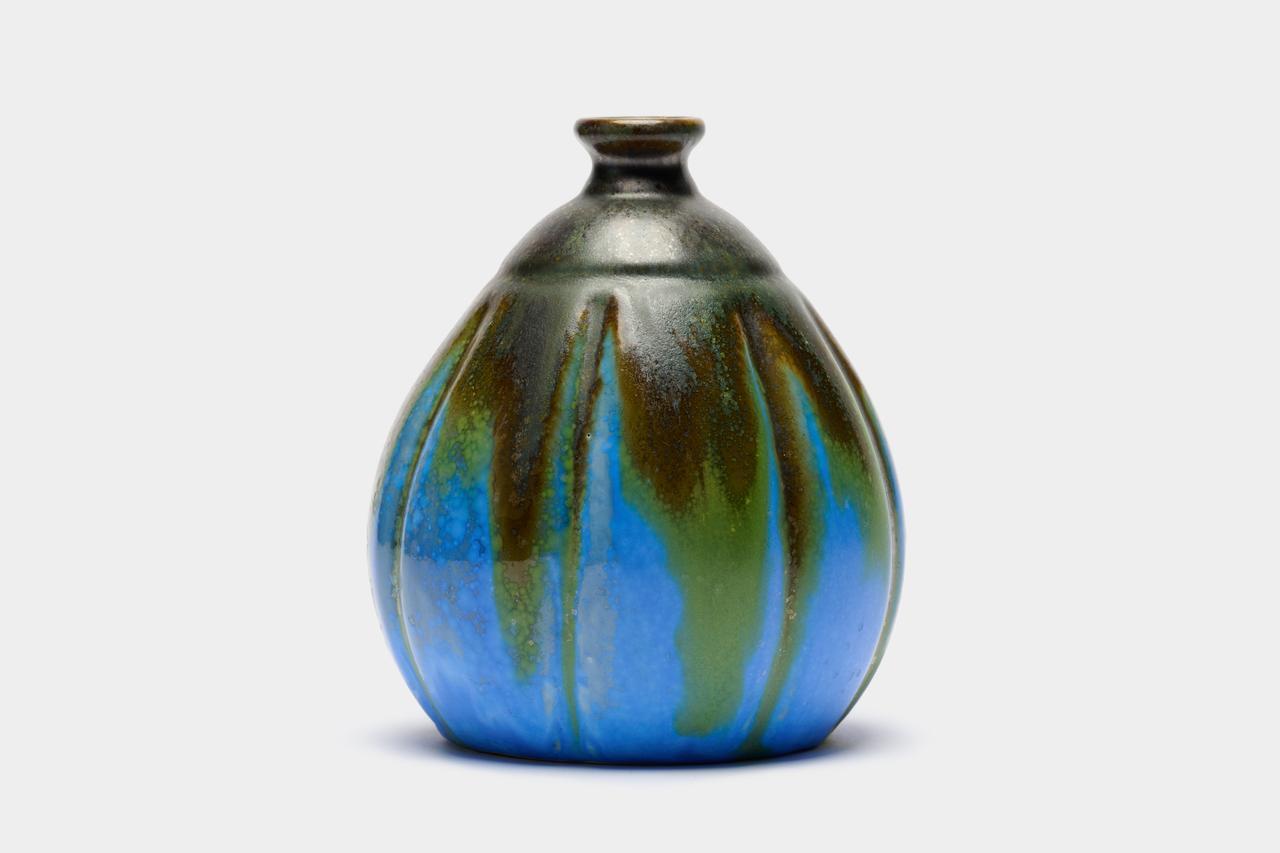
Richard Satava - Baluster vase - Glass - Flared Low Bowl


03
days
07
hours
04
minutes
58
seconds
Current bid
€ 1
Reserve price not met

Expert
Selected by Florentin Brunz Gaborieau
Holds a master’s in Art History, specialising in Second French Empire and Dutch Golden Age.
Estimate € 150 - € 200
 | €1 |
|---|
Catawiki Buyer Protection
Your payment’s safe with us until you receive your object.View details
Trustpilot 4.4 | 138242 reviews
Rated Excellent on Trustpilot.
Description from the seller
A.I info:
The inscription on the bottom of this glass object shows the hand-drawn signature of the famous American glass artist Richard Satava (often signed as Satava).
The Handwriting:
The graceful, wavy letters with the distinctive large 'S' and the connecting lines exactly match the fixed signature style of the American glassblower Richard Satava.
The Numbering:
The numeric combination on the right side is typical for the registration system Satava uses to date and catalog his handmade artworks. This is truly an authentic, handmade piece of American glass art from the Satava Art Glass studio.
Dating / Serial Number:
On the diminutive vase, the code on the right clearly begins with an elegant "2", followed by a few more digits (such as 2002 or 2-02). This means it is an early registered model, or that it was specifically blown in the year 2002 (if ending in 02). Thanks to this number you can be one hundred percent sure that this is a catalogued collectible and not mass-produced.
Unique Character:
No two craquelé vases are the same; the network of lines crack open differently on each piece. Your vase is thus an absolute one-of-a-kind.
With dimensions (8 cm high and 11.5 cm wide) you have a so-called "Squat Vase" (low, stout vase) or a "Flared Low Bowl" by Richard Satava in your hands.
Why the craquelé technique increases value.
Craftsmanship and Risk:
The ice-crackle technique requires that the molten glass be plunged into cold water. This carries a high risk that the vase may shatter completely during production. Collectors pay extra for these vases.
Because the vase is wider than it is tall, this is a very specific and stable model that fits perfectly with the organic style of Satava Art Glass from the early 2000s.
Vases from this specific period (2003) in this size are highly sought after by enthusiasts of American glass art. There is no new supply of this type of vase. This drives up the prices of catalogued pieces from the early 2000s (such as your piece from ’03).
The current market value of your specific 2003 Richard Satava craquelé vase lies between €300 and €450.
Due to the combination of the specific dimensions (8 x 11.5 cm), the purple base with glitter, and the technically challenging craquelé finish, this vase falls into the higher end of the market.
A.I info:
The inscription on the bottom of this glass object shows the hand-drawn signature of the famous American glass artist Richard Satava (often signed as Satava).
The Handwriting:
The graceful, wavy letters with the distinctive large 'S' and the connecting lines exactly match the fixed signature style of the American glassblower Richard Satava.
The Numbering:
The numeric combination on the right side is typical for the registration system Satava uses to date and catalog his handmade artworks. This is truly an authentic, handmade piece of American glass art from the Satava Art Glass studio.
Dating / Serial Number:
On the diminutive vase, the code on the right clearly begins with an elegant "2", followed by a few more digits (such as 2002 or 2-02). This means it is an early registered model, or that it was specifically blown in the year 2002 (if ending in 02). Thanks to this number you can be one hundred percent sure that this is a catalogued collectible and not mass-produced.
Unique Character:
No two craquelé vases are the same; the network of lines crack open differently on each piece. Your vase is thus an absolute one-of-a-kind.
With dimensions (8 cm high and 11.5 cm wide) you have a so-called "Squat Vase" (low, stout vase) or a "Flared Low Bowl" by Richard Satava in your hands.
Why the craquelé technique increases value.
Craftsmanship and Risk:
The ice-crackle technique requires that the molten glass be plunged into cold water. This carries a high risk that the vase may shatter completely during production. Collectors pay extra for these vases.
Because the vase is wider than it is tall, this is a very specific and stable model that fits perfectly with the organic style of Satava Art Glass from the early 2000s.
Vases from this specific period (2003) in this size are highly sought after by enthusiasts of American glass art. There is no new supply of this type of vase. This drives up the prices of catalogued pieces from the early 2000s (such as your piece from ’03).
The current market value of your specific 2003 Richard Satava craquelé vase lies between €300 and €450.
Due to the combination of the specific dimensions (8 x 11.5 cm), the purple base with glitter, and the technically challenging craquelé finish, this vase falls into the higher end of the market.
Details
Era
After 2000
Title additional information
Flared Low Bowl
Country of origin
United States
Designer/artist/maker
Richard Satava
Material
Glass
Style
Modern
Colour
Purple
Condition
As new - unused
Height
8 cm
Width
11.5 cm
Depth
11.5 cm
Diameter
11.5 cm
Estimated period
2000-2010