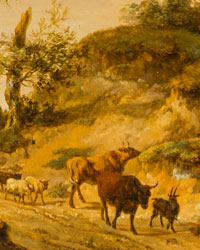
W Gdanietz (1893-1962) - De Spinster


04
days
21
hours
35
minutes
19
seconds
Current bid
€ 1
No reserve price

Expert
Selected by Leo Setz
Over 30 years’ experience as art dealer, appraiser and restorer.
Estimate € 350 - € 400
 | €1 |
|---|
Catawiki Buyer Protection
Your payment’s safe with us until you receive your object.View details
Trustpilot 4.4 | 140076 reviews
Rated Excellent on Trustpilot.
Oil painting De Spinster by W. Gdanietz (1893–1962), created in 1910–1920 in Germany in a traditional realist style, signed handgesigneerd and sold with the frame, framed size 39 × 49 cm (canvas 30 × 40 cm).
AI-assisted summary
Description from the seller
1893
Wilhelm Gdanietz was born on January 21, 1893, in Mainz, Germany.
1895
At the age of two he becomes deaf after a bout of scarlet fever. This handicap shapes his youth, but does not prevent him from pursuing a career as an artist.
1902–1908
Attends the school for the deaf (Taubstummenanstalt) in Osnabrück, where his drawing talent further develops.
1911–1918
Studies at the Kunstakademie Düsseldorf. He studies with teachers including Claus Meyer, Eduard von Gebhardt and Wilhelm (Willy) Spatz. He also works in the master studio of Franz Kiederich.
1918–about 1927
Makes study trips to the Alps, South Tyrol and Austria. His early paintings mainly show mountain landscapes and rural scenes.
1920
Has an exhibition in the museum of the Dürerbund in Osnabrück, one of his first important public presentations.
1927
Settles in Volendam (Netherlands), where he opens a studio. He becomes fascinated by the traditional fishing life, the clothing and the characteristic interiors. These subjects become his trademark.
1930
Due to changes surrounding the closure of the Zuiderzee and the disappearance of the old fishing life, he leaves Volendam and returns to Düsseldorf. He nevertheless continues to paint almost exclusively Dutch subjects and even arranges his home as a Volendam fishing cottage.
1939–1944
Participates annually in the Große Deutsche Kunstausstellung in Munich. In this period, several of his paintings were purchased by prominent figures from the Nazi regime. This marks a historically loaded chapter in his career.
1945–1969
Remains working in Düsseldorf. He mostly paints genre scenes, fishermen, interiors and portraits in a traditional, realist style, largely based on his memories of Volendam. His oeuvre grows to more than 1,000 paintings.
1969
Died in Düsseldorf.
2009
His work was included in the exhibition “Gehörlose Künstler im Dritten Reich,” which also drew attention to his remarkable life story as a deaf artist.
Characteristics of his work
* Worked in a realistic, traditional style, inspired by the Dutch masters of the 17th century.
* Renowned for his genre depictions of daily life in Volendam.
* Painted many fishermen, women in traditional dress, domestic interiors and portraits.
* His paintings are characterized by a warm light, carefully worked details and a nostalgic atmosphere.
* Although he lived in Germany again after 1930, the Netherlands – and especially Volendam – remained his main source of inspiration.
Spieraam 30 x 40 cm
Lijst 39 x 49 cm
A beautiful overall piece, in good condition; of course the frame shows small signs of age—please review the photos, they are part of the description.
Will be well packed and sent by registered/insured mail.
Naturally you are welcome to collect the work by appointment.
1893
Wilhelm Gdanietz was born on January 21, 1893, in Mainz, Germany.
1895
At the age of two he becomes deaf after a bout of scarlet fever. This handicap shapes his youth, but does not prevent him from pursuing a career as an artist.
1902–1908
Attends the school for the deaf (Taubstummenanstalt) in Osnabrück, where his drawing talent further develops.
1911–1918
Studies at the Kunstakademie Düsseldorf. He studies with teachers including Claus Meyer, Eduard von Gebhardt and Wilhelm (Willy) Spatz. He also works in the master studio of Franz Kiederich.
1918–about 1927
Makes study trips to the Alps, South Tyrol and Austria. His early paintings mainly show mountain landscapes and rural scenes.
1920
Has an exhibition in the museum of the Dürerbund in Osnabrück, one of his first important public presentations.
1927
Settles in Volendam (Netherlands), where he opens a studio. He becomes fascinated by the traditional fishing life, the clothing and the characteristic interiors. These subjects become his trademark.
1930
Due to changes surrounding the closure of the Zuiderzee and the disappearance of the old fishing life, he leaves Volendam and returns to Düsseldorf. He nevertheless continues to paint almost exclusively Dutch subjects and even arranges his home as a Volendam fishing cottage.
1939–1944
Participates annually in the Große Deutsche Kunstausstellung in Munich. In this period, several of his paintings were purchased by prominent figures from the Nazi regime. This marks a historically loaded chapter in his career.
1945–1969
Remains working in Düsseldorf. He mostly paints genre scenes, fishermen, interiors and portraits in a traditional, realist style, largely based on his memories of Volendam. His oeuvre grows to more than 1,000 paintings.
1969
Died in Düsseldorf.
2009
His work was included in the exhibition “Gehörlose Künstler im Dritten Reich,” which also drew attention to his remarkable life story as a deaf artist.
Characteristics of his work
* Worked in a realistic, traditional style, inspired by the Dutch masters of the 17th century.
* Renowned for his genre depictions of daily life in Volendam.
* Painted many fishermen, women in traditional dress, domestic interiors and portraits.
* His paintings are characterized by a warm light, carefully worked details and a nostalgic atmosphere.
* Although he lived in Germany again after 1930, the Netherlands – and especially Volendam – remained his main source of inspiration.
Spieraam 30 x 40 cm
Lijst 39 x 49 cm
A beautiful overall piece, in good condition; of course the frame shows small signs of age—please review the photos, they are part of the description.
Will be well packed and sent by registered/insured mail.
Naturally you are welcome to collect the work by appointment.
Details
Artist
W Gdanietz (1893-1962)
Sold with frame
Yes
Sold by
Owner or reseller
Edition
Original
Title of artwork
De Spinster
Technique
Oil painting
Signature
Hand signed
Country of origin
Germany
Condition
Good condition
Height
49 cm
Width
39 cm
Style
Classical
Period
1910-1920
Sold by