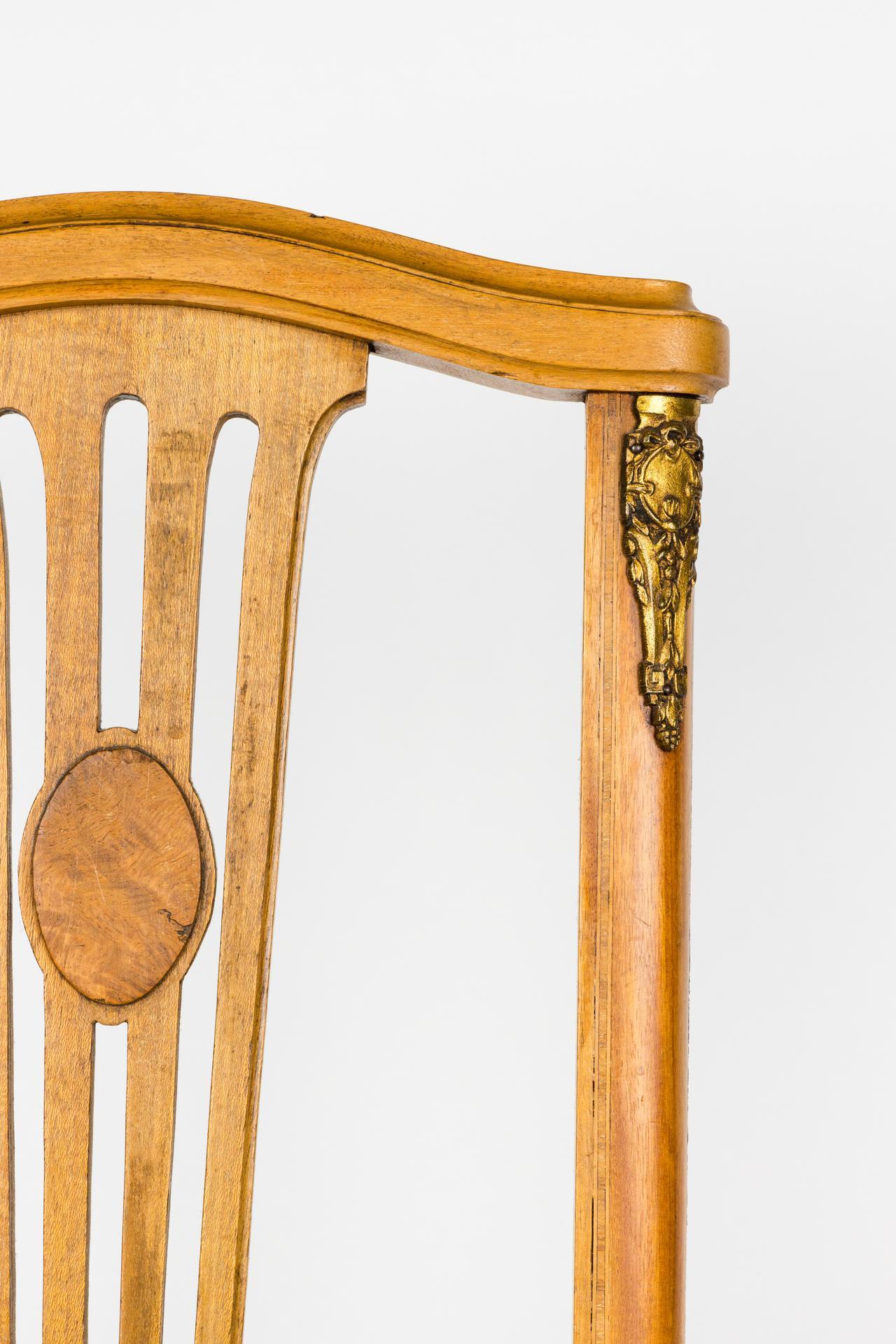
Office chair - Wood - Empire style


02
days
17
hours
55
minutes
31
seconds
Starting bid
€ 1
Reserve price not met

Expert
Selected by Paul Wullems
He accumulated 18 years' experience, worked as junior specialist at Sotheby’s and managed Kunsthandel Jacques Fijnaut.
Estimate € 500 - € 800
No bids placed
Catawiki Buyer Protection
Your payment’s safe with us until you receive your object.View details
Trustpilot 4.4 | 139338 reviews
Rated Excellent on Trustpilot.
Napoleon III era office chair from France, circa 1860–1880, made of ebonized oak with brown natural leather upholstery, in the Second Empire historicist style, 83 × 60 × 50 cm, in good used condition with minor signs of wear.
AI-assisted summary
Description from the seller
Napoleon III Office Chair. French, from the Napoleonic era, second half of the 19th century, circa 1860–1880, executed in ebonized oak, designed as an office chair in correspondence with the Napoléon III escritoire to which it originally belonged. It features a robust and enveloping structure, in the historicist taste characteristic of the Second French Empire, combining Classical and Neo-Renaissance references with abundant decoration and strong sculptural presence. The backrest, low and enveloping, extends laterally to form the arms, with a cut top finish and richly ornamented detailing. In the center stands a stylized palmette in relief, flanked by rosettes, scrolls and incised and carved vegetal motifs, arranged symmetrically. The ends of the arms are marked by sculptural and framed elements, giving greater architectural richness to the composition. The arm supports feature a vertical, stepped design, with moldings and carved ornaments, extending into a structure of solid lines typical of French desk furniture of the Napoleon III period. The back and seat are upholstered in natural brown leather, with a warm tone, applied over the wooden frame and finished with decorative metal tacks. The seat, generously sized and with a slightly rounded profile, conveys the comfortable and representative character of the piece. The front waist, of curved configuration, presents rich carved decoration, with palmettes, flowers, rosettes, volutes and vegetal motifs, in a coherent composition with the other ornamental elements of the chair. It rests on four legs, the front ones being turned and carved, with the upper bulbous section decorated with stylized leaves, continuing into tapered shafts enriched by incised motifs and ending in small turned feet. The rear legs have a simpler configuration, suited to the stability of the structure. The ebonizing of the oak, combined with the brown tone of the leather and the richness of the carving, gives the piece a sober and monumental appearance, fully integrated into the decorative taste of the Second Empire, a period in which French furniture blended diverse historic repertoires with a pronounced taste for ornament and luxury. The correspondence with the Napoléon III escretoire to which it belonged reinforces the importance of the piece, allowing it to be interpreted as an integral part of an imposing office furniture set originally intended for a prestigious study. It shows signs of use consistent with age, wear of the ebonizing and leather, small marks and scratches. The seat shows a tear/damage visible in the leather covering, a conservation intervention is recommended.
Origin: France
Era: Second half of the 19th century, 1860–1880
Style: Napoléon III / Second Empire
Wood: Ebonized oak
Upholstery: Natural brown leather
Decoration: Carved vegetal motifs, palmettes, rosettes, scrolls and historicist motifs
Finials: Metal edging/tacking
Dimensions: 83 × 60 × 50 cm
Napoleon III Office Chair. French, from the Napoleonic era, second half of the 19th century, circa 1860–1880, executed in ebonized oak, designed as an office chair in correspondence with the Napoléon III escritoire to which it originally belonged. It features a robust and enveloping structure, in the historicist taste characteristic of the Second French Empire, combining Classical and Neo-Renaissance references with abundant decoration and strong sculptural presence. The backrest, low and enveloping, extends laterally to form the arms, with a cut top finish and richly ornamented detailing. In the center stands a stylized palmette in relief, flanked by rosettes, scrolls and incised and carved vegetal motifs, arranged symmetrically. The ends of the arms are marked by sculptural and framed elements, giving greater architectural richness to the composition. The arm supports feature a vertical, stepped design, with moldings and carved ornaments, extending into a structure of solid lines typical of French desk furniture of the Napoleon III period. The back and seat are upholstered in natural brown leather, with a warm tone, applied over the wooden frame and finished with decorative metal tacks. The seat, generously sized and with a slightly rounded profile, conveys the comfortable and representative character of the piece. The front waist, of curved configuration, presents rich carved decoration, with palmettes, flowers, rosettes, volutes and vegetal motifs, in a coherent composition with the other ornamental elements of the chair. It rests on four legs, the front ones being turned and carved, with the upper bulbous section decorated with stylized leaves, continuing into tapered shafts enriched by incised motifs and ending in small turned feet. The rear legs have a simpler configuration, suited to the stability of the structure. The ebonizing of the oak, combined with the brown tone of the leather and the richness of the carving, gives the piece a sober and monumental appearance, fully integrated into the decorative taste of the Second Empire, a period in which French furniture blended diverse historic repertoires with a pronounced taste for ornament and luxury. The correspondence with the Napoléon III escretoire to which it belonged reinforces the importance of the piece, allowing it to be interpreted as an integral part of an imposing office furniture set originally intended for a prestigious study. It shows signs of use consistent with age, wear of the ebonizing and leather, small marks and scratches. The seat shows a tear/damage visible in the leather covering, a conservation intervention is recommended.
Origin: France
Era: Second half of the 19th century, 1860–1880
Style: Napoléon III / Second Empire
Wood: Ebonized oak
Upholstery: Natural brown leather
Decoration: Carved vegetal motifs, palmettes, rosettes, scrolls and historicist motifs
Finials: Metal edging/tacking
Dimensions: 83 × 60 × 50 cm
Details
Era
1400-1900
Style subtype
Napoleon III
Over 200 years old
No
Title additional information
Empire style
Country of origin
France
Material
Wood
Style
Antique
Condition
Good condition - used with small signs of aging & blemishes
Height
83 cm
Width
60 cm
Depth
50 cm
Estimated period
1860-1880
Sold by