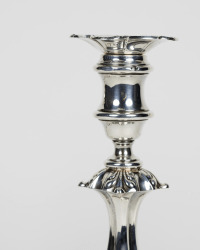
Guido Settepassi - Jug (4) - Silver


Starting bid
€ 1
Add to your favourites to get an alert when the auction starts.

Expert
Selected by Chiara Scotto Pasanisi dei Foscarini
Holds master’s in art business and decorative arts; exhibited at TEFAF Maastricht.
Estimate € 4,100 - € 5,000
Catawiki Buyer Protection
Your payment’s safe with us until you receive your object.View details
Trustpilot 4.4 | 139719 reviews
Rated Excellent on Trustpilot.
Description from the seller
Pair of carafes or jugs with a matching pair of dishes - in 800/1000 silver - Guido Settepassi, Florence, Italy. Italians, Florence, circa 1968–1975, an important dessert service consisting of a pair of carafes or jugs and their two dishes/basins, executed in 800/1000 silver, from the Florentine workshop of Guido Settepassi. The jugs feature an elegant ovoid body, inspired by historicism, raised on a fluted and stepped circular foot. The lower part of the body tapers progressively to the stem, marked by large vertical relief panels, giving the piece a strong vertical emphasis. The body is wrapped by a wide decorative band in relief, repoussé and chased, with an exuberant naturalistic bouquet of grape clusters, grape leaves, tendrils and vegetal scrolls, highlighted against a deliberately darkened background, creating a strong contrast with the smooth, polished silver surfaces. Above this band are successive rings and smooth borders, leading to a tall, narrow neck, also worked with large vertical, ribbed recesses. The neck is finished at the top by a delicate floral relief band, opening onto a wide, asymmetrical mouth that forms an especially pronounced, undulating, elegant pouring spout with a molded edge. Particularly distinctive are the tall, slender, very open ears, almost vegetal in shape, formed by a large upper arch and extended downward by a winding vine with small buds and foliate elements. This solution gives the pieces a strong sculptural and decorative character. The corresponding dishes/basins are circular, shallow, and of large diameter, with a wide rim and a center molded to accommodate the bases of the jugs. They feature rich engraved and chased decoration complementary to the ornamentation of the jugs. One dish predominantly features large scrolls and acanthus tendrils, while the other presents a denser composition of grape leaves and grape clusters, reinforcing the wine theme of the whole set. The decorative repertoire combines Neo-Rococo and Neobaroque elements, reinterpreted according to the historicist taste of Florentine goldsmithing in the second half of the 20th century. The surface treatment blends polished areas, darkened/oxidized backgrounds, and raised chased relief zones, producing a rich contrast. The pieces are marked with the “800” assay mark (silver 800/1000) and with the Italian “★ 460 FI” mark, associated with Guido Settepassi, Firenze, workshop registered in Florence from 1968. The presence of this mark allows dating the execution probably to the late 1960s to the first half of the 1970s. They show signs consistent with age and use, yet the set retains a good overall presence and strong decorative impact.
Origin: Florence, Italy.
Manufacturer: Guido Settepassi.
Mark: ★ 460 FI.
Title: silver 800/1000.
Era: circa 1968–1975.
Composition: 2 carafes/jugs + 2 dishes/basins.
Style: Historicist, Neo-Rococo / Neobaroque.
Decoration: grapevine, grape clusters, leaves, flowers, acanthus and scrolls.
Techniques: repoussé, chasing, engraving, casting and applying elements, polishing and darkening.
Dimensions: approximately 33 × 24 × 24 cm each set.
Total weight: 1,352 grams.
Pair of carafes or jugs with a matching pair of dishes - in 800/1000 silver - Guido Settepassi, Florence, Italy. Italians, Florence, circa 1968–1975, an important dessert service consisting of a pair of carafes or jugs and their two dishes/basins, executed in 800/1000 silver, from the Florentine workshop of Guido Settepassi. The jugs feature an elegant ovoid body, inspired by historicism, raised on a fluted and stepped circular foot. The lower part of the body tapers progressively to the stem, marked by large vertical relief panels, giving the piece a strong vertical emphasis. The body is wrapped by a wide decorative band in relief, repoussé and chased, with an exuberant naturalistic bouquet of grape clusters, grape leaves, tendrils and vegetal scrolls, highlighted against a deliberately darkened background, creating a strong contrast with the smooth, polished silver surfaces. Above this band are successive rings and smooth borders, leading to a tall, narrow neck, also worked with large vertical, ribbed recesses. The neck is finished at the top by a delicate floral relief band, opening onto a wide, asymmetrical mouth that forms an especially pronounced, undulating, elegant pouring spout with a molded edge. Particularly distinctive are the tall, slender, very open ears, almost vegetal in shape, formed by a large upper arch and extended downward by a winding vine with small buds and foliate elements. This solution gives the pieces a strong sculptural and decorative character. The corresponding dishes/basins are circular, shallow, and of large diameter, with a wide rim and a center molded to accommodate the bases of the jugs. They feature rich engraved and chased decoration complementary to the ornamentation of the jugs. One dish predominantly features large scrolls and acanthus tendrils, while the other presents a denser composition of grape leaves and grape clusters, reinforcing the wine theme of the whole set. The decorative repertoire combines Neo-Rococo and Neobaroque elements, reinterpreted according to the historicist taste of Florentine goldsmithing in the second half of the 20th century. The surface treatment blends polished areas, darkened/oxidized backgrounds, and raised chased relief zones, producing a rich contrast. The pieces are marked with the “800” assay mark (silver 800/1000) and with the Italian “★ 460 FI” mark, associated with Guido Settepassi, Firenze, workshop registered in Florence from 1968. The presence of this mark allows dating the execution probably to the late 1960s to the first half of the 1970s. They show signs consistent with age and use, yet the set retains a good overall presence and strong decorative impact.
Origin: Florence, Italy.
Manufacturer: Guido Settepassi.
Mark: ★ 460 FI.
Title: silver 800/1000.
Era: circa 1968–1975.
Composition: 2 carafes/jugs + 2 dishes/basins.
Style: Historicist, Neo-Rococo / Neobaroque.
Decoration: grapevine, grape clusters, leaves, flowers, acanthus and scrolls.
Techniques: repoussé, chasing, engraving, casting and applying elements, polishing and darkening.
Dimensions: approximately 33 × 24 × 24 cm each set.
Total weight: 1,352 grams.
Details
Era
1900-2000
Gross weight
1352 g
Number of objects
4
Country of origin
Italy
Manufacturer/brand
Guido Settepassi
Material
Silver
Condition
Good condition - used with small signs of ageing
Height
33 cm
Width
24 cm
Depth
24 cm
Estimated period
20th Century
Sold by