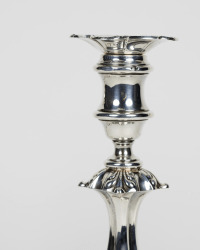
Cruet set - Silver, Glass - 1810 - 1822


05
days
21
hours
26
minutes
32
seconds
Starting bid
€ 1
Reserve price not met

Expert
Selected by Chiara Scotto Pasanisi dei Foscarini
Holds master’s in art business and decorative arts; exhibited at TEFAF Maastricht.
Estimate € 5,500 - € 6,100
No bids placed
Catawiki Buyer Protection
Your payment’s safe with us until you receive your object.View details
Trustpilot 4.4 | 139338 reviews
Rated Excellent on Trustpilot.
Description from the seller
Elegant Portuguese cruet set from the first half of the 19th century, of exceptional craftsmanship, composed of a raised and pierced silver frame and a set of glass cruets blown and cut, richly gilded with fine gold. The circular base, supported on an elevated foot, features an elaborate lacy neoclassical decoration, executed in pierced silver with geometric and vegetal motifs. At the center rises an elegant turned stem, topped by a movable cut-out wing, allowing the piece to be carried—a characteristic solution of presentation cruets produced in the early decades of the 19th century. The set retains four original transparent glass vessels intended for oil, vinegar, and condiments. The cruets feature delicate hand-applied gilded decoration, composed of friezes, garlands, stylized leaves, and floral motifs, complemented by equally decorated glass stoppers. The molded handles lend elegance and functionality to the ensemble. The silver frame bears the municipal marks of Lisbon from the assay master José Joaquim da Costa (L-38.0b), dated between 1810 and 1822, as well as the mark of the prestigious goldsmith Joaquim Prudêncio Vital Dinis, registered in 1812 and documented until 1852 (L-443.0), constituting an important testimony of late Georgian and Neoclassical Portuguese goldsmithing. Piece of high historical and collector interest, representative of the luxurious tables of the Portuguese aristocracy and upper middle class in the first half of the 19th century. Condition: Good overall, consistent with age. Shows signs of use; one of the glass stoppers is broken and two stoppers are missing, as described. The silver framework remains solid and well preserved.
Origin: Portugal
Era: 1st half of the 19th century (1810–1822)
Material: Silver and blown glass with gold decoration
Marks: Lisbon, assay master José Joaquim da Costa (L-38.0b)
Goldsmith: Joaquim Prudêncio Vital Dinis (L-443.0)
Silver weight: 2,506.3 grams
Height: 31 cm
Estimated market value
Elegant Portuguese cruet set from the first half of the 19th century, of exceptional craftsmanship, composed of a raised and pierced silver frame and a set of glass cruets blown and cut, richly gilded with fine gold. The circular base, supported on an elevated foot, features an elaborate lacy neoclassical decoration, executed in pierced silver with geometric and vegetal motifs. At the center rises an elegant turned stem, topped by a movable cut-out wing, allowing the piece to be carried—a characteristic solution of presentation cruets produced in the early decades of the 19th century. The set retains four original transparent glass vessels intended for oil, vinegar, and condiments. The cruets feature delicate hand-applied gilded decoration, composed of friezes, garlands, stylized leaves, and floral motifs, complemented by equally decorated glass stoppers. The molded handles lend elegance and functionality to the ensemble. The silver frame bears the municipal marks of Lisbon from the assay master José Joaquim da Costa (L-38.0b), dated between 1810 and 1822, as well as the mark of the prestigious goldsmith Joaquim Prudêncio Vital Dinis, registered in 1812 and documented until 1852 (L-443.0), constituting an important testimony of late Georgian and Neoclassical Portuguese goldsmithing. Piece of high historical and collector interest, representative of the luxurious tables of the Portuguese aristocracy and upper middle class in the first half of the 19th century. Condition: Good overall, consistent with age. Shows signs of use; one of the glass stoppers is broken and two stoppers are missing, as described. The silver framework remains solid and well preserved.
Origin: Portugal
Era: 1st half of the 19th century (1810–1822)
Material: Silver and blown glass with gold decoration
Marks: Lisbon, assay master José Joaquim da Costa (L-38.0b)
Goldsmith: Joaquim Prudêncio Vital Dinis (L-443.0)
Silver weight: 2,506.3 grams
Height: 31 cm
Estimated market value
Details
Era
1400-1900
Gross weight
2506 g
Title additional information
1810 - 1822
Country of origin
Portugal
Material
Glass, Silver
Condition
Good condition - used with small signs of ageing
Height
31 cm
Width
22 cm
Depth
22 cm
Estimated period
1800-1850
Sold by