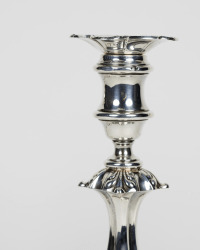
Figure - Virgen en Pedestal - Silver, Marble


05
days
06
hours
30
minutes
52
seconds
Starting bid
€ 1
Reserve price not met

Expert
Selected by Chiara Scotto Pasanisi dei Foscarini
Holds master’s in art business and decorative arts; exhibited at TEFAF Maastricht.
Estimate € 1,400 - € 1,600
No bids placed
Catawiki Buyer Protection
Your payment’s safe with us until you receive your object.View details
Trustpilot 4.4 | 139647 reviews
Rated Excellent on Trustpilot.
Description from the seller
It is a 19th-century silver Virgin that concentrates all the drama contained and the elegant theatricality of Baroque art reinterpreted in a devotional key. The figure, weighing about 400 grams of silver, not counting the internal structure or the base, rises with solemn verticality: the mantle falls in deep, almost architectural folds that wrap the body like a metallic cascade, while the tunic hints at a gentle movement, more spiritual than physical.
The face, serene and slightly inclined, responds to the late Baroque canon: full cheeks, a lowered gaze, a sweetness that is not ingenuous but meditative. The Child, held with firmness and tenderness, presents the same meticulous craft, with burin-worked hair and a small yet proportioned anatomy, typical of the peninsular workshops of the 19th century that followed models from the previous century.
The pedestal, of independent structure, acts as a counterpoint: it elevates the figure and separates it from the everyday world, reinforcing its character as an object of worship. The silver, with its restrained shine and ancient patina, provides a noble presence, almost liturgical, reminiscent of processional images in smaller formats or of pieces intended for private oratories.
Taken together, it is a work that blends devotion, craftsmanship, and Baroque theatricality—a sculpture designed to accompany silently, with the symbolic density and sober beauty of antique metalwork.
Shipped with tracking and careful packaging.
Seller's Story
Vintage Shop SL is a prominent antique store that since 2010 has been committed to customer satisfaction and sustainability. This shop is not only a cultural treasure that preserves the history and heritage of our societies, but also strives to operate in a sustainable and environmentally responsible manner.
At Vintage Shop SL, we believe that customer service is essential to our success. Our highly trained team is dedicated to providing friendly, knowledgeable, and personalized service. We take pride in helping our customers find the perfect vintage pieces that fit their individual tastes and needs, ensuring their satisfaction and fostering lasting relationships.
But that's not all. At Vintage Shop SL, we also care about the sustainability of the business and its impact on the natural environment. We are committed to reducing our carbon footprint and promoting responsible business practices.
On the one hand, we promote the circular economy and reuse by offering vintage items in excellent condition. By acquiring antiques at our shop, customers contribute to the conservation of natural resources by avoiding the production of new items and reducing the carbon emissions associated with manufacturing and transportation.
Translated by Google TranslateIt is a 19th-century silver Virgin that concentrates all the drama contained and the elegant theatricality of Baroque art reinterpreted in a devotional key. The figure, weighing about 400 grams of silver, not counting the internal structure or the base, rises with solemn verticality: the mantle falls in deep, almost architectural folds that wrap the body like a metallic cascade, while the tunic hints at a gentle movement, more spiritual than physical.
The face, serene and slightly inclined, responds to the late Baroque canon: full cheeks, a lowered gaze, a sweetness that is not ingenuous but meditative. The Child, held with firmness and tenderness, presents the same meticulous craft, with burin-worked hair and a small yet proportioned anatomy, typical of the peninsular workshops of the 19th century that followed models from the previous century.
The pedestal, of independent structure, acts as a counterpoint: it elevates the figure and separates it from the everyday world, reinforcing its character as an object of worship. The silver, with its restrained shine and ancient patina, provides a noble presence, almost liturgical, reminiscent of processional images in smaller formats or of pieces intended for private oratories.
Taken together, it is a work that blends devotion, craftsmanship, and Baroque theatricality—a sculpture designed to accompany silently, with the symbolic density and sober beauty of antique metalwork.
Shipped with tracking and careful packaging.
Seller's Story
Vintage Shop SL is a prominent antique store that since 2010 has been committed to customer satisfaction and sustainability. This shop is not only a cultural treasure that preserves the history and heritage of our societies, but also strives to operate in a sustainable and environmentally responsible manner.
At Vintage Shop SL, we believe that customer service is essential to our success. Our highly trained team is dedicated to providing friendly, knowledgeable, and personalized service. We take pride in helping our customers find the perfect vintage pieces that fit their individual tastes and needs, ensuring their satisfaction and fostering lasting relationships.
But that's not all. At Vintage Shop SL, we also care about the sustainability of the business and its impact on the natural environment. We are committed to reducing our carbon footprint and promoting responsible business practices.
On the one hand, we promote the circular economy and reuse by offering vintage items in excellent condition. By acquiring antiques at our shop, customers contribute to the conservation of natural resources by avoiding the production of new items and reducing the carbon emissions associated with manufacturing and transportation.
Translated by Google TranslateDetails
Era
1400-1900
Gross weight
3 kg
Title
Virgen en Pedestal
Country of origin
Spain
Material
Marble, Silver
Condition
Good condition - used with small signs of aging & blemishes
Height
45 cm
Width
23 cm
Depth
23 cm
Estimated period
1850-1900
Sold by