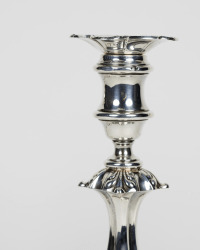
Chalice - Silver


Starting bid
€ 1
Add to your favourites to get an alert when the auction starts.

Expert
Selected by Chiara Scotto Pasanisi dei Foscarini
Holds master’s in art business and decorative arts; exhibited at TEFAF Maastricht.
Estimate € 2,800 - € 3,300
Catawiki Buyer Protection
Your payment’s safe with us until you receive your object.View details
Trustpilot 4.4 | 139719 reviews
Rated Excellent on Trustpilot.
Description from the seller
LITURGICAL CALICE IN SILVER
Gioacchino Belli
Rome, 1815–circa 1822
Main attribution based on stamping, technical characteristics, and stylistic influence
CATALOG DATA
Artist / workshop: Gioacchino Belli, main attribution
Place of execution: Rome
Chronology: circa 1815–1822
Object: Liturgical chalice
Material: Silver, with gilding on the interior
Technique: Plateworking, turning, repoussé, chasing, and gilding
Height: 26.5 cm
Cup diameter: 8.5 cm
Base diameter: 13 cm
Weight: 422 g
Stamping: workshop stamp G11B and the papal chamber mark post-1815, impressed in multiple points of the work
Condition: Good, with normal signs of use, oxidation; interior gilding preserved
DESCRIPTION
Elegant silver liturgical chalice, with harmonious and slender proportions, characterized by a refined neoclassical decorative program, where the sobriety of the structure combines with an ornamental repertory of late eighteenth-century derivation.
The cup, with a slightly truncated-conical, flared form, features at the lower part a continuous ornamental band composed of lanceolate leaves, embossed and finely chased. The decoration develops in a regular, orderly rhythm, enhancing the metal surface and emphasizing the transition to the underneath-fountain. A circular, clear, well-marked molding links the cup to the underlying structure.
The underneath-fountain repeats the cup’s ornamental language and introduces the transition to the stem through a calibrated sequence of moulded elements and circular joints.
The stem, articulated in several turned and moulded elements, is built through a succession of circular profiles, joints, and bulbous forms that give the whole a balanced vertical flow. The vegetal decoration, together with the rigorous spacing of the mouldings, highlights the neoclassical character of the object.
The base, wide, circular, and stepped, presents a continuous ornamental band with lanceolate leaves and palmette motifs. The central field, smooth and slightly bulged, creates an effective contrast with the decorated band and lends the base a visually solid yet elegant structure.
The interior of the cup is gilded, in keeping with the traditional liturgical purpose of the object. The exterior surface bears a patina of use and widespread traces of manual workmanship, particularly legible in the decorated areas, elements that contribute to the sense of authenticity and the artisanal quality of the work.
HALLMARKS
The chalice bears multiple marks stamped on the cup, the undersupport, and the base, a feature of particular interest for identification and dating of the work.
Among the marks is recognizable the workshop mark G11B, accompanied by the papal chamber mark introduced with the 1815 hallmark reform.
The presence of this marks system constitutes an important chronological element and allows dating the object within Roman silverware produced after 1815.
It should be noted that the G11B mark is documented in relation to Gioacchino Belli’s workshop and was also used by his son Pietro Belli in the period immediately after the father’s death.
This circumstance theoretically makes a dating as late as circa 1825 possible. However, in the specific case of this chalice, the overall stylistic and technical characteristics — the quality of the vegetal ornament, the neoclassical structuring, the organization of the mouldings, and the balanced relationship between decoration and architectural framework — make a realization in the Gioacchino Belli production, and particularly in the period between 1815 and 1822, more plausible.
Proposed attribution
Gioacchino Belli, main attribution
Rome, circa 1815–1822
HISTORICAL-ARTISTIC FRAME
The chalice falls within the production of Roman silverware in the early decades of the nineteenth century, a phase marked by the progressive affirmation of neoclassical taste, alongside the persistence of late eighteenth-century ornamental motifs.
The object’s structure, strictly articulated through mouldings and geometric profiles, is enriched by a vegetal repertoire composed mainly of lanceolate leaves and palmette motifs. The decoration does not overshadow the architectural structure of the chalice but integrates harmoniously with it, according to a principle of balance particularly significant for neoclassical culture.
The construction of the stem, the breadth of the base, and the orderly spacing of the various parts confer the piece an elegant, solemn, and liturgically functional character.
The quality of repoussé and chasing, together with the turning of the structural elements and the interior gilding of the cup, reveals a production of artisanal quality.
CONDITION
The chalice is in good condition for its age and intended use.
Normal signs of use, oxidation, and the natural traces of manual workmanship are present. The repoussé and chasing decoration is overall legible and well preserved.
The interior gilding of the cup is preserved, maintaining the object’s original liturgical function.
LITURGICAL CALICE IN SILVER
Gioacchino Belli
Rome, 1815–circa 1822
Main attribution based on stamping, technical characteristics, and stylistic influence
CATALOG DATA
Artist / workshop: Gioacchino Belli, main attribution
Place of execution: Rome
Chronology: circa 1815–1822
Object: Liturgical chalice
Material: Silver, with gilding on the interior
Technique: Plateworking, turning, repoussé, chasing, and gilding
Height: 26.5 cm
Cup diameter: 8.5 cm
Base diameter: 13 cm
Weight: 422 g
Stamping: workshop stamp G11B and the papal chamber mark post-1815, impressed in multiple points of the work
Condition: Good, with normal signs of use, oxidation; interior gilding preserved
DESCRIPTION
Elegant silver liturgical chalice, with harmonious and slender proportions, characterized by a refined neoclassical decorative program, where the sobriety of the structure combines with an ornamental repertory of late eighteenth-century derivation.
The cup, with a slightly truncated-conical, flared form, features at the lower part a continuous ornamental band composed of lanceolate leaves, embossed and finely chased. The decoration develops in a regular, orderly rhythm, enhancing the metal surface and emphasizing the transition to the underneath-fountain. A circular, clear, well-marked molding links the cup to the underlying structure.
The underneath-fountain repeats the cup’s ornamental language and introduces the transition to the stem through a calibrated sequence of moulded elements and circular joints.
The stem, articulated in several turned and moulded elements, is built through a succession of circular profiles, joints, and bulbous forms that give the whole a balanced vertical flow. The vegetal decoration, together with the rigorous spacing of the mouldings, highlights the neoclassical character of the object.
The base, wide, circular, and stepped, presents a continuous ornamental band with lanceolate leaves and palmette motifs. The central field, smooth and slightly bulged, creates an effective contrast with the decorated band and lends the base a visually solid yet elegant structure.
The interior of the cup is gilded, in keeping with the traditional liturgical purpose of the object. The exterior surface bears a patina of use and widespread traces of manual workmanship, particularly legible in the decorated areas, elements that contribute to the sense of authenticity and the artisanal quality of the work.
HALLMARKS
The chalice bears multiple marks stamped on the cup, the undersupport, and the base, a feature of particular interest for identification and dating of the work.
Among the marks is recognizable the workshop mark G11B, accompanied by the papal chamber mark introduced with the 1815 hallmark reform.
The presence of this marks system constitutes an important chronological element and allows dating the object within Roman silverware produced after 1815.
It should be noted that the G11B mark is documented in relation to Gioacchino Belli’s workshop and was also used by his son Pietro Belli in the period immediately after the father’s death.
This circumstance theoretically makes a dating as late as circa 1825 possible. However, in the specific case of this chalice, the overall stylistic and technical characteristics — the quality of the vegetal ornament, the neoclassical structuring, the organization of the mouldings, and the balanced relationship between decoration and architectural framework — make a realization in the Gioacchino Belli production, and particularly in the period between 1815 and 1822, more plausible.
Proposed attribution
Gioacchino Belli, main attribution
Rome, circa 1815–1822
HISTORICAL-ARTISTIC FRAME
The chalice falls within the production of Roman silverware in the early decades of the nineteenth century, a phase marked by the progressive affirmation of neoclassical taste, alongside the persistence of late eighteenth-century ornamental motifs.
The object’s structure, strictly articulated through mouldings and geometric profiles, is enriched by a vegetal repertoire composed mainly of lanceolate leaves and palmette motifs. The decoration does not overshadow the architectural structure of the chalice but integrates harmoniously with it, according to a principle of balance particularly significant for neoclassical culture.
The construction of the stem, the breadth of the base, and the orderly spacing of the various parts confer the piece an elegant, solemn, and liturgically functional character.
The quality of repoussé and chasing, together with the turning of the structural elements and the interior gilding of the cup, reveals a production of artisanal quality.
CONDITION
The chalice is in good condition for its age and intended use.
Normal signs of use, oxidation, and the natural traces of manual workmanship are present. The repoussé and chasing decoration is overall legible and well preserved.
The interior gilding of the cup is preserved, maintaining the object’s original liturgical function.
Details
Era
1400-1900
Style subtype
Neo-Classicism
Gross weight
422 g
Specific region of origin
Roma
Country of origin
Italy
Material
Silver
Style
Antique
Colour
Gold, Silver
Condition
Good condition - used with small signs of ageing
Height
26.5 cm
Width
0 cm
Diameter
13 cm
Depth
8.5 cm
Estimated period
1800-1850
Sold by