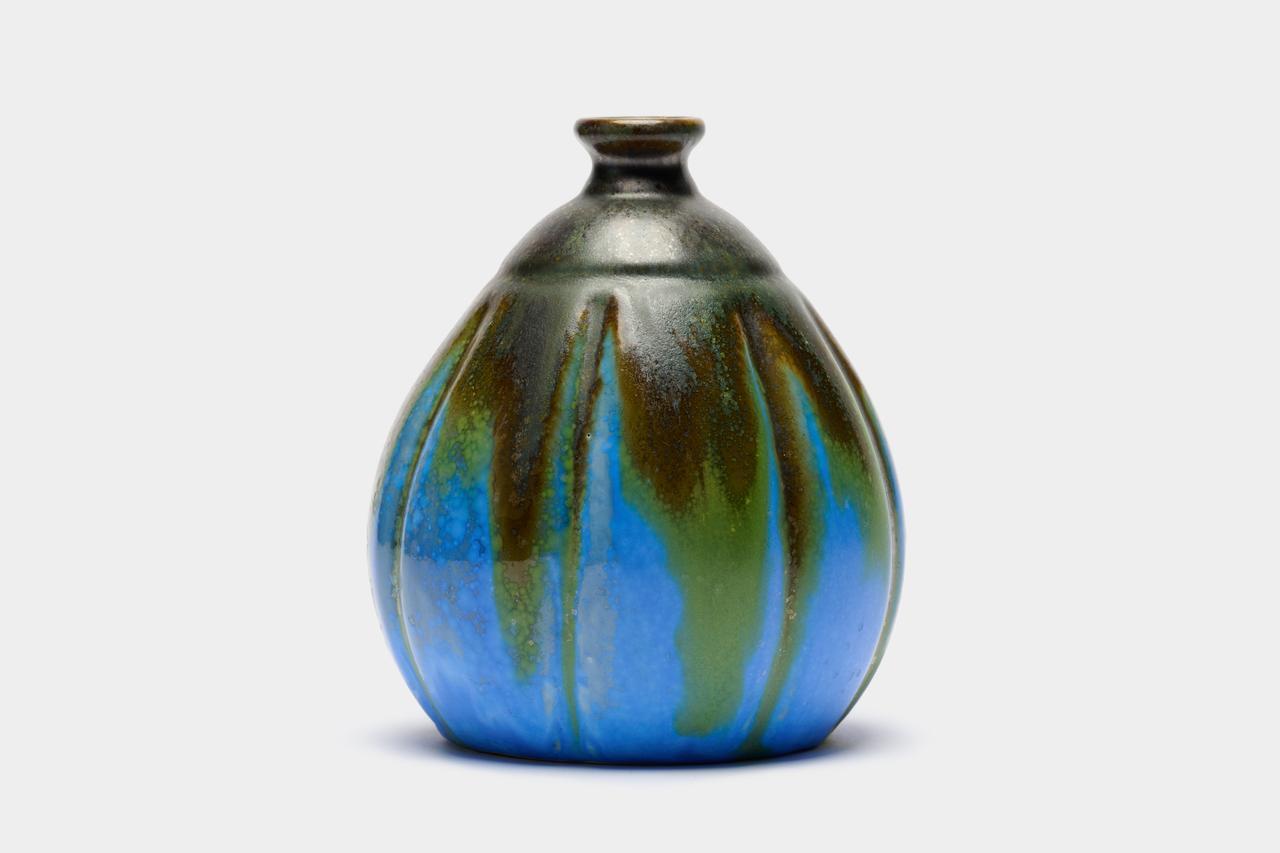
Giulia Mangani - Vase - W10089 - Porcelain


Starting bid
€ 1
Add to your favourites to get an alert when the auction starts.

Expert
Selected by Florentin Brunz Gaborieau
Holds a master’s in Art History, specialising in Second French Empire and Dutch Golden Age.
Estimate € 350 - € 400
Catawiki Buyer Protection
Your payment’s safe with us until you receive your object.View details
Trustpilot 4.4 | 140009 reviews
Rated Excellent on Trustpilot.
Description from the seller
Ornamental amphora-shaped vase with two-toned body, made in Paris porcelain (often defined as Vieux Paris) or in the Sèvres style, dating from the 19th century (Empire or Restoration period).
Vase characteristics:
Shape and Structure: The central body is ovoid with a flared neck. The piece rests on a stemmed foot that ends with a square base (plinth).
Handles: The two side handles are gilded and feature decorative plastic motifs with figural or zoomorphic designs (frequently lion heads, sphinxes, or classical elements).
Painted decoration: In the center there is a hand-painted medallion or reserve showing a bucolic/agrestic landscape inspired by Italy, complete with ancient architectures (castles or villas), trees, and a body of water.
Finishes: The vase is richly decorated with bright and matte gilt gold, embellished by continuous geometric wave motifs (Greek-key/volutes) along the edges of the reserve and by vegetal palmette motifs on the neck and base.
Back features:
Subject: At the center of the medallion stands a bouquet of field and garden flowers (including roses, anemones, and small blue and yellow flowers) painted by hand.
Period use: In neoclassical and Empire amphorae of Mangani manufacture, the alternation between landscape and flowers was designed to offer two different display options depending on taste or placement in the room.
Structural details: The gilded finishes, the geometric volute motif, and the lion-head handle shapes maintain perfect symmetry with respect to the front side.
Height: 40 cm
Width (maximum span at the handles): 26 cm
Ornamental amphora-shaped vase with two-toned body, made in Paris porcelain (often defined as Vieux Paris) or in the Sèvres style, dating from the 19th century (Empire or Restoration period).
Vase characteristics:
Shape and Structure: The central body is ovoid with a flared neck. The piece rests on a stemmed foot that ends with a square base (plinth).
Handles: The two side handles are gilded and feature decorative plastic motifs with figural or zoomorphic designs (frequently lion heads, sphinxes, or classical elements).
Painted decoration: In the center there is a hand-painted medallion or reserve showing a bucolic/agrestic landscape inspired by Italy, complete with ancient architectures (castles or villas), trees, and a body of water.
Finishes: The vase is richly decorated with bright and matte gilt gold, embellished by continuous geometric wave motifs (Greek-key/volutes) along the edges of the reserve and by vegetal palmette motifs on the neck and base.
Back features:
Subject: At the center of the medallion stands a bouquet of field and garden flowers (including roses, anemones, and small blue and yellow flowers) painted by hand.
Period use: In neoclassical and Empire amphorae of Mangani manufacture, the alternation between landscape and flowers was designed to offer two different display options depending on taste or placement in the room.
Structural details: The gilded finishes, the geometric volute motif, and the lion-head handle shapes maintain perfect symmetry with respect to the front side.
Height: 40 cm
Width (maximum span at the handles): 26 cm
Details
Era
1900-2000
Weight
3 g
Number of objects
1
Country of origin
Italy
Model
W10089
Material
Porcelain
Manufacturer/brand
Giulia Mangani
Condition
As new - unused
Height
40 cm
Width
26 cm
Depth
26 cm
Estimated period
1970-1980
Sold by