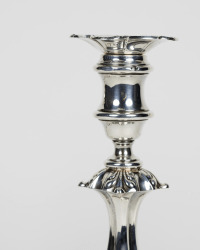
Sugar bowl (2) - .800 silver


07
days
21
hours
23
minutes
57
seconds
Starting bid
€ 1
Reserve price not met

Expert
Selected by Chiara Scotto Pasanisi dei Foscarini
Holds master’s in art business and decorative arts; exhibited at TEFAF Maastricht.
Estimate € 280 - € 350
No bids placed
Catawiki Buyer Protection
Your payment’s safe with us until you receive your object.View details
Trustpilot 4.4 | 141663 reviews
Rated Excellent on Trustpilot.
Set comprising a solid 800 silver sugar shaker from Florence with Empire/Neoclassical decoration and a matching heavy-plated paletta spoon, dating to the 1950s–1960s, shaker diameter and height 13.5 cm, weight 99 g, with OLRI factory mark on the spoon and a 800 silver hallmark on the shaker; condition good to excellent with light wear and natural patina from oxidation.
AI-assisted summary
Description from the seller
Description: The set consists of an antique sugar shaker finely worked with beading, complemented by two side volute handles and a lid topped by a figurative fusion knob, paired with a spoon with a shaped handle.
Material: Sugar shaker: solid 800 silver, guaranteed by antique hallmarks.
Spoon: High-thickness metal with silver-plating (Silverplate).
Punching and Marking: On the Sugar Shaker (outer edge): Presence of the 800 fineness mark and the manufacturer's identifying initials 386 FI. Both stamps are manually impressed "bare" directly onto the metal sheet in an open field, without modern geometric outlines (lozenges or diamonds), as evidence of artisanal antique stamping, but they are overlapped, hence unclear.
On the Spoon (back of the handle): Factory mark inserted in an oval cartouche bearing the name OLRI, official designation of the Milanese Olri Italy manufactory.
Style: Empire / Neoclassical, characterized by vertically fluted symmetric ribs running along the body, slender lines and curved handles worked into scrolls.
Period: 1960s, identifiable by the punching technique prior to the 1968 reforms.
Manufacturer / Workshop: Sugar shaker: Made in Florence (FI). The punch 386 FI without the star may correspond to the silversmith Masti Renato.
Spoon: Produced in Milan by the historic Olri Italy brand (related to the high-end Padua manufactory Calegaro).
Weight: 99 grams (referring to the sugar shaker alone in solid silver).
Dimensions: Sugar shaker: Maximum diameter 13.5 cm; Height 13.5 cm.
Condition: Good/Excellent. Structure and beading perfectly intact, free of dents. There is widespread natural oxidation from sulfation (surface tarnish typical of antique silver), which can be removed with targeted cleaning or left to emphasize the relief of the decorations.
Description: The set consists of an antique sugar shaker finely worked with beading, complemented by two side volute handles and a lid topped by a figurative fusion knob, paired with a spoon with a shaped handle.
Material: Sugar shaker: solid 800 silver, guaranteed by antique hallmarks.
Spoon: High-thickness metal with silver-plating (Silverplate).
Punching and Marking: On the Sugar Shaker (outer edge): Presence of the 800 fineness mark and the manufacturer's identifying initials 386 FI. Both stamps are manually impressed "bare" directly onto the metal sheet in an open field, without modern geometric outlines (lozenges or diamonds), as evidence of artisanal antique stamping, but they are overlapped, hence unclear.
On the Spoon (back of the handle): Factory mark inserted in an oval cartouche bearing the name OLRI, official designation of the Milanese Olri Italy manufactory.
Style: Empire / Neoclassical, characterized by vertically fluted symmetric ribs running along the body, slender lines and curved handles worked into scrolls.
Period: 1960s, identifiable by the punching technique prior to the 1968 reforms.
Manufacturer / Workshop: Sugar shaker: Made in Florence (FI). The punch 386 FI without the star may correspond to the silversmith Masti Renato.
Spoon: Produced in Milan by the historic Olri Italy brand (related to the high-end Padua manufactory Calegaro).
Weight: 99 grams (referring to the sugar shaker alone in solid silver).
Dimensions: Sugar shaker: Maximum diameter 13.5 cm; Height 13.5 cm.
Condition: Good/Excellent. Structure and beading perfectly intact, free of dents. There is widespread natural oxidation from sulfation (surface tarnish typical of antique silver), which can be removed with targeted cleaning or left to emphasize the relief of the decorations.
Details
Era
1900-2000
Style subtype
Empire
Gross weight
113 g
Silver type
.800 silver
Specific region of origin
Toscana
Number of objects
2
Country of origin
Italy
Material
Silver
Style
Antique
Colour
Silver
Condition
Excellent condition: barely used with minimal signs of wear
Height
13.5 cm
Width
13.5 cm
Depth
13.5 cm
Estimated period
1950-1960
Sold by