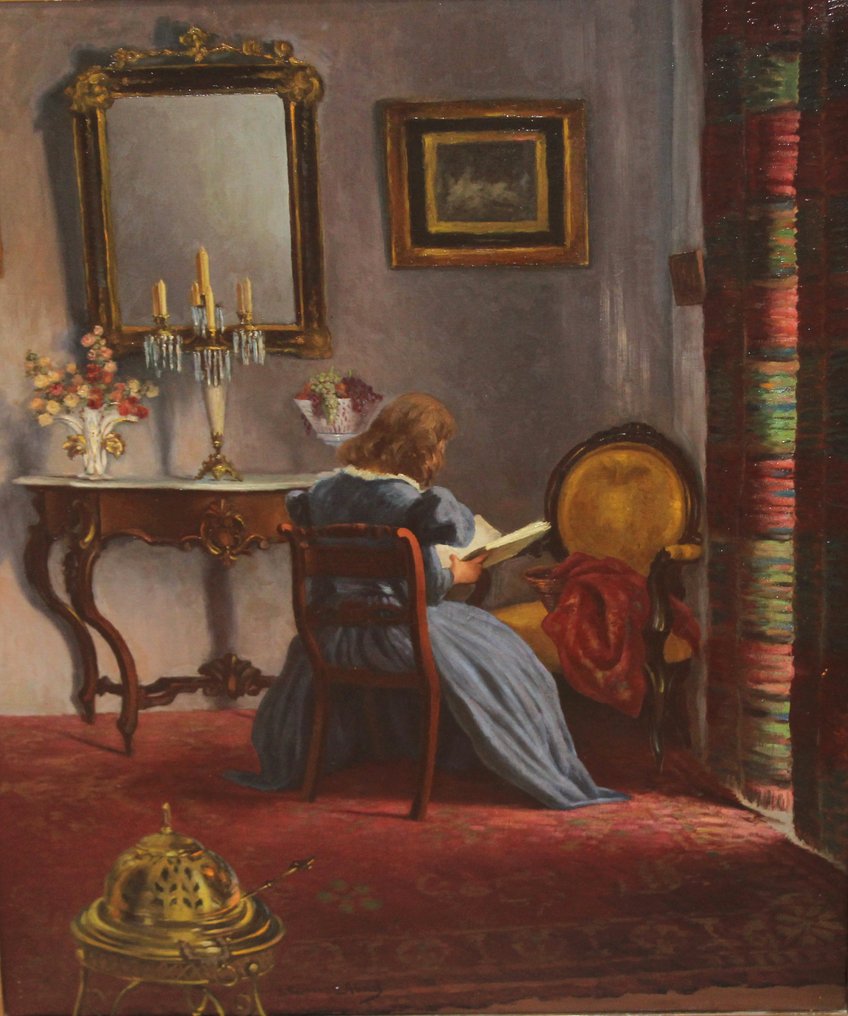
José Gómez Abad (1904-1993) - Interior con dama leyendo


09
days
00
hours
57
minutes
19
seconds
Current bid
€ 1
Reserve price not met

Expert
Selected by Caroline Bokobza
Graduated as French auctioneer and worked in Sotheby’s Paris valuation department.
Estimate € 800 - € 1,000
 | €1 |
|---|
Catawiki Buyer Protection
Your payment’s safe with us until you receive your object.View details
Trustpilot 4.4 | 140462 reviews
Rated Excellent on Trustpilot.
Interior con dama leyendo, an oil painting by José Gómez Abad (1946) from the 1940–1950 period, Spain, sold with frame by Galería; measures 95 × 80 cm, original edition, signed by the artist and dated 1946, in acceptable condition.
AI-assisted summary
Description from the seller
Signed by the artist on the bottom and dated 1946
On the back, it is signed again
Dimensions of the artwork: 81 x 65 cm.
Dimensions of the artwork: 95 x 80 cm.
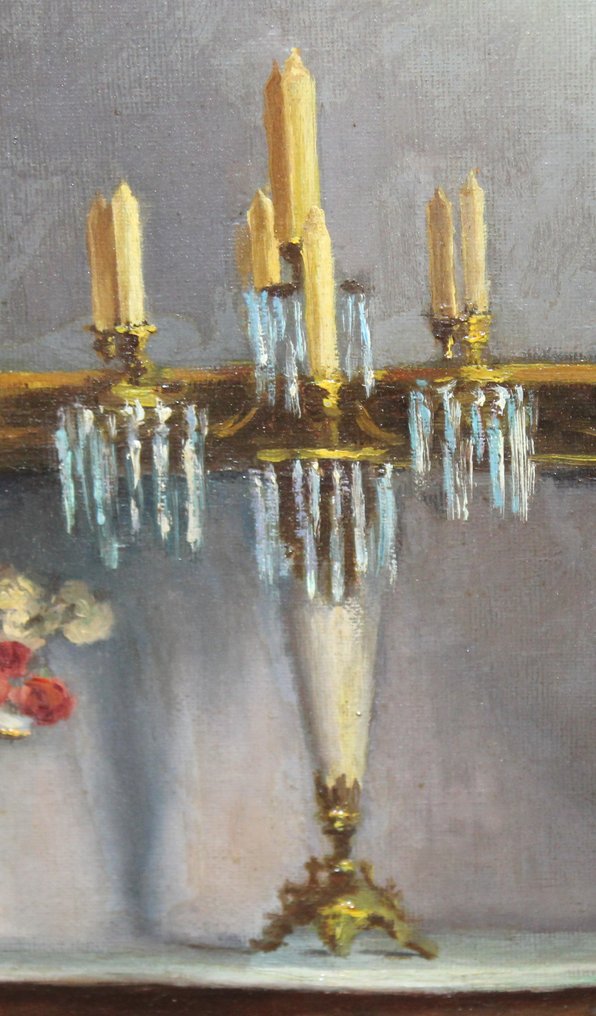
The work is presented framed (the frame has a break in the top-left corner and some others distributed across the piece)
Good condition of preservation of the work
::::::::::::::::::::::::::::::::::::::::::::::::::::
BIOGRAPHY OF JOSE GÓMEZ ABAD (Pechina, 1904 - Almería, 1993)
Painter. Known as the painter of the grapes and his accomplished still lifes, he has become a prophet in his homeland and is considered one of the most recognized figurative painters of Almería in the 20th century. As a child he attended an art academy located on Real Street, but he soon left classes to enter the workforce; this lack of formal training has always given him the definition of autodidact that he himself proclaimed. He was not fully satisfied with work, and as early as 1931 he went to Madrid, where he began to paint. On his return he decided to exhibit in a shop in Almería and, in 1936, taking advantage of a trip to Barcelona, he first exhibited at the Layetana Gallery. The Civil War broke out and he had to leave everything to move to Valencia and then to Almería. After the war, he returned to work and moved to Barcelona (1941) with 6 paintings that were quickly sold again at the Layetana Gallery. On returning to Almería he decided to quit his job to devote himself entirely to painting and, in 1942, he returned to Barcelona with great public and critical success. In the 1940s he continued to show his work mainly in Barcelona, at Sala Augusta or at the Layetana Gallery. One of his first exhibitions in Almería was in 1942, in the hall of the Provincial Delegation of the Vicesecretariat of Popular Education. Even in these early works his definitive style is solidified: still lifes of fruits or game, where marine elements are included. The profile of his drawing gradually solidified and acquired the virtuosity that has characterized him. Jesús Perceval, in the early Indaliano Movement, included him in the first group exhibitions they held and even exhibited in the Indaliana show at the Museo Nacional de Arte Moderno (Madrid, 1947). However, Indalian aesthetic principles were far from Gómez Abad's “still lifes,” his lack of immersion in Mediterranean light; and his ideological and even chronological separation, since he was much older than the rest of the painters. Perhaps for this reason he ceased to be considered as such and remained faithful to his bodegón style, where there is something more than a mere copying exactness, recreating textures, fragrances and textures. Many objects are his source of inspiration: baskets, tablecloths, seafood, furniture, game, flowers... but his fruits stand out, especially grapes, which with undeniable mastery he presents full of chromaticity, transparency and simplicity, where meticulousness and care transcend the very reality of the bunch.
In 1952 he held an exhibition at the Villaespesa Library in Almería where he mainly used oil-based inks, drawing on a smooth metal plate with printing ink and then stamping it onto paper. This unique work was called a “monotype.” Between the 1950s and 1970s he exhibited in numerous cities: Granada, Vitoria, Barcelona, Zaragoza, Bilbao (1969)... and, of course, in Almería, at the Casino Cultural, Círculo Mercantil... always faithful to his aesthetic principles of a meticulous painter, creating true miniatures of large format. In 1962 he won the Bronze Palm at the first painting competition of Southeast Spain, in Elche.
In Almería his exhibitions were a total success with the public and critics, most of them in August, so his paintings gradually acquired a cosmopolitan character. In 1979 a retrospective of his work was held, given the character of his “golden weddings” in painting, which became a tribute to his personal and artistic figure, receiving laudatory articles from the era's most important critics. On this occasion a monographic Art Notebook was published with 140 pages of texts and photographs covering his entire artistic background, along with comments and critiques from the art critics of the time. His painting seems timeless and his works, with slight variations, continue to be a great attraction for the public in Almería. The Harvy Gallery in Almería hosted several exhibitions in the 1970s, notably an unusual one in 1976 featuring landscapes of farmhouses and mountain villages."
Signed by the artist on the bottom and dated 1946
On the back, it is signed again
Dimensions of the artwork: 81 x 65 cm.
Dimensions of the artwork: 95 x 80 cm.
The work is presented framed (the frame has a break in the top-left corner and some others distributed across the piece)
Good condition of preservation of the work
::::::::::::::::::::::::::::::::::::::::::::::::::::
BIOGRAPHY OF JOSE GÓMEZ ABAD (Pechina, 1904 - Almería, 1993)
Painter. Known as the painter of the grapes and his accomplished still lifes, he has become a prophet in his homeland and is considered one of the most recognized figurative painters of Almería in the 20th century. As a child he attended an art academy located on Real Street, but he soon left classes to enter the workforce; this lack of formal training has always given him the definition of autodidact that he himself proclaimed. He was not fully satisfied with work, and as early as 1931 he went to Madrid, where he began to paint. On his return he decided to exhibit in a shop in Almería and, in 1936, taking advantage of a trip to Barcelona, he first exhibited at the Layetana Gallery. The Civil War broke out and he had to leave everything to move to Valencia and then to Almería. After the war, he returned to work and moved to Barcelona (1941) with 6 paintings that were quickly sold again at the Layetana Gallery. On returning to Almería he decided to quit his job to devote himself entirely to painting and, in 1942, he returned to Barcelona with great public and critical success. In the 1940s he continued to show his work mainly in Barcelona, at Sala Augusta or at the Layetana Gallery. One of his first exhibitions in Almería was in 1942, in the hall of the Provincial Delegation of the Vicesecretariat of Popular Education. Even in these early works his definitive style is solidified: still lifes of fruits or game, where marine elements are included. The profile of his drawing gradually solidified and acquired the virtuosity that has characterized him. Jesús Perceval, in the early Indaliano Movement, included him in the first group exhibitions they held and even exhibited in the Indaliana show at the Museo Nacional de Arte Moderno (Madrid, 1947). However, Indalian aesthetic principles were far from Gómez Abad's “still lifes,” his lack of immersion in Mediterranean light; and his ideological and even chronological separation, since he was much older than the rest of the painters. Perhaps for this reason he ceased to be considered as such and remained faithful to his bodegón style, where there is something more than a mere copying exactness, recreating textures, fragrances and textures. Many objects are his source of inspiration: baskets, tablecloths, seafood, furniture, game, flowers... but his fruits stand out, especially grapes, which with undeniable mastery he presents full of chromaticity, transparency and simplicity, where meticulousness and care transcend the very reality of the bunch.
In 1952 he held an exhibition at the Villaespesa Library in Almería where he mainly used oil-based inks, drawing on a smooth metal plate with printing ink and then stamping it onto paper. This unique work was called a “monotype.” Between the 1950s and 1970s he exhibited in numerous cities: Granada, Vitoria, Barcelona, Zaragoza, Bilbao (1969)... and, of course, in Almería, at the Casino Cultural, Círculo Mercantil... always faithful to his aesthetic principles of a meticulous painter, creating true miniatures of large format. In 1962 he won the Bronze Palm at the first painting competition of Southeast Spain, in Elche.
In Almería his exhibitions were a total success with the public and critics, most of them in August, so his paintings gradually acquired a cosmopolitan character. In 1979 a retrospective of his work was held, given the character of his “golden weddings” in painting, which became a tribute to his personal and artistic figure, receiving laudatory articles from the era's most important critics. On this occasion a monographic Art Notebook was published with 140 pages of texts and photographs covering his entire artistic background, along with comments and critiques from the art critics of the time. His painting seems timeless and his works, with slight variations, continue to be a great attraction for the public in Almería. The Harvy Gallery in Almería hosted several exhibitions in the 1970s, notably an unusual one in 1976 featuring landscapes of farmhouses and mountain villages."
Details
Artist
José Gómez Abad (1904-1993)
Sold with frame
Yes
Sold by
Gallery
Edition
Original
Title of artwork
Interior con dama leyendo
Technique
Oil painting
Signature
Hand signed
Country of origin
Spain
Year
1946
Condition
Fair condition
Height
95 cm
Width
80 cm
Period
1940-1950
Sold by
