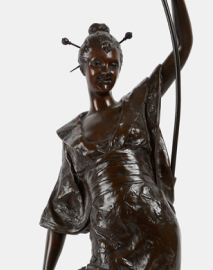
Achille D'Orsi (1845-1929) - Sculpture, Pathos - 43 cm - Bronze


05
days
06
hours
18
minutes
00
seconds
Starting bid
€ 1
Reserve price not met

Expert
Selected by Paul Wullems
He accumulated 18 years' experience, worked as junior specialist at Sotheby’s and managed Kunsthandel Jacques Fijnaut.
Estimate € 400 - € 500
No bids placed
Catawiki Buyer Protection
Your payment’s safe with us until you receive your object.View details
Trustpilot 4.4 | 141384 reviews
Rated Excellent on Trustpilot.
Description from the seller
A student of Tito Angelini and Tommaso Solari at the Accademia di Belle Arti di Napoli, he perfected his art with a sojourn in Rome, before returning to live in the city of Naples.
He adheres to the realist movement and becomes known for his works Parasites (the bronze model is now housed in the Galleria d'Arte Moderna in Florence, while the plaster version patinated to imitate bronze is in the National Museum of Capodimonte in Naples), La vecchia, and Il venditore, presented at the Naples Exhibition of 1877. These same works were reintroduced the following year at the 1878 Universal Exposition held in Paris.
The breakthrough comes three years later, with Proximus tuus, at the Turin Exhibition.
At the beginning of the 20th century he continued to gain recognition, with his participation in the Venice Biennale, where he exhibited works such as Nel concilio di Trento (1909), Romano della decadenza (1914), Nell'antico Egitto (1924), and Eolo (1928).
During his career he was commissioned numerous busts and portraits; among them the monument to Umberto I of Italy in Naples, those to the philosopher Bernardino Telesio in Cosenza and to Orazio in Venosa, and the busts of Filippo Palizzi and Salvatore Farina.
One of his large marble statues depicting Alfonso d'Aragona stands in front of the facade of the Royal Palace of Naples and is part of the series of eight kings of Naples.
A student of Tito Angelini and Tommaso Solari at the Accademia di Belle Arti di Napoli, he perfected his art with a sojourn in Rome, before returning to live in the city of Naples.
He adheres to the realist movement and becomes known for his works Parasites (the bronze model is now housed in the Galleria d'Arte Moderna in Florence, while the plaster version patinated to imitate bronze is in the National Museum of Capodimonte in Naples), La vecchia, and Il venditore, presented at the Naples Exhibition of 1877. These same works were reintroduced the following year at the 1878 Universal Exposition held in Paris.
The breakthrough comes three years later, with Proximus tuus, at the Turin Exhibition.
At the beginning of the 20th century he continued to gain recognition, with his participation in the Venice Biennale, where he exhibited works such as Nel concilio di Trento (1909), Romano della decadenza (1914), Nell'antico Egitto (1924), and Eolo (1928).
During his career he was commissioned numerous busts and portraits; among them the monument to Umberto I of Italy in Naples, those to the philosopher Bernardino Telesio in Cosenza and to Orazio in Venosa, and the busts of Filippo Palizzi and Salvatore Farina.
One of his large marble statues depicting Alfonso d'Aragona stands in front of the facade of the Royal Palace of Naples and is part of the series of eight kings of Naples.
Details
Era
1400-1900
Over 200 years old
Yes
Country of origin
Italy
Style
Art Nouveau
Material
Bronze
Artist
Achille D'Orsi (1845-1929)
Title of artwork
Pathos
Signature
Signed
Colour
Bronze, Brown
Condition
Excellent condition
Height
43 cm
Width
18 cm
Depth
19 cm
Weight
50 kg
Sold by