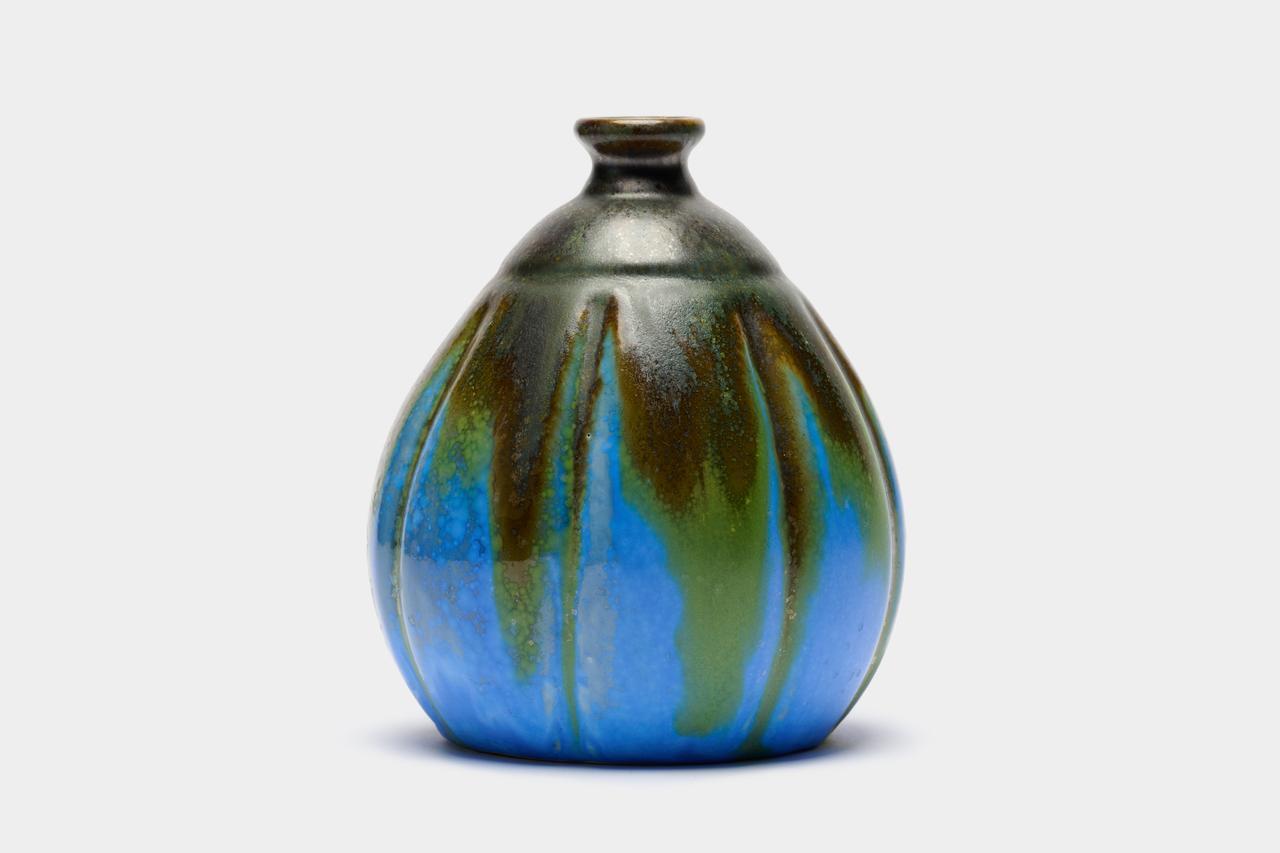
Vase - Stoneware


03
days
12
hours
07
minutes
48
seconds
Current bid
€ 25
Reserve price not met

Expert
Selected by Florentin Brunz Gaborieau
Holds a master’s in Art History, specialising in Second French Empire and Dutch Golden Age.
Estimate € 150 - € 200
 | €25 | |
|---|---|---|
| €20 | |
| €15 | |
Catawiki Buyer Protection
Your payment’s safe with us until you receive your object.View details
Trustpilot 4.4 | 142120 reviews
Rated Excellent on Trustpilot.
A museum-worthy 44 cm tall hand-turned gres stoneware vase by Belgian ceramist Antoine Dubois, signed on the base as model E 12 C of the Egyptian series, circa 1925–1930, with three unique sgraffito relief scenes and cobalt blue plus dark brown salt glaze.
AI-assisted summary
Description from the seller
an exceptionally large, rare gres-ceramic stoneware vase by the celebrated Belgian ceramic artist Antoine Dubois (founder of Les Grès d’Art de Bouffioulx). This museum piece dates from the heyday of Art Deco, circa 1925–1930. After the discovery of Tutankhamun's tomb in 1922, Europe was gripped by the Egyptian Revival. This vase is one of the most iconic and sought-after expressions of that movement. What makes this exemplar unique is the fully all-around, three-part decoration. While smaller vases often have a single repeating motif, this monumental piece displays three unique, masterfully incised (sgraffito) relief scenes: A kneeling, winged Egyptian goddess (Isis/Maät). An elegant priestess in profile with a sacred blue lotus flower. A seated pharaoh or deity on a throne, complete with a scepter and the Ankh symbol (the emblem of eternal life). The interspaces are richly decorated with stylized lotus blossoms and finished with the iconic cobalt blue and deep brown polychrome glaze against a beautifully speckled, salt-glazed beige ground. The neck widens into a distinctive, wavy eight-lobed opening. Specifications & Features: Designer: Antoine Dubois (signed on the base) Model number: E 12 C (the 'E' stands for the exclusive Egyptian series) Origin: Bouffioulx, Belgium Period: Art Deco (ca. 1925–1930) Height: An impressive 44 cm (XL edition) Technique: Hand-turned gres stoneware, sgraffito relief, salt glaze Condition: Absolutely pristine. Vases of this size and age almost always show edge chipping or hairlines, but this piece is completely free of chips, restorations or cracks. The beveled neck rim is in perfect condition. A rarity! Very careful packaging for shipping.
an exceptionally large, rare gres-ceramic stoneware vase by the celebrated Belgian ceramic artist Antoine Dubois (founder of Les Grès d’Art de Bouffioulx). This museum piece dates from the heyday of Art Deco, circa 1925–1930. After the discovery of Tutankhamun's tomb in 1922, Europe was gripped by the Egyptian Revival. This vase is one of the most iconic and sought-after expressions of that movement. What makes this exemplar unique is the fully all-around, three-part decoration. While smaller vases often have a single repeating motif, this monumental piece displays three unique, masterfully incised (sgraffito) relief scenes: A kneeling, winged Egyptian goddess (Isis/Maät). An elegant priestess in profile with a sacred blue lotus flower. A seated pharaoh or deity on a throne, complete with a scepter and the Ankh symbol (the emblem of eternal life). The interspaces are richly decorated with stylized lotus blossoms and finished with the iconic cobalt blue and deep brown polychrome glaze against a beautifully speckled, salt-glazed beige ground. The neck widens into a distinctive, wavy eight-lobed opening. Specifications & Features: Designer: Antoine Dubois (signed on the base) Model number: E 12 C (the 'E' stands for the exclusive Egyptian series) Origin: Bouffioulx, Belgium Period: Art Deco (ca. 1925–1930) Height: An impressive 44 cm (XL edition) Technique: Hand-turned gres stoneware, sgraffito relief, salt glaze Condition: Absolutely pristine. Vases of this size and age almost always show edge chipping or hairlines, but this piece is completely free of chips, restorations or cracks. The beveled neck rim is in perfect condition. A rarity! Very careful packaging for shipping.
Details
Era
1900-2000
Weight
4400 g
Number of objects
1
Country of origin
Belgium
Material
Stoneware
Style
Art Deco
Condition
As new - unused
Height
44 cm
Width
21 cm
Depth
21 cm
Diameter
21 cm
Estimated period
1920-1930
Sold by