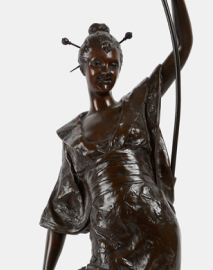
Sculpture, L'Angélus de Jean-François Millet ca. 1860 - 38 cm - Spelter


01
day
18
hours
39
minutes
59
seconds
Current bid
€ 15
No reserve price

Expert
Selected by Paul Wullems
He accumulated 18 years' experience, worked as junior specialist at Sotheby’s and managed Kunsthandel Jacques Fijnaut.
Estimate € 140 - € 170
 | €15 | |
|---|---|---|
 | €10 | |
| €9 | |
Catawiki Buyer Protection
Your payment’s safe with us until you receive your object.View details
Trustpilot 4.4 | 141948 reviews
Rated Excellent on Trustpilot.
Description from the seller
Angelus sculpture by Jean-François Millet, about 38 cm tall and weighing around 1.2 kg, depicting a young rural worker in a contemplative pose. The figure appears with his head tilted, holding his circular hat against his chest and leaning on a long spade, composing an image with a markedly intimate character related to the rural and naturalist iconography developed in France during the 19th century.
Given its technical and stylistic characteristics, a French production in the third quarter of the 19th century—roughly between 1860 and 1880—appears plausible, although to date no signature or foundry mark has been located to establish a definite attribution.
The piece is executed by hollow casting in white metal, probably zinc d’art, later patinated to imitate the look of bronze. This process gained considerable diffusion during the second half of the 19th century: specialized sources document a particularly abundant production of zinc sculptures in the 1860s and 1870s, favored by its lower cost compared to bronze and by the possibility of applying finishes that visually reproduce more noble metals.
The photograph of the bottom allows a clear view of its hollow construction, showing the inner walls of the casting and the base’s structure. This method aligns with historical techniques documented for zinc sculpture, in which the liquid metal was distributed over the inner walls of the mold to obtain relatively light hollow bodies.
Inside there is also a small loose metallic element audible when the sculpture is carefully inverted. It is probably some old fastening or assembly component—screw, nut or similar—currently detached. Its presence is compatible with historical techniques of constructing zinc sculptures, which could incorporate parts manufactured separately and subsequently joined by mounting or reinforcement elements. It does not apparently affect the exterior stability of the sculpture.
The figure rests on an elaborate rococo-inspired historicist plinth, decorated with abundant vegetal scrolls, volutes, and ornamental reliefs. This contrast between the simplicity of the young farmer and the decorative richness of the pedestal is especially characteristic of the 19th-century historicist taste.
The finish preserves an old dark patina with wear and losses in certain areas that reveal the gray tone of the underlying metal. This circumstance is also coherent with antique patinated zinc sculptures: the Smithsonian notes the gray color of the metal as a useful identifying feature, while the Canadian Conservation Institute warns that many sculptures apparently bronze from the late 19th and early 20th centuries were actually made of white metal and subsequently bronzed with surface finishes.
Characteristics: probable France, ca. 1860–1880; patinated zinc / régule, attribution of material pending instrumental analysis; hollow casting; 38 cm in height; around 1.2 kg; no visible signature; ancient patina with wear and age-related signs; small loose metal element audible inside; seemingly intact exterior structure.
Subject: a young farmer or agricultural worker in a contemplative stance, probably related to the French 19th-century rural figurative tradition and to the iconography of the worker paused in his labors.
Angelus sculpture by Jean-François Millet, about 38 cm tall and weighing around 1.2 kg, depicting a young rural worker in a contemplative pose. The figure appears with his head tilted, holding his circular hat against his chest and leaning on a long spade, composing an image with a markedly intimate character related to the rural and naturalist iconography developed in France during the 19th century.
Given its technical and stylistic characteristics, a French production in the third quarter of the 19th century—roughly between 1860 and 1880—appears plausible, although to date no signature or foundry mark has been located to establish a definite attribution.
The piece is executed by hollow casting in white metal, probably zinc d’art, later patinated to imitate the look of bronze. This process gained considerable diffusion during the second half of the 19th century: specialized sources document a particularly abundant production of zinc sculptures in the 1860s and 1870s, favored by its lower cost compared to bronze and by the possibility of applying finishes that visually reproduce more noble metals.
The photograph of the bottom allows a clear view of its hollow construction, showing the inner walls of the casting and the base’s structure. This method aligns with historical techniques documented for zinc sculpture, in which the liquid metal was distributed over the inner walls of the mold to obtain relatively light hollow bodies.
Inside there is also a small loose metallic element audible when the sculpture is carefully inverted. It is probably some old fastening or assembly component—screw, nut or similar—currently detached. Its presence is compatible with historical techniques of constructing zinc sculptures, which could incorporate parts manufactured separately and subsequently joined by mounting or reinforcement elements. It does not apparently affect the exterior stability of the sculpture.
The figure rests on an elaborate rococo-inspired historicist plinth, decorated with abundant vegetal scrolls, volutes, and ornamental reliefs. This contrast between the simplicity of the young farmer and the decorative richness of the pedestal is especially characteristic of the 19th-century historicist taste.
The finish preserves an old dark patina with wear and losses in certain areas that reveal the gray tone of the underlying metal. This circumstance is also coherent with antique patinated zinc sculptures: the Smithsonian notes the gray color of the metal as a useful identifying feature, while the Canadian Conservation Institute warns that many sculptures apparently bronze from the late 19th and early 20th centuries were actually made of white metal and subsequently bronzed with surface finishes.
Characteristics: probable France, ca. 1860–1880; patinated zinc / régule, attribution of material pending instrumental analysis; hollow casting; 38 cm in height; around 1.2 kg; no visible signature; ancient patina with wear and age-related signs; small loose metal element audible inside; seemingly intact exterior structure.
Subject: a young farmer or agricultural worker in a contemplative stance, probably related to the French 19th-century rural figurative tradition and to the iconography of the worker paused in his labors.
Details
Era
1400-1900
Over 200 years old
No
Country of origin
France
Material
Spelter
Title of artwork
L'Angélus de Jean-François Millet ca. 1860
Signature
Not signed
Colour
Bronze
Condition
Excellent condition
Height
38 cm
Width
12 cm
Depth
12 cm
Weight
1.2 kg
Sold by