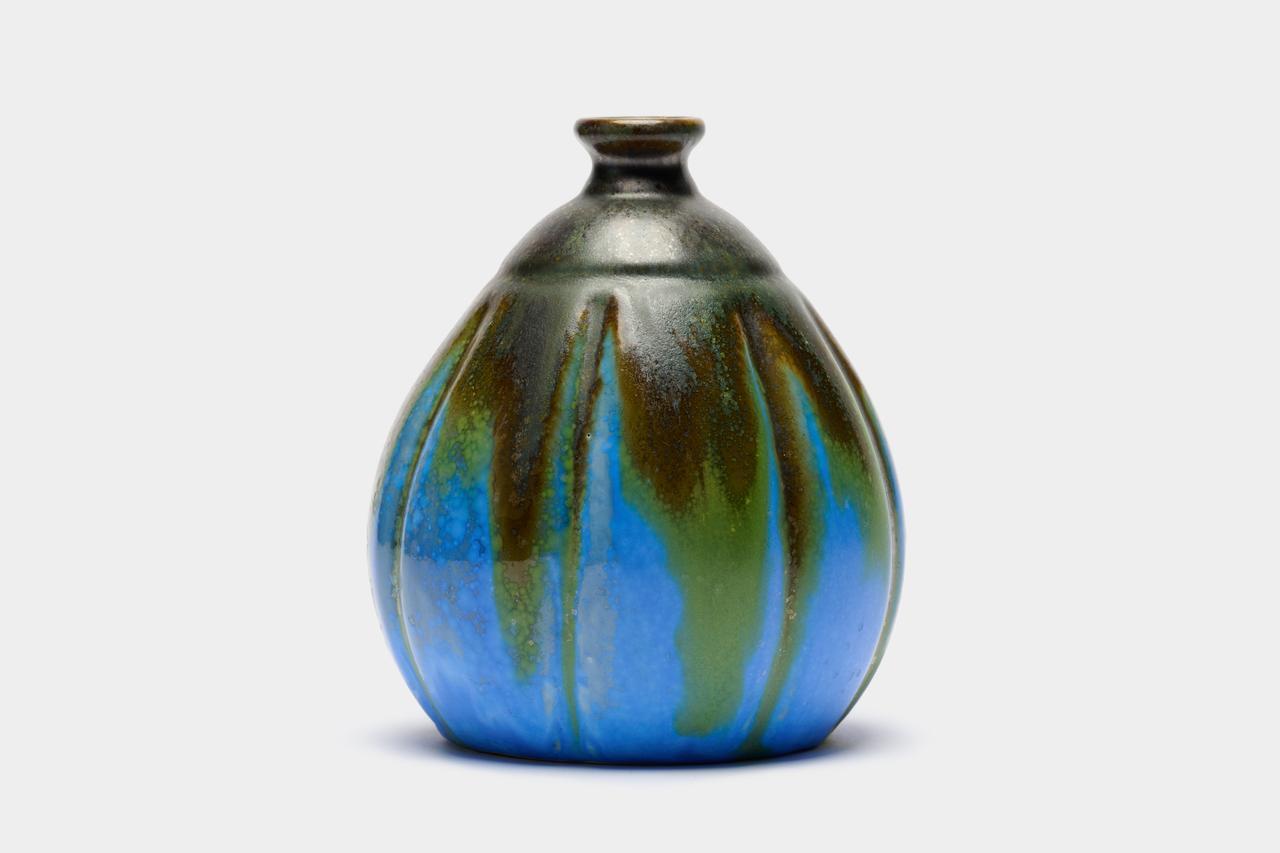
Deruta Vaso ceramica dipinta a mano ''Maiolica di Deruta Oro'' - Vase - Porcelain, Ceramic


03
days
23
hours
43
minutes
03
seconds

 | €4 | |
|---|---|---|
 | €3 | |
| €1 |
Catawiki Buyer Protection
Your payment’s safe with us until you receive your object.View details
Trustpilot 4.4 | 142038 reviews
Rated Excellent on Trustpilot.
Deruta hand-painted porcelain ceramic vase in Maiolica di Deruta Oro, circa 1950–1960, in excellent condition, with dimensions 11 cm wide, 11 cm deep and 31 cm high, made in Italy.
AI-assisted summary
Description from the seller
Exceptional ceramic depicting a Dragon Vase and base plate Artistic Deruta Ceramics 1950 Rare
The abundance of clay deposits and the favorable position along important land and river routes favored the development of ceramic production in Deruta since the Middle Ages.
With an uninterrupted continuity for at least seven centuries, Deruta still represents today the center of the largest production of artistic maiolica in Italy. In this great ceramic cradle there are countless artisanal workshops, kilns where new clays were created and tested, new techniques were experimented with, new shapes designed, new glazes and varnishes tried, new colors used and new decorations painted.
The artistic production, from the earliest times, had an extraordinary opportunity for publicity: the proximity of Assisi, a magnet and political center of all Christian Europe. In the Assisi Franciscan Archive, documents from 1358 and 1359 were found in which a potter, Cecce d’Alessandro, the wholesaler, sold hundreds of ceramic pieces to the friars of the Assisi Convent, for which the friars even paid the transport costs from Deruta. The Umbria ceramic production center benefited from its geographic position: along the Tiber Route, which together with the Flaminia formed the most important axis of communication between Rome and the Adriatic. However, it is not possible to provide a precise characterization of the “arcano derutese” considering that the extraordinary, very rich, and well-documented production of Deruta maiolica dates back to the Renaissance and to later centuries, which have inexorably confined the archaic period to a shadowy area. Nevertheless, in the 13th and 14th centuries (the archaic period) this production began to become particularly important for the city, with the creation of objects for everyday and domestic use, pouring vessels, basins, and bowls.
The objects were decorated with geometric, floral, and sometimes zoomorphic figures, with a palette limited to the ramina green (copper oxide) and the manganese brown, according to the canons of the archaic style.
Around 1400 there is an evolution of forms, with the refinement of wheel-throwing technique and decorations. From this period are the productions of albarelli known for pharmaceutical use and jars with twisted handles, often bearing the effigy of noble Umbrian families; scenes of war, hunting, amorous and allegorical subjects, heraldic symbols are depicted on “pompa” plates.
Around 1450 the production further enriches in forms, decorations and techniques.
Being a genuine vintage piece, it represents an elegant testimony of the past and may show slight signs of aging, elements that add charm and authenticity to its history.
Product deliveries are entrusted only to top couriers such as UPS, DHL and BRT, with guaranteed and insured delivery. The price lists are publicly available online.
Seller's Story
Designers and textile-loving artisans present their creations: artworks, jewelry, furnishings, vintage clothing, experiments and other forms of textile expression. They also briefly share something about themselves and their work. A harmonious overview that brings color to a timeless moment.
Translated by Google TranslateExceptional ceramic depicting a Dragon Vase and base plate Artistic Deruta Ceramics 1950 Rare
The abundance of clay deposits and the favorable position along important land and river routes favored the development of ceramic production in Deruta since the Middle Ages.
With an uninterrupted continuity for at least seven centuries, Deruta still represents today the center of the largest production of artistic maiolica in Italy. In this great ceramic cradle there are countless artisanal workshops, kilns where new clays were created and tested, new techniques were experimented with, new shapes designed, new glazes and varnishes tried, new colors used and new decorations painted.
The artistic production, from the earliest times, had an extraordinary opportunity for publicity: the proximity of Assisi, a magnet and political center of all Christian Europe. In the Assisi Franciscan Archive, documents from 1358 and 1359 were found in which a potter, Cecce d’Alessandro, the wholesaler, sold hundreds of ceramic pieces to the friars of the Assisi Convent, for which the friars even paid the transport costs from Deruta. The Umbria ceramic production center benefited from its geographic position: along the Tiber Route, which together with the Flaminia formed the most important axis of communication between Rome and the Adriatic. However, it is not possible to provide a precise characterization of the “arcano derutese” considering that the extraordinary, very rich, and well-documented production of Deruta maiolica dates back to the Renaissance and to later centuries, which have inexorably confined the archaic period to a shadowy area. Nevertheless, in the 13th and 14th centuries (the archaic period) this production began to become particularly important for the city, with the creation of objects for everyday and domestic use, pouring vessels, basins, and bowls.
The objects were decorated with geometric, floral, and sometimes zoomorphic figures, with a palette limited to the ramina green (copper oxide) and the manganese brown, according to the canons of the archaic style.
Around 1400 there is an evolution of forms, with the refinement of wheel-throwing technique and decorations. From this period are the productions of albarelli known for pharmaceutical use and jars with twisted handles, often bearing the effigy of noble Umbrian families; scenes of war, hunting, amorous and allegorical subjects, heraldic symbols are depicted on “pompa” plates.
Around 1450 the production further enriches in forms, decorations and techniques.
Being a genuine vintage piece, it represents an elegant testimony of the past and may show slight signs of aging, elements that add charm and authenticity to its history.
Product deliveries are entrusted only to top couriers such as UPS, DHL and BRT, with guaranteed and insured delivery. The price lists are publicly available online.
Seller's Story
Designers and textile-loving artisans present their creations: artworks, jewelry, furnishings, vintage clothing, experiments and other forms of textile expression. They also briefly share something about themselves and their work. A harmonious overview that brings color to a timeless moment.
Translated by Google TranslateDetails
Era
1900-2000
Country of origin
Italy
Designer/artist/maker
Deruta Vaso ceramica dipinta a mano ''Maiolica di Deruta Oro''
Material
Ceramic, Porcelain
Condition
Excellent condition: barely used with minimal signs of wear
Height
31 cm
Width
11 cm
Depth
11 cm
Estimated period
1950-1960
Sold by