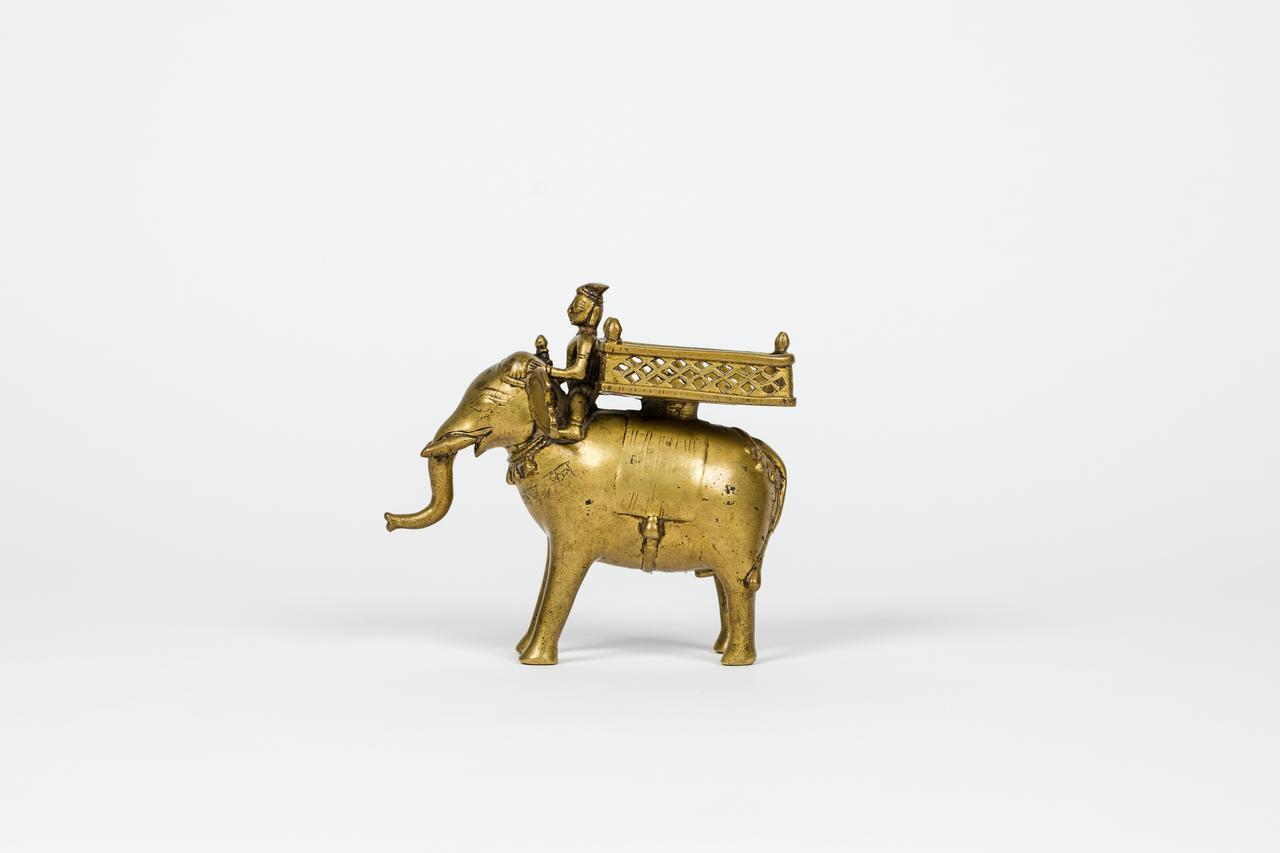
Two betel nut crackers - Brass - India - Early 20th century


04
days
14
hours
17
minutes
38
seconds
Starting bid
€ 1
No reserve price

Expert
Selected by Surya Rutten
Has over 25 years' experience in Asian art and owned an art gallery.
Estimate € 150 - € 200
No bids placed
Catawiki Buyer Protection
Your payment’s safe with us until you receive your object.View details
Trustpilot 4.4 | 142317 reviews
Rated Excellent on Trustpilot.
Lot of 2 brass betel nut crackers from India, titled Two betel nut crackers, dating to the early 20th century, in good condition, with a cavalier piece measuring 13 cm by 9 cm and a parrot piece measuring 16 cm by 8 cm.
AI-assisted summary
Description from the seller
Set of 2 areca-nut cutters (sarota) in brass, India, early 20th century
These two cast-brass objects, 13 cm long and 9 cm high (the cavalier) and 16 cm by 8 cm (the parrot), are areca nut cutters, called in Hindi sarota or saroti, designed to cut dried areca nut, the aril of the areca palm fruit, consumed in India for millennia wrapped in betel leaf with lime and various spices to form paan, a chewing preparation with mildly stimulating effects. They consist of two arms articulated by a central rivet, functioning like scissors or a nutcracker: the upper arm, molded in relief, fits onto the lower arm in a mirror image, whose inner ferrous blade ensures a shear cut under pressure of the two arms. The golden patina is characteristic of well-maintained antique brass.
The sarota is one of the most widespread utensils throughout India, present in every household since at least the Middle Ages, and its fabrication in brass or bronze has for centuries been a regional artisanal specialty in several regions, notably Rajasthan, Gujarat, Kutch, and Bengal, where local foundrymen and chasers competed in ingenuity to make objects both decorative and everyday tools. Sarotas with a galloping horse motif, an iconographic theme extremely common in 19th-century Indian craft, are generally attributed to workshops in Rajasthan or Kutch, where the horse figure, associated with royalty, valor, and the sun god Surya, holds a central place in the popular decorative repertoire. The presence of a rider recalls representations of epic heroes or equestrian deities of the Hindu tradition, such as Khandoba, Ayyappan, or Revanta, a Hindu deity patron of horsemen.
The parrot, in Sanskrit suka, is one of the most emblematic animals of classical and popular Indian culture. It is the companion of Kama, the god of love, on whose perch it sits, and features prominently in Sanskrit love poetry and in Moghul and Rajput miniatures as a messenger of lovers. In Hindu and Jain popular culture, it symbolizes eloquence, memory, and the transmission of sacred knowledge. To link the parrot with a tool as everyday and intimate as the sarota was thus a way to elevate its use, reminding that paan preparation, this vegetal offering consumed at social gatherings and ceremonies, participates in a symbolic register that goes beyond mere digestive habit.
In Indian households, the sarota was an essential object, used several times a day during paan preparation, but also a traditional wedding gift and a symbol of hospitality. Its workmanship varied from the humblest iron-forged model to solid silver versions for the high Mughal and Rajput aristocracy, through this intermediate category in elaborately worked brass, intended for the affluent middle class, of which this example is representative.
Set of 2 areca-nut cutters (sarota) in brass, India, early 20th century
These two cast-brass objects, 13 cm long and 9 cm high (the cavalier) and 16 cm by 8 cm (the parrot), are areca nut cutters, called in Hindi sarota or saroti, designed to cut dried areca nut, the aril of the areca palm fruit, consumed in India for millennia wrapped in betel leaf with lime and various spices to form paan, a chewing preparation with mildly stimulating effects. They consist of two arms articulated by a central rivet, functioning like scissors or a nutcracker: the upper arm, molded in relief, fits onto the lower arm in a mirror image, whose inner ferrous blade ensures a shear cut under pressure of the two arms. The golden patina is characteristic of well-maintained antique brass.
The sarota is one of the most widespread utensils throughout India, present in every household since at least the Middle Ages, and its fabrication in brass or bronze has for centuries been a regional artisanal specialty in several regions, notably Rajasthan, Gujarat, Kutch, and Bengal, where local foundrymen and chasers competed in ingenuity to make objects both decorative and everyday tools. Sarotas with a galloping horse motif, an iconographic theme extremely common in 19th-century Indian craft, are generally attributed to workshops in Rajasthan or Kutch, where the horse figure, associated with royalty, valor, and the sun god Surya, holds a central place in the popular decorative repertoire. The presence of a rider recalls representations of epic heroes or equestrian deities of the Hindu tradition, such as Khandoba, Ayyappan, or Revanta, a Hindu deity patron of horsemen.
The parrot, in Sanskrit suka, is one of the most emblematic animals of classical and popular Indian culture. It is the companion of Kama, the god of love, on whose perch it sits, and features prominently in Sanskrit love poetry and in Moghul and Rajput miniatures as a messenger of lovers. In Hindu and Jain popular culture, it symbolizes eloquence, memory, and the transmission of sacred knowledge. To link the parrot with a tool as everyday and intimate as the sarota was thus a way to elevate its use, reminding that paan preparation, this vegetal offering consumed at social gatherings and ceremonies, participates in a symbolic register that goes beyond mere digestive habit.
In Indian households, the sarota was an essential object, used several times a day during paan preparation, but also a traditional wedding gift and a symbol of hospitality. Its workmanship varied from the humblest iron-forged model to solid silver versions for the high Mughal and Rajput aristocracy, through this intermediate category in elaborately worked brass, intended for the affluent middle class, of which this example is representative.
Details
Dynastic Style/Period
Early 20th century
Number of objects
2
Country of Origin
India
Attribution
Original
Material
Brass
Height
13 cm
Width
9 cm
Title of artwork
Two betel nut crackers
Depth
1 cm
Condition
Good condition
Sold by