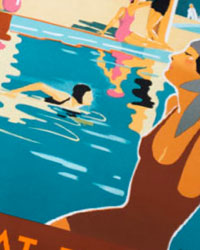
Henri Matisse (1869-1954), after - Mille et Une Nuits - Offset lithograph - 100x50 - SIAE licensed print - 2006


04
days
21
hours
29
minutes
03
seconds
Starting bid
€ 1
Reserve price not met

Expert
Selected by Juan Antonio Rodríguez
Eight years experience valuing posters, previously valuer at Balclis, Barcelona.
Estimate € 150 - € 200
No bids placed
Catawiki Buyer Protection
Your payment’s safe with us until you receive your object.View details
Trustpilot 4.4 | 143038 reviews
Rated Excellent on Trustpilot.
Description from the seller
Offset lithograph after Henri Matisse (*)
Reproduction of the work “Mille et Une Nuits”, a work created by Matisse in 1952,
Print authorized by the Matisse Estate.
Signed on the plate.
Specifications:
- Support dimensions: 50 x 100 cm
- Year: 2006
- Condition: Excellent (this work has never been framed or exhibited, and has always been kept in a professional art folder, and is therefore offered in perfect condition).
The work will be carefully handled and packaged in a reinforced flat cardboard package. The shipment will be tracked with a tracking number.
The shipment will also include full insurance for the final value of the work with full reimbursement in case of loss or damage, at no cost to the buyer.
(*) Henri Matisse was born in 1869 in Cateau-Cambresis (France). As Pierre Bonnard did, Matisse studied Law. He began painting in 1890 and attended classes at the Académie Julian (1891-1892). He enrolled at the École des Beaux-Arts in Paris in 1892 and joined Gustave Moreau’s workshop. The landscapes and still lifes he painted in that period are of a classical style, yet color holds a predominant importance. His first solo exhibition took place in 1904.
The year before, Matisse had co-founded the Salon d'Automne and was an integral part of the group “La cage aux fauves” in 1905. Matisse is the one who truly headed the Fauvism movement that caused so much scandal; the artist applies vivid and flat colors on the canvas that translate the intensity of his emotions, simplifies the forms and outlines them with a black stroke. His travels to sunny countries (Corsica, southern France, Algeria, Spain, Tahiti…) confirm his inclination to privilege color. Matisse paints landscapes, portraits, and compositions with figures.
In 1907, the artist opened a painting school, the Matisse Academy, in his own Paris workshop. He published in 1910 “Notes of a Painter” in which he states: “what I pursue above all is expression.” The arabesque is among the motifs of this expression around 1910. He paints interiors, studios, nudes. His free treatment of color and form provokes scandal at the Armory Show in which he participated in 1913.
After the end of World War I, Matisse devoted himself to representing female figures, odalisques posing for him in iridescent-colored settings, with arabesque and floral motifs.
Matisse settled in Nice in 1921, where he would live until the end of his life. Matisse drew series, etched, illustrated, created frescoes, designed theater decor and costumes, bust models and female nudes, painted and entered a new phase of experimentation from 1947: he cut and pasted papers enhanced with wash painting; the artist’s work becomes more abstract.
Matisse created the album “Jazz” in 1947 and another series of “Interiors” following the same scheme.
Matisse died in Nice in 1954.
Seller's Story
EsKobARTE carefully selects artworks from renowned and emerging artists worldwide, offering them here at affordable prices. *** HIGH-QUALITY LICENSED PRINTS *** We only sell authentic artworks and high-quality licensed prints. *** WE ARE PROFESSIONALS *** You can bid on our items with complete confidence. Over 1000 positive reviews on Catawiki attest to our professionalism. *** SECURE, CERTIFIED, AND INSURED SHIPPING *** All our items are carefully packaged in eco-friendly cardboard boxes. We work with the best courier services (UPS, DPD, DHL, FedEx) to guarantee the best service and tracking. Our shipments also include insurance against damage or loss, at no extra cost to the buyer *** COMBINED SHIPPING *** If you purchase multiple items -even from different auctions- you will only pay for shipping once *** ANY QUESTIONS? *** Feel free to contact us via chat, we will gladly assist you as soon as possible *** THANK YOU AND GOOD LUCK WITH YOUR BIDS! ***
Translated by Google TranslateOffset lithograph after Henri Matisse (*)
Reproduction of the work “Mille et Une Nuits”, a work created by Matisse in 1952,
Print authorized by the Matisse Estate.
Signed on the plate.
Specifications:
- Support dimensions: 50 x 100 cm
- Year: 2006
- Condition: Excellent (this work has never been framed or exhibited, and has always been kept in a professional art folder, and is therefore offered in perfect condition).
The work will be carefully handled and packaged in a reinforced flat cardboard package. The shipment will be tracked with a tracking number.
The shipment will also include full insurance for the final value of the work with full reimbursement in case of loss or damage, at no cost to the buyer.
(*) Henri Matisse was born in 1869 in Cateau-Cambresis (France). As Pierre Bonnard did, Matisse studied Law. He began painting in 1890 and attended classes at the Académie Julian (1891-1892). He enrolled at the École des Beaux-Arts in Paris in 1892 and joined Gustave Moreau’s workshop. The landscapes and still lifes he painted in that period are of a classical style, yet color holds a predominant importance. His first solo exhibition took place in 1904.
The year before, Matisse had co-founded the Salon d'Automne and was an integral part of the group “La cage aux fauves” in 1905. Matisse is the one who truly headed the Fauvism movement that caused so much scandal; the artist applies vivid and flat colors on the canvas that translate the intensity of his emotions, simplifies the forms and outlines them with a black stroke. His travels to sunny countries (Corsica, southern France, Algeria, Spain, Tahiti…) confirm his inclination to privilege color. Matisse paints landscapes, portraits, and compositions with figures.
In 1907, the artist opened a painting school, the Matisse Academy, in his own Paris workshop. He published in 1910 “Notes of a Painter” in which he states: “what I pursue above all is expression.” The arabesque is among the motifs of this expression around 1910. He paints interiors, studios, nudes. His free treatment of color and form provokes scandal at the Armory Show in which he participated in 1913.
After the end of World War I, Matisse devoted himself to representing female figures, odalisques posing for him in iridescent-colored settings, with arabesque and floral motifs.
Matisse settled in Nice in 1921, where he would live until the end of his life. Matisse drew series, etched, illustrated, created frescoes, designed theater decor and costumes, bust models and female nudes, painted and entered a new phase of experimentation from 1947: he cut and pasted papers enhanced with wash painting; the artist’s work becomes more abstract.
Matisse created the album “Jazz” in 1947 and another series of “Interiors” following the same scheme.
Matisse died in Nice in 1954.
Seller's Story
EsKobARTE carefully selects artworks from renowned and emerging artists worldwide, offering them here at affordable prices. *** HIGH-QUALITY LICENSED PRINTS *** We only sell authentic artworks and high-quality licensed prints. *** WE ARE PROFESSIONALS *** You can bid on our items with complete confidence. Over 1000 positive reviews on Catawiki attest to our professionalism. *** SECURE, CERTIFIED, AND INSURED SHIPPING *** All our items are carefully packaged in eco-friendly cardboard boxes. We work with the best courier services (UPS, DPD, DHL, FedEx) to guarantee the best service and tracking. Our shipments also include insurance against damage or loss, at no extra cost to the buyer *** COMBINED SHIPPING *** If you purchase multiple items -even from different auctions- you will only pay for shipping once *** ANY QUESTIONS? *** Feel free to contact us via chat, we will gladly assist you as soon as possible *** THANK YOU AND GOOD LUCK WITH YOUR BIDS! ***
Translated by Google TranslateDetails
Sold by
Gallery
Edition
Limited edition
Artist
Henri Matisse (1869-1954), after
Title of artwork
Mille et Une Nuits - Offset lithograph - 100x50 - SIAE licensed print - 2006
Technique
Lithograph
Signature
Plate signed
Country of origin
Italy
Condition
Excellent condition
Height
50 cm
Width
100 cm
Style
Fauvism
Sold with frame
No
Period
1990-2000