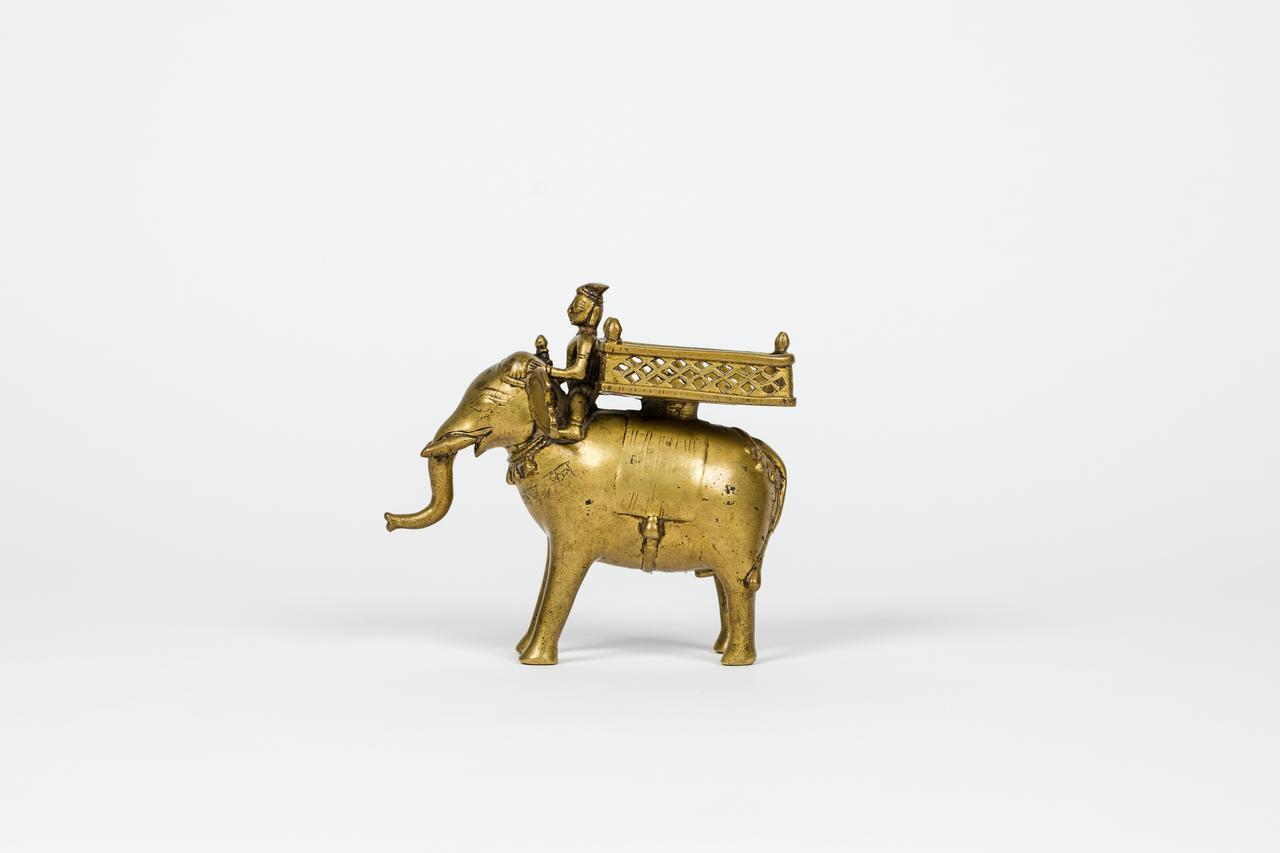
Temple horse on wheels, India - Bronze - India - 19th century


00
days
06
hours
54
minutes
21
seconds
Current bid
€ 74
No reserve price

Expert
Selected by Surya Rutten
Has over 25 years' experience in Asian art and owned an art gallery.
Estimate € 150 - € 200
 | €74 | |
|---|---|---|
| €65 | |
 | €60 | |
Catawiki Buyer Protection
Your payment’s safe with us until you receive your object.View details
Trustpilot 4.4 | 142645 reviews
Rated Excellent on Trustpilot.
Bronze temple horse on wheels from India, XIXe siècle, 13 cm wide, 14 cm high, 10 cm deep, in good condition.
AI-assisted summary
Description from the seller
Bronze temple horse on wheels, India
This horse, 14 cm high and 13 cm long, is cast in solid bronze using the lost-wax technique, a process that explains the slight casting irregularities and the charm of the piece. The animal, standing on four sturdy legs, wears a finely detailed harness: a bridle encircling the muzzle, a mane rendered by a series of parallel incisions reminiscent of stylized spines, a tuft in the shape of a flower on the forehead, and a bridle-tacked saddle ornamented with incised diamond motifs on the flank. Each pair of legs extends into a metal axle through which four massive wheels with protruding hubs freely turn, coated in white and punctuated by dark spots, now partly erased by use.
This object belongs to the category that Western collectors commonly designate as “temple toys” — a production of popular bronzes made mainly in South India and Central India, notably in Tamil Nadu and Maharashtra, between the 19th and mid-20th centuries. Contrary to what the name suggests, these figurines were not originally designed as children’s toys but as votive offerings deposited by devotees in sanctuaries dedicated to popular protective deities such as Ayyanar, Karuppan or Khandoba: offering a horse, a camel or an elephant to the deity was believed to guarantee protection and aid in times of need, with the horse occupying a special place as the mount of the village guardian gods.
Once the offering was made and accepted by the temple, these figurines sometimes accumulated inside the sacred precinct, where children accompanying their parents to ceremonies would retrieve them and roll them as toys, giving them a dual status as both cult object and plaything, long sustained by local oral tradition.
Beautiful old patina.
Bronze temple horse on wheels, India
This horse, 14 cm high and 13 cm long, is cast in solid bronze using the lost-wax technique, a process that explains the slight casting irregularities and the charm of the piece. The animal, standing on four sturdy legs, wears a finely detailed harness: a bridle encircling the muzzle, a mane rendered by a series of parallel incisions reminiscent of stylized spines, a tuft in the shape of a flower on the forehead, and a bridle-tacked saddle ornamented with incised diamond motifs on the flank. Each pair of legs extends into a metal axle through which four massive wheels with protruding hubs freely turn, coated in white and punctuated by dark spots, now partly erased by use.
This object belongs to the category that Western collectors commonly designate as “temple toys” — a production of popular bronzes made mainly in South India and Central India, notably in Tamil Nadu and Maharashtra, between the 19th and mid-20th centuries. Contrary to what the name suggests, these figurines were not originally designed as children’s toys but as votive offerings deposited by devotees in sanctuaries dedicated to popular protective deities such as Ayyanar, Karuppan or Khandoba: offering a horse, a camel or an elephant to the deity was believed to guarantee protection and aid in times of need, with the horse occupying a special place as the mount of the village guardian gods.
Once the offering was made and accepted by the temple, these figurines sometimes accumulated inside the sacred precinct, where children accompanying their parents to ceremonies would retrieve them and roll them as toys, giving them a dual status as both cult object and plaything, long sustained by local oral tradition.
Beautiful old patina.
Details
Dynastic Style/Period
19th century
Country of Origin
India
Material
Bronze
Height
14 cm
Width
13 cm
Title of artwork
Temple horse on wheels, India
Depth
10 cm
Condition
Good condition
Sold by