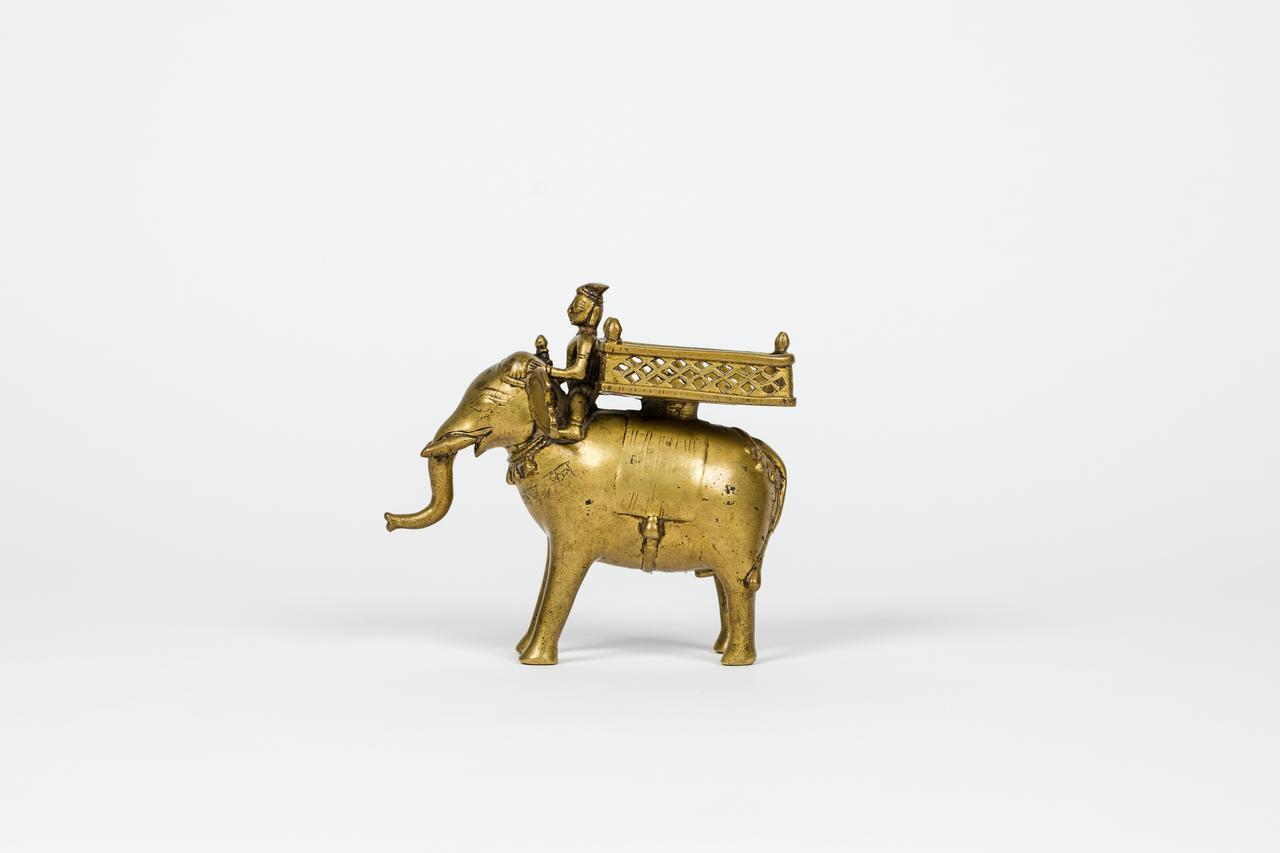
Statue, Kaliya Mardana - mid 20th c. - 16 cm - Bronze


04
days
15
hours
47
minutes
06
seconds
Starting bid
€ 1
Reserve price not met

Expert
Selected by Surya Rutten
Has over 25 years' experience in Asian art and owned an art gallery.
Estimate € 150 - € 200
No bids placed
Catawiki Buyer Protection
Your payment’s safe with us until you receive your object.View details
Trustpilot 4.4 | 142824 reviews
Rated Excellent on Trustpilot.
Bronze sculpture from India titled Kaliya Mardana - mid 20th c., measuring 16 cm high, 7.5 cm wide and 5.2 cm deep, in good condition and unsigned.
AI-assisted summary
Description from the seller
Krishna dancing on the serpent Kaliya
India
Mid-20th century
Bronze
Dimensions: 16 × 7.5 × 5.2 cm
Beautiful bronze statuette representing Krishna dancing on the naga Kaliya, a famous episode from the god's childhood told in the Vaishnava tradition and known in Indian iconography as Kaliya Mardana, "the subjugation of Kaliya".
Krishna is depicted in a particularly dynamic dancing posture, his body animated by a strong twist. One leg rests on the serpent's hood while the other is raised and bent. This stance conveys the moment when the young god, after confronting the gigantic naga, dances on its heads to break its pride and neutralize its venom.
According to traditional narrative, Kaliya had taken up residence in the waters of the Yamuna, poisoning them with his potent venom. Krishna plunged into the river and confronted the serpent, which tried to smother him in its coils. Freeing himself from its embrace, the god leapt onto its hoods and began to dance upon them. Defeated, Kaliya finally submitted to Krishna, who spared his life and ordered him to leave the river.
The sculpture translates this narrative episode into an ingeniously vertical composition. The naga's body rises from the base in a long undulating curve, tracing along the entire figure of Krishna. The god grips its upper part with one hand, while the serpent folds at the lower level before joining the creature placed beneath his foot. This sinuous line frames Krishna and accentuates the movement of his dance.
The serpent's face is highly stylized, while its body is covered with deep transverse incisions evoking the reptile's scales and rings.
The bronze presents a warm brown-gold patina, darker in the hollows and lighter on the naturally polished reliefs. Trace of use, small casting irregularities and surface variations contribute to the work's character. In general good condition.
Seller's Story
Kanaka The Collection is a Portugal-based web gallery specialising in Asian art, with a particular focus on the arts of Southeast Asia.
With over 20 years of experience and passion for Asian art, we offer a carefully curated selection of sculptures, ceramics and works of art from across Asia, chosen for their artistic quality, authenticity and historical interest.
Every piece is professionally packed, and we ship worldwide to collectors and institutions.
We remain personally available to collectors before and after each acquisition.
Translated by Google TranslateKrishna dancing on the serpent Kaliya
India
Mid-20th century
Bronze
Dimensions: 16 × 7.5 × 5.2 cm
Beautiful bronze statuette representing Krishna dancing on the naga Kaliya, a famous episode from the god's childhood told in the Vaishnava tradition and known in Indian iconography as Kaliya Mardana, "the subjugation of Kaliya".
Krishna is depicted in a particularly dynamic dancing posture, his body animated by a strong twist. One leg rests on the serpent's hood while the other is raised and bent. This stance conveys the moment when the young god, after confronting the gigantic naga, dances on its heads to break its pride and neutralize its venom.
According to traditional narrative, Kaliya had taken up residence in the waters of the Yamuna, poisoning them with his potent venom. Krishna plunged into the river and confronted the serpent, which tried to smother him in its coils. Freeing himself from its embrace, the god leapt onto its hoods and began to dance upon them. Defeated, Kaliya finally submitted to Krishna, who spared his life and ordered him to leave the river.
The sculpture translates this narrative episode into an ingeniously vertical composition. The naga's body rises from the base in a long undulating curve, tracing along the entire figure of Krishna. The god grips its upper part with one hand, while the serpent folds at the lower level before joining the creature placed beneath his foot. This sinuous line frames Krishna and accentuates the movement of his dance.
The serpent's face is highly stylized, while its body is covered with deep transverse incisions evoking the reptile's scales and rings.
The bronze presents a warm brown-gold patina, darker in the hollows and lighter on the naturally polished reliefs. Trace of use, small casting irregularities and surface variations contribute to the work's character. In general good condition.
Seller's Story
Kanaka The Collection is a Portugal-based web gallery specialising in Asian art, with a particular focus on the arts of Southeast Asia.
With over 20 years of experience and passion for Asian art, we offer a carefully curated selection of sculptures, ceramics and works of art from across Asia, chosen for their artistic quality, authenticity and historical interest.
Every piece is professionally packed, and we ship worldwide to collectors and institutions.
We remain personally available to collectors before and after each acquisition.
Translated by Google TranslateDetails
Era
1900-2000
Country of origin
India
Material
Bronze
Title of artwork
Kaliya Mardana - mid 20th c.
Signature
Not signed
Condition
Good condition
Height
16 cm
Width
7.5 cm
Depth
5.2 cm
Sold by