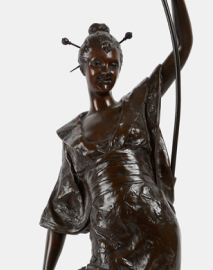
Hans GURADZE (1861-1922) - Sculpture, Retour des champs - 23 cm - Patinated bronze


03
days
01
hour
14
minutes
43
seconds
Starting bid
€ 1
Reserve price not met

Expert
Selected by Paul Wullems
He accumulated 18 years' experience, worked as junior specialist at Sotheby’s and managed Kunsthandel Jacques Fijnaut.
Estimate € 600 - € 800
No bids placed
Catawiki Buyer Protection
Your payment’s safe with us until you receive your object.View details
Trustpilot 4.4 | 143139 reviews
Rated Excellent on Trustpilot.
Description from the seller
Hans GURADZE (1861-1922) – The Return from the Fields
Bronze group with a brown patina, signed, on a green veined marble base – Germany, circa 1900
Theme. Scene of rural life: a peasant wearing a wide-brimmed hat and a long coat brings back his three draft horses after work. He rides one bareback and leads the second to his side, while the third follows, its muzzle pressed against the tail of the lead horse. The animals still wear their collars and harness, and the traces hang along their flanks. With arched necks, manes lifted by the wind, and the heavy gait, the fatigue of the day is conveyed. The naturalistic terrace shows a ground of earth and rock.
Artist. Hans Guradze was born in 1861 in Kottulin, Upper Silesia, and died in Berlin in 1922. Trained at the Dresden Academy and then at the Berlin School of Decorative Arts, he first gained recognition in 1892 with an equestrian statuette of Emperor Wilhelm II. He later specialized in small-edition bronzes, with the horse as his preferred subject. He is referenced in the Thieme-Becker and Bénézit.
Period. Late 19th – early 20th century, circa 1900, in the realist-animalier, Berlin School tradition.
Material. Bronze with a dark brown nuanced patina, the reliefs lightened in places. The group rests on a rectangular marble base green with white veins.
Signature. “GURADZE”, recessed on the terrace.
Hans GURADZE (1861-1922) – The Return from the Fields
Bronze group with a brown patina, signed, on a green veined marble base – Germany, circa 1900
Theme. Scene of rural life: a peasant wearing a wide-brimmed hat and a long coat brings back his three draft horses after work. He rides one bareback and leads the second to his side, while the third follows, its muzzle pressed against the tail of the lead horse. The animals still wear their collars and harness, and the traces hang along their flanks. With arched necks, manes lifted by the wind, and the heavy gait, the fatigue of the day is conveyed. The naturalistic terrace shows a ground of earth and rock.
Artist. Hans Guradze was born in 1861 in Kottulin, Upper Silesia, and died in Berlin in 1922. Trained at the Dresden Academy and then at the Berlin School of Decorative Arts, he first gained recognition in 1892 with an equestrian statuette of Emperor Wilhelm II. He later specialized in small-edition bronzes, with the horse as his preferred subject. He is referenced in the Thieme-Becker and Bénézit.
Period. Late 19th – early 20th century, circa 1900, in the realist-animalier, Berlin School tradition.
Material. Bronze with a dark brown nuanced patina, the reliefs lightened in places. The group rests on a rectangular marble base green with white veins.
Signature. “GURADZE”, recessed on the terrace.
Details
Era
1900-2000
Bronze type
Patinated bronze
Country of origin
Germany
Style
Realism
Material
Bronze, Marble
Artist
Hans GURADZE (1861-1922)
Title of artwork
Retour des champs
Signature
Signed
Colour
Bronze, Brown, Green
Condition
Good condition
Height
23 cm
Width
13 cm
Depth
47 cm
Sold by