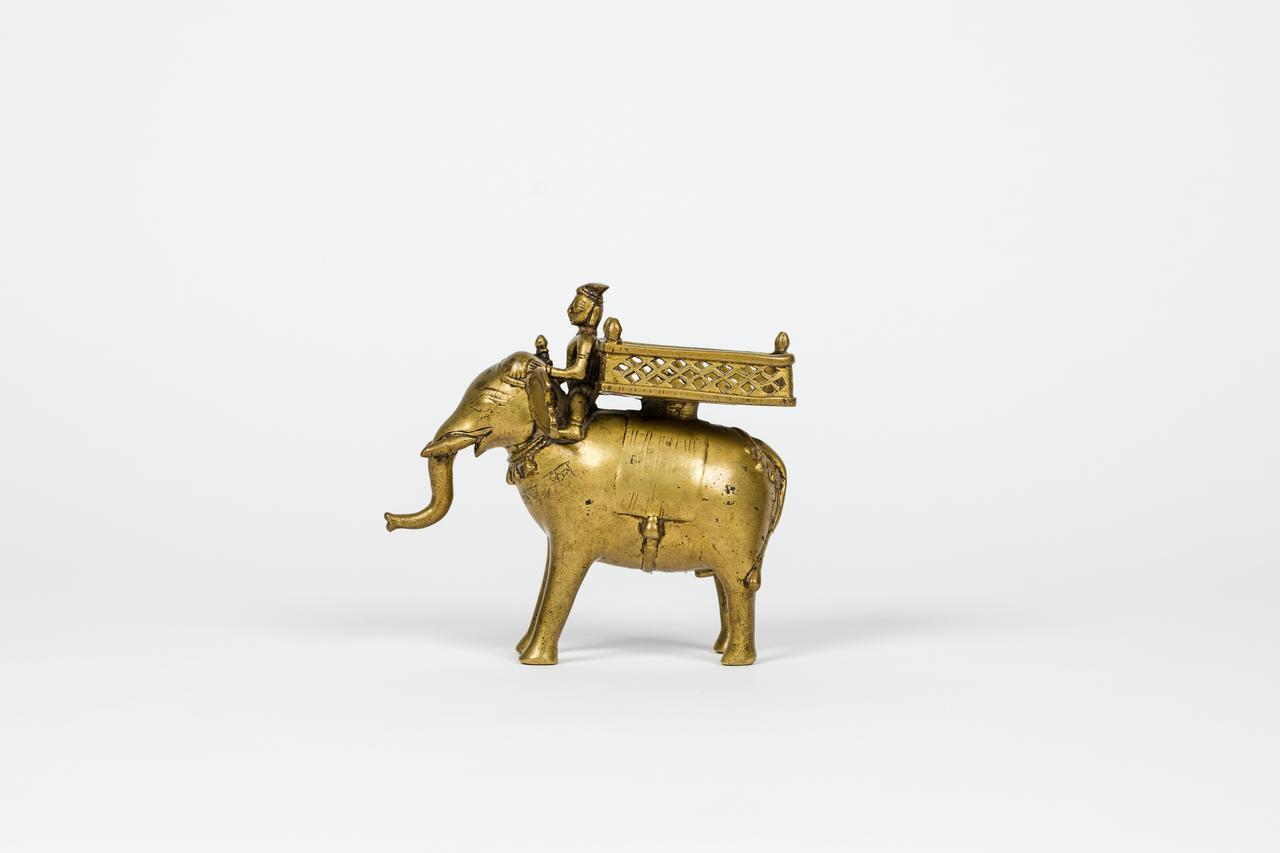
Nandi - Bronze - India - 19th century


05
days
00
hours
37
minutes
16
seconds
Starting bid
€ 1
Reserve price not met

Expert
Selected by Surya Rutten
Has over 25 years' experience in Asian art and owned an art gallery.
Estimate € 150 - € 200
No bids placed
Catawiki Buyer Protection
Your payment’s safe with us until you receive your object.View details
Trustpilot 4.4 | 142824 reviews
Rated Excellent on Trustpilot.
Bronze Nandi, a 5 × 6 × 4 cm devotional statuette from India, dating to the 19th century, in good condition.
AI-assisted summary
Description from the seller
Nandi, the sacred bull of Shiva
India
Late 19th century
Bronze
5 × 6 × 4 cm
Small and endearing representation of Nandi, the sacred bull and vahana (divine vehicle) of the god Shiva. This statuette belongs to the tradition of votive Hindu bronzes of small format, intended for devotion and ritual practices.
Nandi is depicted lying on a rectangular base, the legs folded under the body and the head held upright. Despite the piece’s particularly small dimensions, the bronze artisan gave remarkable attention to its ornamental character. The powerful, rounded body is animated by incised lines depicting the harnesses and ceremonial adornments that cover the back and flanks. The neck bears several rows of necklaces, while a pendant descends onto the chest.
The head presents large, prominent eyes emphasized by the incision, a rounded muzzle and small ears widely spaced. The forehead is also adorned. This abundance of jewellery and harnessing elements recalls that Nandi is not represented as a simple bovine, but as a divine animal adorned for worship.
In front of him sits a small ritual element, a Shivalingam integrated into the same composition. Its presence reinforces the cultic character of the whole. In the Shaivite tradition, Nandi holds an essential position. He is at once mount, servant and guardian of Shiva, but also one of his most fervent devotees. In temples dedicated to Shiva, his image is traditionally placed along the axis of the sanctuary, facing the lingam, which he continually contemplates. This arrangement symbolizes absolute devotion and the privileged relationship between the devotee and the divinity.
Condition: The piece retains a warm golden surface despite cleaning and detarnation. Under the base, traces of mineralization and an old patina attest to its antiquity. Good overall condition.
Provenance: Kanaka The Collection, Portugal
Shipped with UPS and insured
Seller's Story
Kanaka The Collection is a Portugal-based web gallery specialising in Asian art, with a particular focus on the arts of Southeast Asia.
With over 20 years of experience and passion for Asian art, we offer a carefully curated selection of sculptures, ceramics and works of art from across Asia, chosen for their artistic quality, authenticity and historical interest.
Every piece is professionally packed, and we ship worldwide to collectors and institutions.
We remain personally available to collectors before and after each acquisition.
Translated by Google TranslateNandi, the sacred bull of Shiva
India
Late 19th century
Bronze
5 × 6 × 4 cm
Small and endearing representation of Nandi, the sacred bull and vahana (divine vehicle) of the god Shiva. This statuette belongs to the tradition of votive Hindu bronzes of small format, intended for devotion and ritual practices.
Nandi is depicted lying on a rectangular base, the legs folded under the body and the head held upright. Despite the piece’s particularly small dimensions, the bronze artisan gave remarkable attention to its ornamental character. The powerful, rounded body is animated by incised lines depicting the harnesses and ceremonial adornments that cover the back and flanks. The neck bears several rows of necklaces, while a pendant descends onto the chest.
The head presents large, prominent eyes emphasized by the incision, a rounded muzzle and small ears widely spaced. The forehead is also adorned. This abundance of jewellery and harnessing elements recalls that Nandi is not represented as a simple bovine, but as a divine animal adorned for worship.
In front of him sits a small ritual element, a Shivalingam integrated into the same composition. Its presence reinforces the cultic character of the whole. In the Shaivite tradition, Nandi holds an essential position. He is at once mount, servant and guardian of Shiva, but also one of his most fervent devotees. In temples dedicated to Shiva, his image is traditionally placed along the axis of the sanctuary, facing the lingam, which he continually contemplates. This arrangement symbolizes absolute devotion and the privileged relationship between the devotee and the divinity.
Condition: The piece retains a warm golden surface despite cleaning and detarnation. Under the base, traces of mineralization and an old patina attest to its antiquity. Good overall condition.
Provenance: Kanaka The Collection, Portugal
Shipped with UPS and insured
Seller's Story
Kanaka The Collection is a Portugal-based web gallery specialising in Asian art, with a particular focus on the arts of Southeast Asia.
With over 20 years of experience and passion for Asian art, we offer a carefully curated selection of sculptures, ceramics and works of art from across Asia, chosen for their artistic quality, authenticity and historical interest.
Every piece is professionally packed, and we ship worldwide to collectors and institutions.
We remain personally available to collectors before and after each acquisition.
Translated by Google TranslateDetails
Dynastic Style/Period
19th century
Country of Origin
India
Material
Bronze
Height
5 cm
Width
6 cm
Title of artwork
Nandi
Depth
4 cm
Condition
Good condition
Provenance
Private collection
Sold by