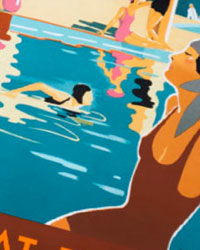
Alexander Calder - Sala Gaspar - Original Lithographic Print 1973


Starting bid
€ 1
Add to your favourites to get an alert when the auction starts.

Expert
Selected by Juan Antonio Rodríguez
Eight years experience valuing posters, previously valuer at Balclis, Barcelona.
Estimate € 150 - € 200
Catawiki Buyer Protection
Your payment’s safe with us until you receive your object.View details
Trustpilot 4.4 | 143467 reviews
Rated Excellent on Trustpilot.
Description from the seller
Original lithographic poster by Alexander Calder (*)
This work was issued to accompany the artist's solo exhibition at Sala Gaspar, in Barcelona, in May 1972.
Last available copy.
Specifications:
Dimensions: 75 x 56 cm
Year: 1973
Condition: Very Good (Shows light overall yellowing due to age. Nevertheless, this work has never been framed or exposed, and has always been kept in a professional art portfolio, so it is offered in very good condition).
Provenance: Private Collection.
The artwork will be carefully handled and packaged in reinforced cardboard packaging. The shipment will be sent with a tracking number.
The shipping will also include transport insurance for the final value of the work with full reimbursement in case of loss or damage, at no cost to the buyer.
(*) Alexander Calder (Philadelphia, United States, 1898 - New York, 1976) was born into a family of artists, but did not initially feel inclined toward art and studied mechanical engineering, which would later prove very useful. He did not enroll in an art school until 1923, where he began by sketching quick views of passersby.
Influenced by abstract artists such as Piet Mondrian, Jean Arp, and Joan Miró, in 1931 he joined the abstract–creational association Abstraction-Creation, and that same year created a work that Marcel Duchamp dubbed a mobile. Precisely, it is the mobiles that elevated Calder to the highest peaks of modern sculpture. With them he sought to create abstract, moving works that, thanks to their dynamism, reflected the changing effects of light.
He produced mobiles of very different sizes, some enormous, in which he used colored brass pieces of abstract shapes, joined by wires or cords; usually suspended from the ceiling, due to their light weight they were easily moved by the air.
With these works, he was the first to incorporate movement into a work of art and became a pioneer of kinetic art. Notably Steel Fish and Red Petals stand out. Calder's great success with the mobiles explains why the artist received commissions from various countries and why his works adorn some of the world's major cities.
He also created stabiles, non-moving sculptures, large and dark-colored, often reproducing monsters or strange animals. Referring to his mobiles, Alexander Calder once said that with them he aimed to give life and movement to the works of Piet Mondrian, which he had the opportunity to see in person and which left a deep impact.
Seller's Story
EsKobARTE carefully selects artworks from renowned and emerging artists worldwide, offering them here at affordable prices. *** HIGH-QUALITY LICENSED PRINTS *** We only sell authentic artworks and high-quality licensed prints. *** WE ARE PROFESSIONALS *** You can bid on our items with complete confidence. Over 1000 positive reviews on Catawiki attest to our professionalism. *** SECURE, CERTIFIED, AND INSURED SHIPPING *** All our items are carefully packaged in eco-friendly cardboard boxes. We work with the best courier services (UPS, DPD, DHL, FedEx) to guarantee the best service and tracking. Our shipments also include insurance against damage or loss, at no extra cost to the buyer *** COMBINED SHIPPING *** If you purchase multiple items -even from different auctions- you will only pay for shipping once *** ANY QUESTIONS? *** Feel free to contact us via chat, we will gladly assist you as soon as possible *** THANK YOU AND GOOD LUCK WITH YOUR BIDS! ***
Translated by Google TranslateOriginal lithographic poster by Alexander Calder (*)
This work was issued to accompany the artist's solo exhibition at Sala Gaspar, in Barcelona, in May 1972.
Last available copy.
Specifications:
Dimensions: 75 x 56 cm
Year: 1973
Condition: Very Good (Shows light overall yellowing due to age. Nevertheless, this work has never been framed or exposed, and has always been kept in a professional art portfolio, so it is offered in very good condition).
Provenance: Private Collection.
The artwork will be carefully handled and packaged in reinforced cardboard packaging. The shipment will be sent with a tracking number.
The shipping will also include transport insurance for the final value of the work with full reimbursement in case of loss or damage, at no cost to the buyer.
(*) Alexander Calder (Philadelphia, United States, 1898 - New York, 1976) was born into a family of artists, but did not initially feel inclined toward art and studied mechanical engineering, which would later prove very useful. He did not enroll in an art school until 1923, where he began by sketching quick views of passersby.
Influenced by abstract artists such as Piet Mondrian, Jean Arp, and Joan Miró, in 1931 he joined the abstract–creational association Abstraction-Creation, and that same year created a work that Marcel Duchamp dubbed a mobile. Precisely, it is the mobiles that elevated Calder to the highest peaks of modern sculpture. With them he sought to create abstract, moving works that, thanks to their dynamism, reflected the changing effects of light.
He produced mobiles of very different sizes, some enormous, in which he used colored brass pieces of abstract shapes, joined by wires or cords; usually suspended from the ceiling, due to their light weight they were easily moved by the air.
With these works, he was the first to incorporate movement into a work of art and became a pioneer of kinetic art. Notably Steel Fish and Red Petals stand out. Calder's great success with the mobiles explains why the artist received commissions from various countries and why his works adorn some of the world's major cities.
He also created stabiles, non-moving sculptures, large and dark-colored, often reproducing monsters or strange animals. Referring to his mobiles, Alexander Calder once said that with them he aimed to give life and movement to the works of Piet Mondrian, which he had the opportunity to see in person and which left a deep impact.
Seller's Story
EsKobARTE carefully selects artworks from renowned and emerging artists worldwide, offering them here at affordable prices. *** HIGH-QUALITY LICENSED PRINTS *** We only sell authentic artworks and high-quality licensed prints. *** WE ARE PROFESSIONALS *** You can bid on our items with complete confidence. Over 1000 positive reviews on Catawiki attest to our professionalism. *** SECURE, CERTIFIED, AND INSURED SHIPPING *** All our items are carefully packaged in eco-friendly cardboard boxes. We work with the best courier services (UPS, DPD, DHL, FedEx) to guarantee the best service and tracking. Our shipments also include insurance against damage or loss, at no extra cost to the buyer *** COMBINED SHIPPING *** If you purchase multiple items -even from different auctions- you will only pay for shipping once *** ANY QUESTIONS? *** Feel free to contact us via chat, we will gladly assist you as soon as possible *** THANK YOU AND GOOD LUCK WITH YOUR BIDS! ***
Translated by Google TranslateDetails
Era
1900-2000
Designer/artist
Alexander Calder
Poster title
Sala Gaspar - Original Lithographic Print 1973
Subject
Art, Original artwork
Country of origin
Spain
Condition
A (excellent - mint condition)
Height
75 cm
Width
56 cm