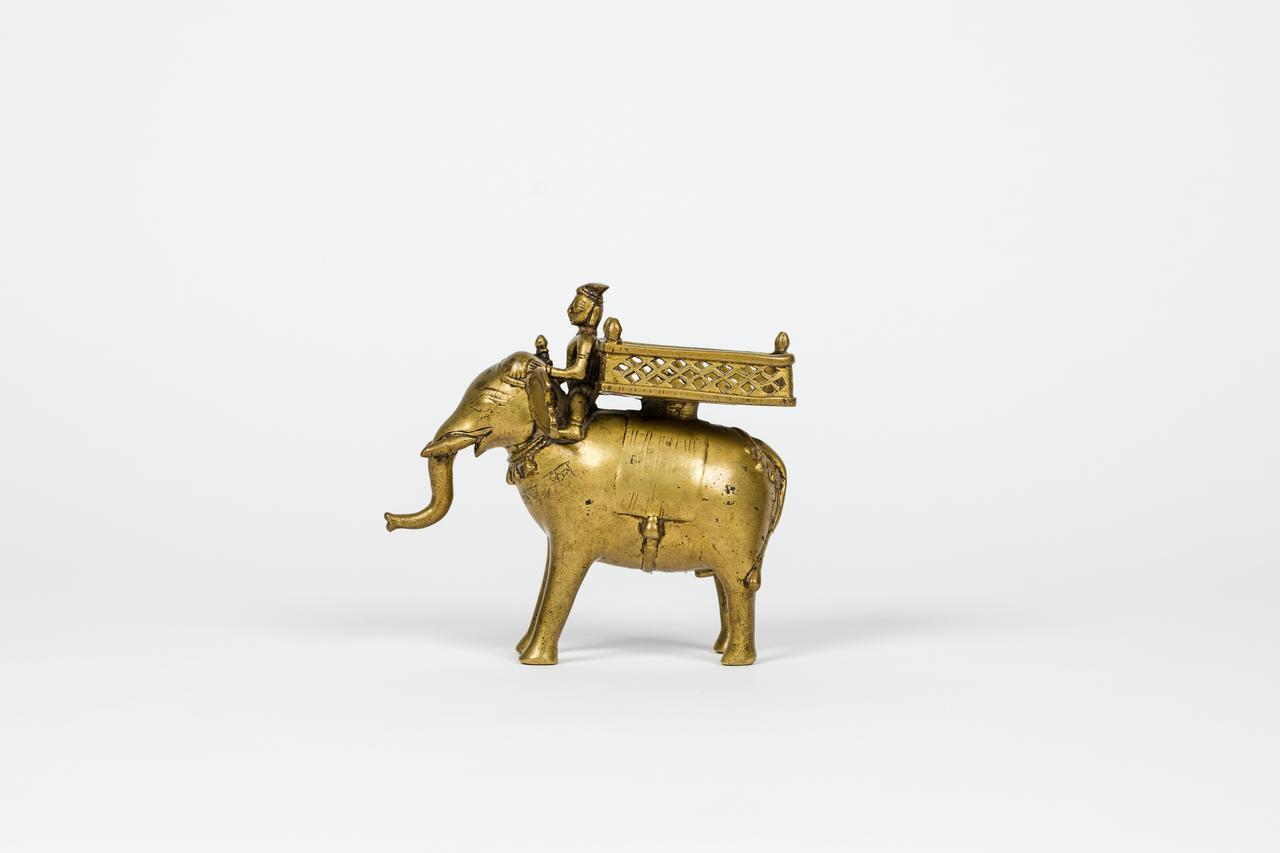
Bowl - Copper - Rare - Lota - 18/19th century


03
days
11
hours
16
minutes
48
seconds
Current bid
€ 3
Reserve price not met

Expert
Selected by Surya Rutten
Has over 25 years' experience in Asian art and owned an art gallery.
Estimate € 400 - € 450
 | €3 | |
|---|---|---|
 | €2 | |
| €1 |
Catawiki Buyer Protection
Your payment’s safe with us until you receive your object.View details
Trustpilot 4.4 | 142857 reviews
Rated Excellent on Trustpilot.
Description from the seller
Rare
Lota (ritual vase / sacred water vessel)
North India (Uttar Pradesh or Himachal Pradesh)
19th century
Copper alloy (brass/bronze) worked in repoussé, chiseled and engraved
Height: 16 cm | Maximum diameter: 17 cm
The iconography skillfully unites the divine world (Ganesha, Hanuman) with the princely imagery of late Rajput or Mughal culture (hunting scenes, riders and elephants in ceremonial attire). This type of vessel was used both in religious rites of ablution/cleansing (abhisheka) and for the conservation of sacred Ganges water (Gangajali) within an aristocratic household.
Spherical vessel with a short flared neck, ending in a plane lip inclined outward. The heavily bulging globular body flares to its maximum diameter of 17 cm before narrowing to a circular flat base, at the center of which are incised concentric circles. The entire exterior surface bears a densely historiated decoration organized in architectural registers by polylobed arches bordered with twisted rims and beaded motifs.
The upper lip forms a circular frieze of punched/engraved motifs in a circular pattern. On the body, five large lobed medallions house mythological and courtly scenes in high relief (obtained by repoussé hammering from the inside, then fine chiseling on a fully guilloché background).
Ganesha: The elephant-headed god standing/dancing with four arms, wearing the nagayajnopavita (sacred serpent-like cord), holding his ritual attributes (ankusha, parashu, laddu bowl).
Hanuman: The monkey god in heroic pose (alidhasana), holding his mace (gada in one hand and bearing in the other the mountain Dronagiri containing the life-greath herb (Sanjeevani)).
Garuda subduing the Naga: The mythical bird-man, Vishnu’s vehicle, depicted in motion, with wings spread and firmly restraining a serpent (Naga) raised before him.
Royal Procession on Elephant: A prince or dignitary seated in a howdah (seat) on a caparisoned elephant, guided by his mahout holding the elephant hook.
Armored Cavalry: A courtly Northern Indian warrior galloping, brandishing a curved saber (tulwar).
Divine Figure / Seated Prince: A figure enthroned, holding a ritual attribute or scepter under an arch of adornment.
The lower part of the belly is outlined by a continuous frieze of stylized lotus petals (padmapitha) blossoming toward the base. This vase fully embodies the tradition of ritual art metals of Northern India from the 18th to the 19th century. The repoussé technique is developed to a remarkable degree of mastery, with the volumes of the figures emerging strongly from the metal wall, while the surface engraving yields great precision in the details of garments, caparisons and jewelry.
Condition: Beautiful patina of brown and golden wear. Surface wear and several dents due to use at the base, the body and the lip.
Seller's Story
Kanaka The Collection is a Portugal-based web gallery specialising in Asian art, with a particular focus on the arts of Southeast Asia.
With over 20 years of experience and passion for Asian art, we offer a carefully curated selection of sculptures, ceramics and works of art from across Asia, chosen for their artistic quality, authenticity and historical interest.
Every piece is professionally packed, and we ship worldwide to collectors and institutions.
We remain personally available to collectors before and after each acquisition.
Translated by Google TranslateRare
Lota (ritual vase / sacred water vessel)
North India (Uttar Pradesh or Himachal Pradesh)
19th century
Copper alloy (brass/bronze) worked in repoussé, chiseled and engraved
Height: 16 cm | Maximum diameter: 17 cm
The iconography skillfully unites the divine world (Ganesha, Hanuman) with the princely imagery of late Rajput or Mughal culture (hunting scenes, riders and elephants in ceremonial attire). This type of vessel was used both in religious rites of ablution/cleansing (abhisheka) and for the conservation of sacred Ganges water (Gangajali) within an aristocratic household.
Spherical vessel with a short flared neck, ending in a plane lip inclined outward. The heavily bulging globular body flares to its maximum diameter of 17 cm before narrowing to a circular flat base, at the center of which are incised concentric circles. The entire exterior surface bears a densely historiated decoration organized in architectural registers by polylobed arches bordered with twisted rims and beaded motifs.
The upper lip forms a circular frieze of punched/engraved motifs in a circular pattern. On the body, five large lobed medallions house mythological and courtly scenes in high relief (obtained by repoussé hammering from the inside, then fine chiseling on a fully guilloché background).
Ganesha: The elephant-headed god standing/dancing with four arms, wearing the nagayajnopavita (sacred serpent-like cord), holding his ritual attributes (ankusha, parashu, laddu bowl).
Hanuman: The monkey god in heroic pose (alidhasana), holding his mace (gada in one hand and bearing in the other the mountain Dronagiri containing the life-greath herb (Sanjeevani)).
Garuda subduing the Naga: The mythical bird-man, Vishnu’s vehicle, depicted in motion, with wings spread and firmly restraining a serpent (Naga) raised before him.
Royal Procession on Elephant: A prince or dignitary seated in a howdah (seat) on a caparisoned elephant, guided by his mahout holding the elephant hook.
Armored Cavalry: A courtly Northern Indian warrior galloping, brandishing a curved saber (tulwar).
Divine Figure / Seated Prince: A figure enthroned, holding a ritual attribute or scepter under an arch of adornment.
The lower part of the belly is outlined by a continuous frieze of stylized lotus petals (padmapitha) blossoming toward the base. This vase fully embodies the tradition of ritual art metals of Northern India from the 18th to the 19th century. The repoussé technique is developed to a remarkable degree of mastery, with the volumes of the figures emerging strongly from the metal wall, while the surface engraving yields great precision in the details of garments, caparisons and jewelry.
Condition: Beautiful patina of brown and golden wear. Surface wear and several dents due to use at the base, the body and the lip.
Seller's Story
Kanaka The Collection is a Portugal-based web gallery specialising in Asian art, with a particular focus on the arts of Southeast Asia.
With over 20 years of experience and passion for Asian art, we offer a carefully curated selection of sculptures, ceramics and works of art from across Asia, chosen for their artistic quality, authenticity and historical interest.
Every piece is professionally packed, and we ship worldwide to collectors and institutions.
We remain personally available to collectors before and after each acquisition.
Translated by Google TranslateDetails
Era
1400-1900
Title additional information
Rare - Lota - 18/19th century
Number of objects
1
Country of origin
India
Material
Copper
Dynastic style/period
19th century
Provenance
Gallery / Antique dealer
Condition
Fair condition - heavily used & with possibly minor parts missing
Height
16 cm
Sold with stand
No
Width
17 cm
Depth
17 cm
Estimated period
1750-1800
Sold by