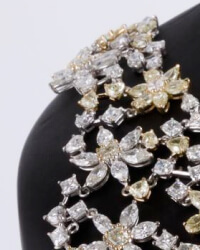
Ring - 18 kt. Yellow gold, White gold - 2.65ct. tw. Sapphire - Diamond - Chevalier Ring


06
days
16
hours
31
minutes
58
seconds
Current bid
€ 1
Reserve price not met

Expert
Selected by Laura Trevino
She has 15 years' auction experience, specialising in vintage jewellery from 1920 to 2000.
Estimate € 3,300 - € 4,000
 | €1 |
|---|
Catawiki Buyer Protection
Your payment’s safe with us until you receive your object.View details
Trustpilot 4.4 | 143362 reviews
Rated Excellent on Trustpilot.
Vintage chevalier-style ring in 18 karat yellow gold with 18 karat white gold accents, a central oval synthetic blue sapphire (~2.65 ct) surrounded by seven natural round brilliant diamonds (~0.70 ct) on a size EU 64 (IT 24, US 10 ¾) setting, in good used condition with no laboratory report.
AI-assisted summary
Description from the seller
Vintage ring from the 1940s–1950s in 18-karat yellow gold with 18-karat white gold accents on the front, featuring a blue synthetic sapphire and natural diamonds.
Impressive vintage-inspired ring, dated roughly to the 1940s–1950s, made in 18-karat yellow gold with 18-karat white gold accents on the front.
The piece presents a striking horseshoe motif, with a vivid blue synthetic sapphire at the center, oval-cut and mixed-cut. The central stone is surrounded by seven natural diamonds in transitional brilliant cut, set in white gold to enhance its luminosity and contrast.
The design combines a mount with geometric lines and substantial volume with the classic elegance of deep blue and the sparkle of diamonds, giving rise to a ring with a distinctive character and a strong presence on the hand.
Characteristics:
- Era: 1940s–1950s, approximate dating.
- Metal: 18-karat yellow gold with 18-karat white gold accents.
- Contrast: stamped 18 K / 750.
- Central stone: blue synthetic sapphire, oval mixed-cut, with an estimated weight of approximately 2.70 carats.
- Diamonds: 7 natural diamonds in transitional brilliant cut, with a total weight of approximately 0.70 carats.
- Total ring weight: 15.57 grams.
- Tatum: 24.
A vintage jewel with a bold and elegant aesthetic, ideal for collectors and lovers of classical jewelry with colored stones.
The piece shows signs of wear consistent with its age.
Seller's Story
Joyerías Sancho is a family business with almost 50 years of experience in the jewelry sector. We specialize in buying jewelry from individuals and in selecting second-hand pieces with authenticity guaranteed. Our catalog focuses mainly on 20th-century jewelry, although occasionally we offer older pieces and also contemporary creations of particular interest. Each lot is reviewed and described with the utmost rigor by our team to ensure a transparent and trustworthy purchasing experience. Our priority is that each jewel finds a new owner who can value its history, quality and design.
Translated by Google TranslateVintage ring from the 1940s–1950s in 18-karat yellow gold with 18-karat white gold accents on the front, featuring a blue synthetic sapphire and natural diamonds.
Impressive vintage-inspired ring, dated roughly to the 1940s–1950s, made in 18-karat yellow gold with 18-karat white gold accents on the front.
The piece presents a striking horseshoe motif, with a vivid blue synthetic sapphire at the center, oval-cut and mixed-cut. The central stone is surrounded by seven natural diamonds in transitional brilliant cut, set in white gold to enhance its luminosity and contrast.
The design combines a mount with geometric lines and substantial volume with the classic elegance of deep blue and the sparkle of diamonds, giving rise to a ring with a distinctive character and a strong presence on the hand.
Characteristics:
- Era: 1940s–1950s, approximate dating.
- Metal: 18-karat yellow gold with 18-karat white gold accents.
- Contrast: stamped 18 K / 750.
- Central stone: blue synthetic sapphire, oval mixed-cut, with an estimated weight of approximately 2.70 carats.
- Diamonds: 7 natural diamonds in transitional brilliant cut, with a total weight of approximately 0.70 carats.
- Total ring weight: 15.57 grams.
- Tatum: 24.
A vintage jewel with a bold and elegant aesthetic, ideal for collectors and lovers of classical jewelry with colored stones.
The piece shows signs of wear consistent with its age.
Seller's Story
Joyerías Sancho is a family business with almost 50 years of experience in the jewelry sector. We specialize in buying jewelry from individuals and in selecting second-hand pieces with authenticity guaranteed. Our catalog focuses mainly on 20th-century jewelry, although occasionally we offer older pieces and also contemporary creations of particular interest. Each lot is reviewed and described with the utmost rigor by our team to ensure a transparent and trustworthy purchasing experience. Our priority is that each jewel finds a new owner who can value its history, quality and design.
Translated by Google TranslateDetails
Era
1900-2000
Shape of surrounding stones
Round
Free resizing offered
No
Total carat weight of all stones
2.65
Laboratory report
No laboratory report
Diamond type of surrounding stones
Natural
No. of main gemstones
1
Cutting style of surrounding stones
Brilliant cut
Metal
White gold, Yellow gold
Fineness
18 kt.
Brand jewellery
No
Number of diamonds surrounding stones
7
Total carat weight of main stone(s)
2.65
Total carat weight of surrounding stones
0.70
Main stone
Sapphire
Surrounding stones
Diamond
Total weight
15.57 g
Condition
Good condition - used with some signs of wear
Gender
Men
Title additional information
Chevalier Ring
Shape of main stone
Oval
Cutting style of main stone
Mixed cut
Ring size
64 (EU) / 24 (IT) / 10 ¾ (US)
Sold by
Disclaimer
Catawiki always aims to offer you the best possible buying experience. Our experts virtually review and select every object in line with our submission guidelines. While we strive to provide a detailed description and photographs of each jewellery object, discrepancies or inaccuracies may occur. It is your responsibility to review all of the information provided about an object, including the condition and description, before placing an order. Sellers are responsible for the information, pictures and description provided, including the quality, quantity and nature of the jewelry supplied. A small imperfection that cannot be seen in the photo but is included in the description is not a non-conformity. A Lab Report is not a guarantee, valuation or appraisal regarding the articles described therein. A Lab Report contains only the characteristics of an article described after it has been graded, tested, examined, and analyzed using the techniques and equipment used at the time of the examination from that specific Lab. The results of any other examination performed on the article may differ depending when, how, by whom and with which grading standard the article is examined. In addition, any changes and improvements in techniques and equipment that may have occurred which may enable the examiner to detect, among other things, the use of processes for altering the characteristics of an article which use was previously undetectable, does not automatically mean the object does not conform to its description.
Catawiki always aims to offer you the best possible buying experience. Our experts virtually review and select every object in line with our submission guidelines. While we strive to provide a detailed description and photographs of each jewellery object, discrepancies or inaccuracies may occur. It is your responsibility to review all of the information provided about an object, including the condition and description, before placing an order. Sellers are responsible for the information, pictures and description provided, including the quality, quantity and nature of the jewelry supplied. A small imperfection that cannot be seen in the photo but is included in the description is not a non-conformity. A Lab Report is not a guarantee, valuation or appraisal regarding the articles described therein. A Lab Report contains only the characteristics of an article described after it has been graded, tested, examined, and analyzed using the techniques and equipment used at the time of the examination from that specific Lab. The results of any other examination performed on the article may differ depending when, how, by whom and with which grading standard the article is examined. In addition, any changes and improvements in techniques and equipment that may have occurred which may enable the examiner to detect, among other things, the use of processes for altering the characteristics of an article which use was previously undetectable, does not automatically mean the object does not conform to its description.