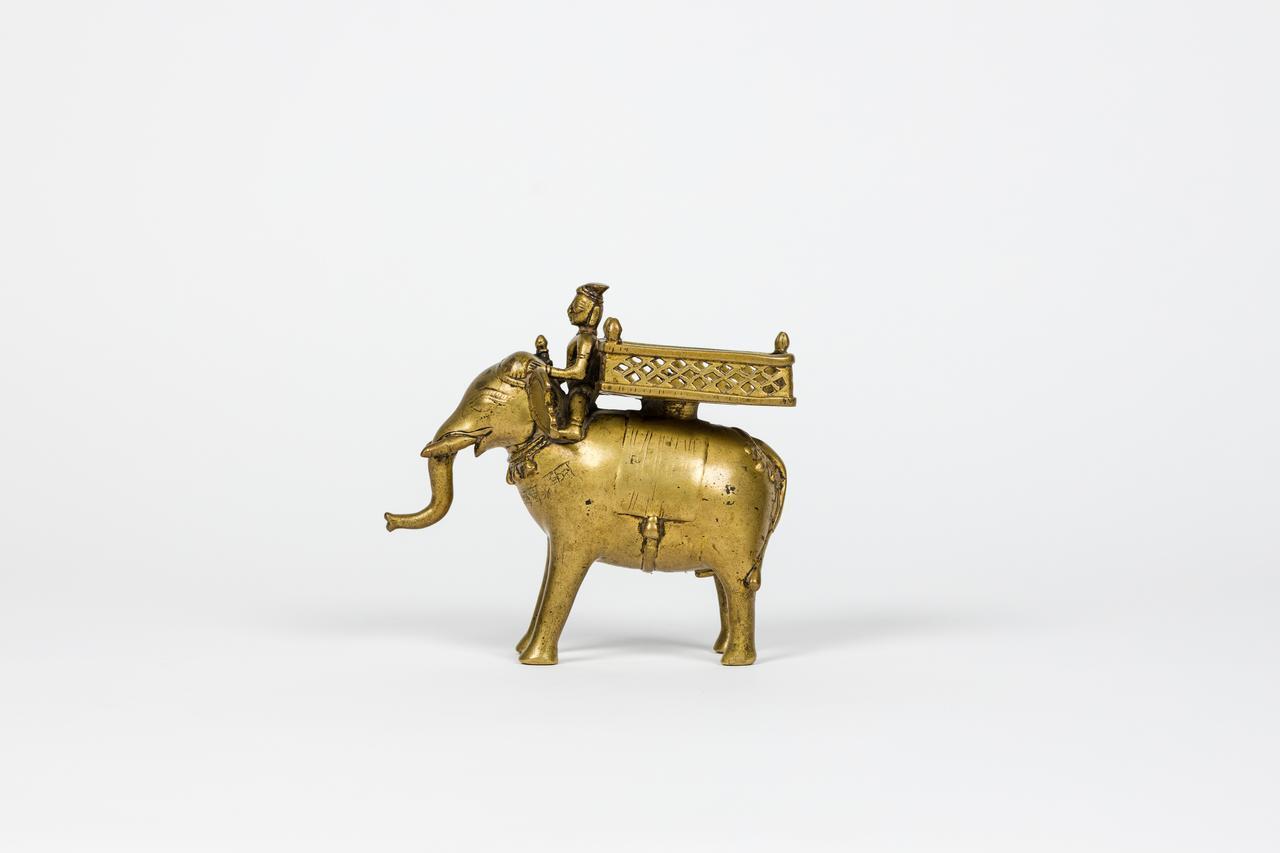
Sculpture, Mahiṣāsuramardinī, bronzo a cera persa con prabhāvali a nāga, India occidentale/Deccan, XIX secolo - 14.5 cm - Lost-wax bronze casting


07
days
03
hours
42
minutes
41
seconds
Starting bid
€ 1
Reserve price not met

Expert
Selected by Surya Rutten
Has over 25 years' experience in Asian art and owned an art gallery.
Estimate € 400 - € 500
No bids placed
Catawiki Buyer Protection
Your payment’s safe with us until you receive your object.View details
Trustpilot 4.4 | 143856 reviews
Rated Excellent on Trustpilot.
Mahiṣāsuramardinī, a bronze wax‑cast devotional sculpture with a prabhāvali halo from western India (Deccan/Maharashtra), dating to the early 19th century, in good condition and unsigned, measuring 14.5 cm high by 7.5 cm wide by 6.5 cm deep.
AI-assisted summary
Description from the seller
Mahiṣāsuramardinī in bronze with prabhāvali, Western India (Deccan/Maharashtra), 19th century.
Bronze devotional cast in the Persian lost-wax technique with an arched halo, prabhāvali, and a rectangular multi-step base. The Goddess is depicted advancing, her torso adorned with jewelry and a tall conical jaṭā-mukuṭa; she wields an elongated weapon (lance/śūla) and with a determined gesture dominates the demon buffalo Mahiṣa: the animal’s body lies at the base, while the anthropomorphic demon emerges from the wound at the neck, a canonical iconographic detail of the Mahiṣāsuramardinī theme. The right leg is elegantly bent and rests squarely on the buffalo’s back, emphasizing victory; beside it, a small figure with hands joined indicates the votive use of the image, while, on the front edge of the pedestal, a pair of footprints (pādukā/pāda-chihna) offers the devotee an aniconic sign of the divine presence and of darśan. On the arch appear small apotropaic and circular emblems, including a crescent moon, in an ornamental repertoire typical of workshops in Western India. The ensemble preserves a light stratification of ritual dust in the cavities, consistent with long ritual use.
Theologically, the subject fully belongs to the Śivaita taste: Mahiṣāsuramardinī is the warrior aspect of Durga/Parvatī, the Śakti (energy) of Śiva. The scene, narrated in the Devi Māhātmya, is an allegory of the feminine principle that reestablishes cosmic order by defeating chaotic forces; the worship of the Goddess, even in a Śivaita context, integrates and “activates” Śiva’s power.
In terms of style and technique—lost-wax casting with smooth surfaces, full face, tall conical headdress, elliptical prabhāvali with punched motifs, and a low stepped base with a small donor in prayer—the work is very likely from the Deccan/Maharashtrian area and dates to the first half of the 19th century, with a language that preserves archaising elements typical of popular sculpture in Western India.
Details
Era
1400-1900
Over 200 years old
No
Country of origin
India
Style
Antique
Material
Lost-wax bronze casting
Title of artwork
Mahiṣāsuramardinī, bronzo a cera persa con prabhāvali a nāga, India occidentale/Deccan, XIX secolo
Dynastic style/period
Maratha Empire (1674-1818)
Signature
Not signed
Provenance
Private collection
Condition
Good condition
Sold with stand
No
Height
14.5 cm
Width
7.5 cm
Depth
6.5 cm
Sold by