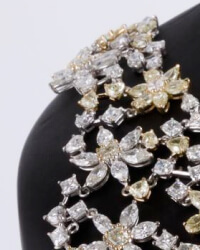
Earrings - 14 kt. Yellow gold - Catalan earrings


06
days
17
hours
19
minutes
30
seconds
Current bid
€ 550
Reserve price not met

Expert
Selected by Laura Trevino
She has 15 years' auction experience, specialising in vintage jewellery from 1920 to 2000.
Estimate € 1,400 - € 1,700
 | €550 | |
|---|---|---|
| €500 |
Catawiki Buyer Protection
Your payment’s safe with us until you receive your object.View details
Trustpilot 4.4 | 143856 reviews
Rated Excellent on Trustpilot.
Catalan 14 kt yellow gold emerald three-part chandelier earrings dating to ca. 1780–1820 from Spain, total weight 8.78 g, length 6 cm, in good used condition with no laboratory report.
AI-assisted summary
Description from the seller
Significant antique emerald arracades (chandelier earrings) in the form of traditional three-part hinged drop earrings from the period around 1800 (Late Baroque / Neoclassicism). Made in Catalonia (Spain) circa 1780–1820. This museum-grade piece was handcrafted in 14K yellow gold and features fine, intricate, openwork ornamentation.
This specific style of three-part, movable filigree jewelry originated in the 18th century in Spain’s wealthier regions. Such opulent pieces were worn exclusively by women of the affluent bourgeoisie and nobility on traditional festive days, regional ceremonial events, and exclusive weddings. The chandelier design served as an unmistakable sign of extreme wealth, status, and regional pride, as the three movable elements glittered with every movement in the candlelight of the time.
The earrings are inlaid along the entire length of the three links with genuine emeralds in the early rose cut (lasque cut). The stones are harmoniously integrated into the fine, pierced goldwork. The pieces are fitted on the back with the period-typical, fully functional hinged clasp that closes from back to front.
All stones are set in the historically typical closed, foil-backed settings and mounted on foil from the back (foil-backed). This technique was used around 1800 to give the emeralds an incredible, deep radiance in the candlelight of the festival halls. An extremely rare pair in European jewelry history in excellent condition.
Details & Measurements
• Era: Late Baroque / Early 19th Century (c. 1780–1820)
• Origin: Catalonia, Spain (Iberian)
• Metal: 14 karat yellow gold
• Setting: Genuine emeralds (closed, foil-backed setting)
• Cut: Early rose cut (lasque cut)
• Dimensions: 6.0 cm length
• Total weight: 8.78 grams
Condition: Age-appropriate, excellent antique conservation state. The hinged clasp is fully functional and closes securely. Note on the setting: it is possible that over the centuries two of the emeralds were professionally replaced, though this is not definitively confirmed and does not detract from the magnificent overall appearance. Please consider the high-resolution photos as an essential part of the condition description.
Please note: Due to camera settings, lighting during photography, and different screen calibrations, the color representation of the emeralds in the photos may differ slightly from the real object.
Historical jewelry with closed/foil-backed settings should not be cleaned with water, cleaning agents, or in an ultrasonic bath to avoid damaging the original foil. This is not a defect but an inherent characteristic of jewelry from around 1800."
Details
Era
1400-1900
Laboratory report
No laboratory report
Style
Baroque
Estimated period
18th century
Metal
Yellow gold
Brand jewellery
No
Fineness
14 kt.
Total weight
8.78 g
Condition
Good condition - used with some signs of wear
Gender
Women
Country of origin
Spain
Title additional information
Catalan earrings
Disclaimer
Catawiki always aims to offer you the best possible buying experience. Our experts virtually review and select every object in line with our submission guidelines. While we strive to provide a detailed description and photographs of each jewellery object, discrepancies or inaccuracies may occur. It is your responsibility to review all of the information provided about an object, including the condition and description, before placing an order. Sellers are responsible for the information, pictures and description provided, including the quality, quantity and nature of the jewelry supplied. A small imperfection that cannot be seen in the photo but is included in the description is not a non-conformity. A Lab Report is not a guarantee, valuation or appraisal regarding the articles described therein. A Lab Report contains only the characteristics of an article described after it has been graded, tested, examined, and analyzed using the techniques and equipment used at the time of the examination from that specific Lab. The results of any other examination performed on the article may differ depending when, how, by whom and with which grading standard the article is examined. In addition, any changes and improvements in techniques and equipment that may have occurred which may enable the examiner to detect, among other things, the use of processes for altering the characteristics of an article which use was previously undetectable, does not automatically mean the object does not conform to its description.
Catawiki always aims to offer you the best possible buying experience. Our experts virtually review and select every object in line with our submission guidelines. While we strive to provide a detailed description and photographs of each jewellery object, discrepancies or inaccuracies may occur. It is your responsibility to review all of the information provided about an object, including the condition and description, before placing an order. Sellers are responsible for the information, pictures and description provided, including the quality, quantity and nature of the jewelry supplied. A small imperfection that cannot be seen in the photo but is included in the description is not a non-conformity. A Lab Report is not a guarantee, valuation or appraisal regarding the articles described therein. A Lab Report contains only the characteristics of an article described after it has been graded, tested, examined, and analyzed using the techniques and equipment used at the time of the examination from that specific Lab. The results of any other examination performed on the article may differ depending when, how, by whom and with which grading standard the article is examined. In addition, any changes and improvements in techniques and equipment that may have occurred which may enable the examiner to detect, among other things, the use of processes for altering the characteristics of an article which use was previously undetectable, does not automatically mean the object does not conform to its description.