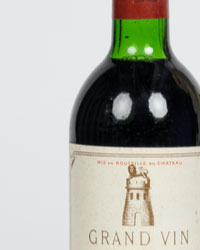
1974 Château Palmer - Margaux 3ème Grand Cru Classé - 1 Bottle (0.75L)


07
days
02
hours
56
minutes
07
seconds

 | €1 |
|---|
Catawiki Buyer Protection
Your payment’s safe with us until you receive your object.View details
Trustpilot 4.4 | 143727 reviews
Rated Excellent on Trustpilot.
Château Palmer 1974 from Margaux, France, in a 0.75 L bottle (one bottle); fill level is a Bordeaux-type bottle with a low neck fill; label intact and legible; capsule slightly corroded/cracked.
AI-assisted summary
Description from the seller
Château Palmer, Third Growth (Classed as 3rd Cru Classé) 1974
Château Palmer takes its name from the English Major General Charles Palmer, who acquired the property under the Restoration in 1814. Previously, the domain was already appreciated by Louis XV, and known as the Château de Gasq. The owner focuses on promoting his wine to British high society, and even today, the English are very big fans. General Palmer led a grand lifestyle… until his bankruptcy forced him to sell his domain in 1843 to the Pereire brothers who would build the current château. Notably recognizable, the château is adorned with four corner turrets. In the 1855 classification, Palmer stumbled at the top of the podium and earned the rank of 3rd Cru Classé. It remains regarded by connoisseurs as the best wine of the appellation, until the rebirth of Château Margaux in the late 1970s, which reestablished the competition between the two crus. Today, Château Palmer belongs to the Mähler-Besse and Sichel families. The harvests are, of course, manual, and the vinification traditional, with the harvests of each grape variety and each plot isolated in separate vats to favor the expression of their specific qualities.
The high proportion of Merlot it contains—47% on average (a sign of the influence of Jean Miailhe, of Pichon Lalande, co-owner of the estate until the end of the 1970s?)—gives it a rich, supple, generous, and fleshy character. Château Palmer’s wines, built for long ageing, are characterized by an exceptionally balanced bouquet of blackcurrant, cherry and liquorice. Rich, yet with freshness, often supple and silky, but always deeply fruity and concentrated, these wines of magnificent elegance undeniably deserve the rank of premier cru classified.
At the end of a 20-month ageing, Palmer wine, every year, is worthy of renewing its membership in the very exclusive circle of the greatest Bordeaux wines. The subtle balance offered by Palmer wines, between aromatic richness and the power of tannins always held in check, makes them unforgettable nectars, reflections of a grape variety where the proportion of Merlot, as important as that of Cabernet Sauvignon, gives the whole a supple, fleshy and velvety character. The flavor palette ranges from blackcurrant to liquorice, passing through cherry, flowers and spices.
Château Palmer takes its name from the English Major General Charles Palmer, who acquired the property under the Restoration in 1814. Previously, the domain was already appreciated by Louis XV, and known as the Château de Gasq. The owner focuses on promoting his wine to British high society, and even today, the English are very big fans. General Palmer leads a great train... until his bankruptcy, which forced him to sell his domain in 1843 to the Pereire brothers who will build the current castle. Particularly recognisable, the castle is decorated with four corner turrets. In the 1855 classification, Palmer stumbled on the top of the podium, and reached the rank of 3rd Cru Classé. However, it remains considered by connoisseurs as the best wine in the appellation, until the rebirth of Château Margaux in the late 1970s, which will restore competition between the two crus. Today, Palmer Castle belongs to the Mähler-Besse and Sichel families. The harvest is obviously manual and the vinification, traditional, the harvests of each grape variety and plot being isolated in different tanks to favour the expression of their specificities.
The high proportion of Merlot it contains - 47% on average (sign of the influence of Jean Miailhe, Pichon Lalande, co-owner of the estate until the end of the 1970s?) Gives him a rich, flexible, generous and fleshy character. Château Palmer's wines, cut for a long keep, are characterised by an exceptionally balanced bouquet of blackcurrant, cherry and liquorice. Rich, but very fresh, often flexible and silky, but always deeply fruity and concentrated, these wines of magnificent elegance undeniably deserve the rank of primer cru classified.
At the end of a 20-month ageing, Palmer wine is, every year, worthy of renewing its membership in the very closed circle of the greatest wines of Bordeaux. The subtle balance offered by Palmer wines, between aromatic richness and power of tannins always retained, makes them unforgettable nectars, reflections of a grape variety where the proportion of Merlot, as important as that of Cabernet Sauvignon, gives the whole a flexible, fleshy and velvety character. The palette of flavours extends from blackcurrant to liquorice, through cherry, flowers and spices.
#ghosts2026
Details
Vintage
1974
Producer, Name of wine
Château Palmer
Classification
3ème Grand Cru Classé
Number of bottles
1
Bottle size
Bottle (0.75L)
Country
France
Region
Margaux
Fill level
Bordeaux bottle type, base neck fill level
Capsule/cork condition
Slightly corroded/ cut or cracked capsule
Label condition
Fully intact, readable label