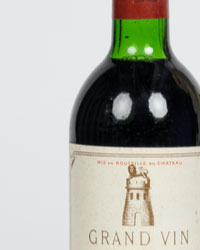
1978 Château Prieure Lichine - Margaux 4ème Grand Cru Classé - 3 Bottles (0.75L)


00
days
17
hours
33
minutes
29
seconds

 | €55 | |
|---|---|---|
 | €50 | |
| €45 | |
Catawiki Buyer Protection
Your payment’s safe with us until you receive your object.View details
Trustpilot 4.4 | 145414 reviews
Rated Excellent on Trustpilot.
Three 0.75-litre bottles of Château Prieure Lichine 1978 from Margaux, France.
AI-assisted summary
Description from the seller
Château Prieuré Lichine 4th Grand Cru Classé 1978
The lands of the Priory of Cantenac, founded by the monks of the Abbey of Vertheuil in the Romanesque era, are devoted to polyculture and breeding even if renowned wines are already produced there. It was not until the middle of the 18th century that the entire estate was entirely dedicated to the vineyard. The Priory cru was then catalogued by the Bordeaux Intendance as the 3rd cru of the grouping of the parishes of Margaux and Cantenac. Following the Revolution, the estate was acquired by M. Durand Delains, a Bordeaux merchant. Promoted to 4th cru during the 1855 classification, the estate was affected by successive crises, phylloxera, then the 1929 crash.
When Alexis Lichine, nicknamed “the Pope of wine,” acquired it in the early 1950s, the vineyard was in a pitiful state. He devoted all his efforts to reviving the cru until his death in 1989. Today Château Prieuré Lichine is owned by the Ballande group, which has sought the counsel of Stéphane Derenoncourt.
About the vintage
Located not far from Château Margaux, the Prieuré-Lichine vineyard has the particularity of spanning the municipalities of Cantenac, Arsac, Labarde, Soussans and Margaux. It is one of the most fragmented estates in the Médoc. Its terroir is composed of gravelly soils and a vine stock with a high proportion of Merlot. The wines are generally quite supple and benefit from a good aging potential.
The wine, let’s talk about it. It is made from a Cabernet Sauvignon–dominant blend at 65% or 70%. It is complemented by Merlot and, to a lesser extent, Petit Verdot. The grapes are harvested in small crates. The berries are sorted, and the vinification is defined by a twenty-day vatting and an élevage in barrels (45% in new oak and 55% in oak of a wine blend).
The tasting reveals a wine with a powerful and complex aromatic profile and an unexpectedly refined palate. A great wine, certainly.
Details
Vintage
1978
Producer, Name of wine
Château Prieure Lichine
Classification
4ème Grand Cru Classé
Number of bottles
3
Bottle size
Bottles (0.75L)
Country
France
Region
Margaux
Fill level
Bordeaux bottle type, top shoulder fill level
Capsule/cork condition
Slightly corroded/ cut or cracked capsule
Label condition
Stained/written/torn or loose readable label