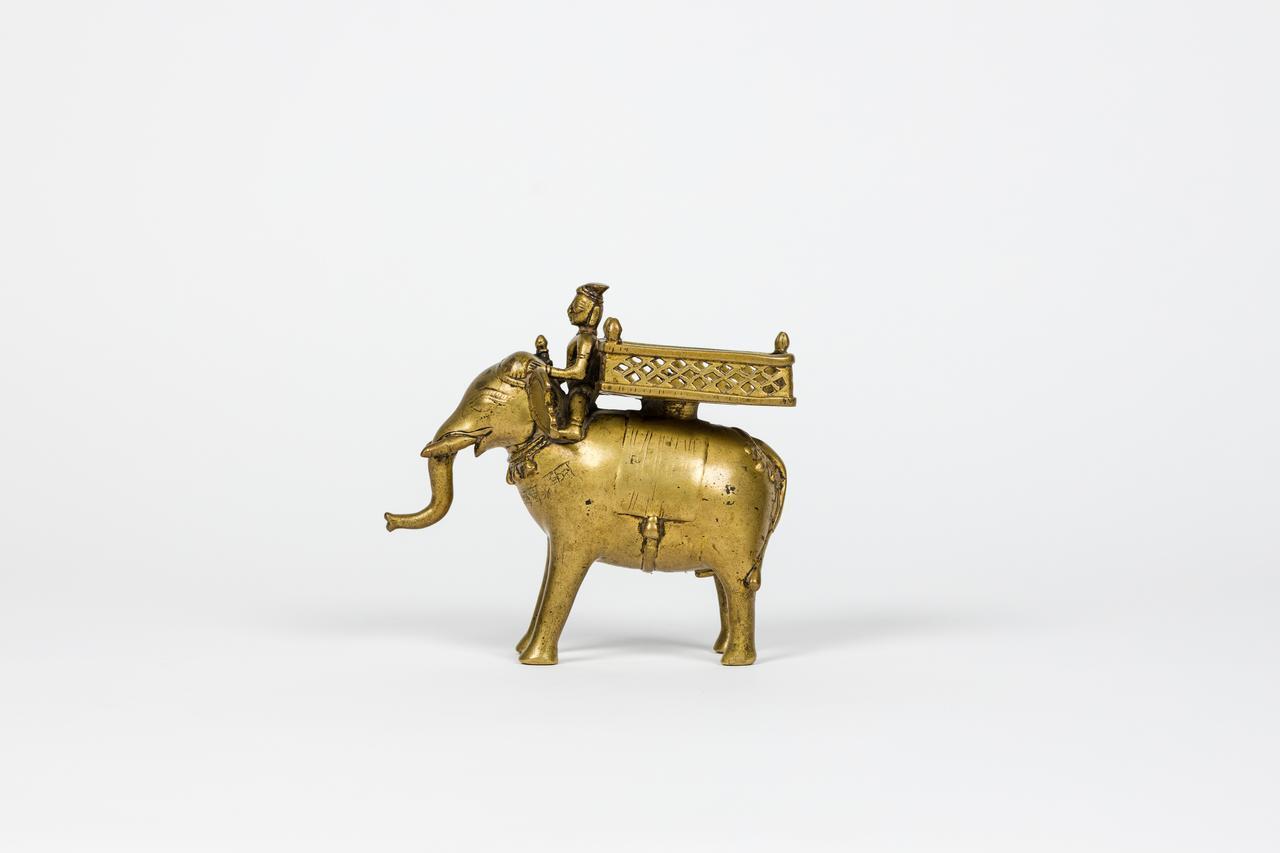
Sculpture, Śiva Mukhaliṅga-kavaca con nāga-chattrā, Deccan (Maharashtra o Karnataka), XIX secolo, India - 17.5 cm - Lost-wax bronze casting


06
days
17
hours
00
minutes
58
seconds
Current bid
€ 2
Reserve price not met

Expert
Selected by Surya Rutten
Has over 25 years' experience in Asian art and owned an art gallery.
Estimate € 650 - € 750
 | €2 |
|---|
Catawiki Buyer Protection
Your payment’s safe with us until you receive your object.View details
Trustpilot 4.4 | 143856 reviews
Rated Excellent on Trustpilot.
Indian bronze (lost-wax cast) sculpture from the Maratha Empire (1674–1818), titled Śiva Mukhaliṅga-kavaca con nāga-chattrā, Deccan, 19th century, 8 × 17.5 × 8 cm, from a private collection, in good condition and unsigned.
AI-assisted summary
Description from the seller
Śiva Mukhaliṅga-kavaca with nāga-chattrā, Central Deccan (Maharashtra–Karnataka), 19th century, India
Rare ritual coating (kavaca) for a lingam in pear-shaped cast bronze, incised, depicting the face of Śiva surmounted by a broad cobra hood (nāga-chattrā) and enveloped by the serpentine body: the structure, open at the bottom, was used to “dress” the liturgical lingam during pūjā, in keeping with the Śaivite practice of transforming the aniconic sign into an anthropomorphic presence (mukhaliṅga). The face, with half-closed eyes and a slight urṇā at the center of the forehead, shows the Deccan’s typical devotional rendering with prominent moustaches and ears adorned with earrings. Around the neck runs a necklace that supports a lingam. The broad cobra hood, with a heart-shaped profile, bears small incised spiral motifs and tiny punch marks at the base, while the turns of the serpent are crossed by dense scale-like notches. Traces of red ritual powder appear in the crevices and hollows, indicating intense anointing and prolonged cult contact. The iconography is fully Śaiva: the nāga guarding the god’s head functions as a royal canopy and, together with the necklace bearing the lingam, reinforces Śiva’s nature.
The ritual wear is evident along the edges and on the protrusions of the face, as well as fine cracks and small losses at the base, consistent with long use in a domestic shrine or in a small Veerashaiva matha. By type, formal grammar, and alloy, an attribution to peninsular India, central Deccan region (Maharashtra–Karnataka) dating to the 19th century is proposed.
A work of strong interest because it condenses in a single artifact the three main emblems of the cult: the metamorphosis of the lingam through the kavaca (mukhaliṅga), the protection of the nāga, and the adornment of Śiva, devices that in devotional practice accompany daily veneration of the lingam and its ritual baths.
Details
Era
1400-1900
Over 200 years old
No
Country of origin
India
Style
Antique
Material
Lost-wax bronze casting
Title of artwork
Śiva Mukhaliṅga-kavaca con nāga-chattrā, Deccan (Maharashtra o Karnataka), XIX secolo, India
Dynastic style/period
Maratha Empire (1674-1818)
Signature
Not signed
Provenance
Private collection
Condition
Good condition
Sold with stand
No
Height
17.5 cm
Width
8 cm
Depth
8 cm
Sold by