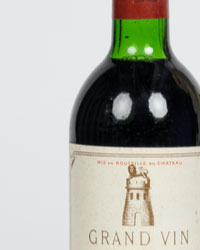
2016 Château Gruaud Larose - Saint-Julien 2ème Grand Cru Classé - 3 Bottles (0.75L)


00
days
05
hours
44
minutes
18
seconds
Current bid
€ 175
Reserve price met

Expert
Selected by Patricia Verschelling
Holds WSET Level 3 and 4, Vinoloog degree; auction house wine expert since 2004.
Estimate € 200 - € 250
 | €175 | |
|---|---|---|
| €161 | |
 | €151 | |
Catawiki Buyer Protection
Your payment’s safe with us until you receive your object.View details
Trustpilot 4.4 | 145304 reviews
Rated Excellent on Trustpilot.
Three 0.75-litre bottles of Château Gruaud Larose Saint-Julien 2016.
AI-assisted summary
Description from the seller
Wine stored in an electronic cellar! Purchased en primeur!
Region: Bordeaux
Estate: Château Gruaud Larose
Color: red
Grape composition: Malbec, Cabernet Franc, Petit Verdot, Cabernet Sauvignon
Food pairings: Coquilles Saint-Jacques with cepes, Roasted squab, Hare in the royal style
Appellation: Saint-Julien
Classification: Second Growth (Deuxième Grand Cru Classé)
Owner: Groupe Bernard Taillan
Viticulture: ecological Learn more...
Serving temperature: 16°C
About the estate
The Gruaud-Larose estate stretches between Branaire-Ducru to the east and Lagrange to the west. Its extensive vineyard (82 hectares) sits on a soil of medium gravels. In the 18th century, the estate, owned by the Gruaud brothers, covered up to 115 hectares. The son-in-law of one of them, Mr. de Larose, took over the domaine and became the tireless ambassador of this wine, which reached the royal table, hence the famous label phrase still readable today: "the king of wines, the wine of kings." A rightly deserved claim, as for many years the wines were among the most massive and slowest to evolve in Saint-Julien. Yet Gruaud Larose’s history has not been a smooth voyage. After many changes of ownership in the 19th century, the estate suffered from a turbulent succession and split in 1867. One owner was Baron Sarget, after whom the current second wine is named, Sarget de Gruaud Larose. The Cordier Group, which became owner in 1917, managed to reunify the two parcels of the old estate in 1934. Gruaud Larose was sold in 1993 to Alcatel Alsthom, then in 1997 to the Merlaut family. Gruaud Larose’s wines stand among the best produced in Saint-Julien. The vineyard has been fully certified organic since 2022, with a dominance of Cabernet Sauvignon (60%), complemented by Merlot (30%), Cabernet Franc (7%), and Petit Verdot (3%). The winemakers employ biodynamic-inspired practices, notably the use of herbal infusions from various plants as an alternative to pest control, as well as the addition of trace elements at the base of the vines.
About the cuvée
Originating from deep Garonnais gravels, this Second Growth of Saint-Julien favors a blend dominated by Cabernet Sauvignon and Merlot, with Cabernet Franc completing the mix. The grapes are hand-picked and carefully sorted before parcel-by-parcel winemaking to preserve the precision of each lot.
Fermentation occurs half in wooden vats and half in thermoregulated concrete tanks. The maceration, lasting between twenty and thirty days, allows color, fruit, and structure to be extracted without hardening the substance. Maturation continues for twelve months in French barrels, with a limited proportion of new oak.
The garnet color hints at a deep nose of blackcurrant, blackberry, and black plum, enhanced by cedar, graphite, and spice notes. On the palate, the wine appears dense, ample, and savory, supported by ripe tannins with a velvety feel. An elegant freshness balances the fruit’s richness and extends a persistent finish. Already appealing in its youth, this Saint-Julien has the structure needed to age gracefully in the cellar."
Details
Vintage
2016
Producer, Name of wine
Château Gruaud Larose
Classification
2ème Grand Cru Classé
Number of bottles
3
Bottle size
Bottles (0.75L)
Country
France
Region
Saint-Julien
Fill level
Bordeaux bottle type, neck fill level
Sold by