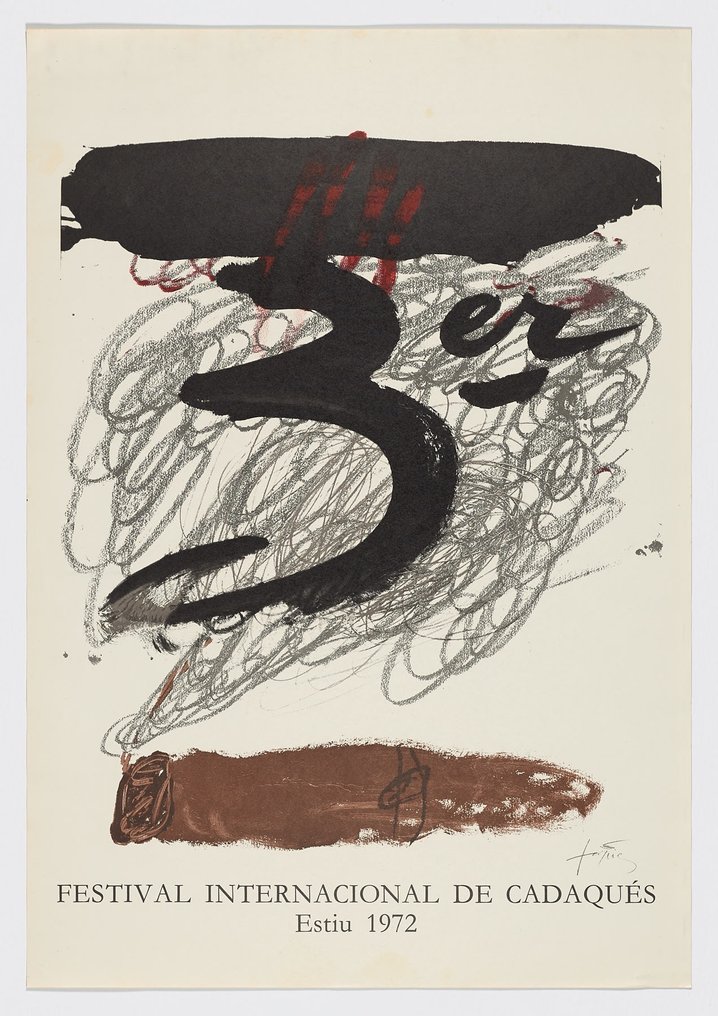
Antoni Tapies (after) - Festival Internacional de Cadaqués ** ORIGINAL LITHOGRAPHIC PRINT 1972 ** COA **



05
days
06
hours
54
minutes
09
seconds
Starting bid
€ 1
Reserve price not met

Expert
Selected by Juan Antonio Rodríguez
Eight years experience valuing posters, previously valuer at Balclis, Barcelona.
Estimate € 150 - € 200
No bids placed
Catawiki Buyer Protection
Your payment’s safe with us until you receive your object.View details
Trustpilot 4.4 | 144679 reviews
Rated Excellent on Trustpilot.
Description from the seller
Original lithographic print by Antoni Tàpies (*).
This work was created to mark the third anniversary of the Cadaqués International Festival.
Made on heavyweight lithographic paper.
Includes Certificate of Authenticity (COA).
Specifications:
Dimensions: 90 x 64 cm
Year: 1972
Condition: Very Good (Shows very light yellowing due to age. Nevertheless, this work has never been framed or exhibited, and has always been kept in a professional art folder, and is therefore offered in very good condition).
Provenance: Private Collection.
The work will be carefully handled and packed in a reinforced cardboard carton. Shipping will be tracked and certified.
The shipment will also include shipping insurance for the final value of the work with full reimbursement in case of loss or damage, at no cost to the buyer.
(*) Antoni Tàpies was born in 1923 in Barcelona, Spain. He studied law and drawing at the Valls Academy (1943). The military uprising led by General Franco from Morocco spread to all of Spain and led to the Civil War. Antoni Tàpies, an opponent of the dictator from within, was ultimately shaped by this horrific war.
In 1948 he co-founded the group “Dau al Set” and its magazine of the same name. He met Joan Miró. After a period of surrealist production, Tàpies became interested in philosophy and Eastern art, especially calligraphy. Tàpies transforms diverse, often humble, materials into pictorial signs.
His first solo exhibition was organized in 1950. The artist incorporated colors and fossils into pasted blocks with glue, sand, and plaster that would become “walls bearing witness to the martyrdom of our people.” Tapiès used newspaper papers, scraps of rope for social‑meaning collages with provocative symbolism.
In 1951, in Paris, he met Braque and Picasso, discovered informal art with Dubuffet and Fautrier, and the writings of Michel Tapié. The artist leaned toward more figurative compositions toward the late 1960s. The cross is a recurrent sign in his oeuvre, whether in painted or graphic works, numerous pieces that he elaborates in parallel. His torn and scratched compositions continue to express a critical stance. The impressions and traces reveal inner meditation.
From the early 1980s, Tàpies created “installations” and devoted himself to ceramics and mosaic art. From 1962, major museums organized retrospectives of his work (Hanover 1962, Vienna 1968, Musée d’Art Moderne de Paris in 1973, itinerant retrospective in the United States in 1988...).
Antoni Tàpies is the author of several writings reflecting on art: “Práctica del arte” (1970), “El Arte contra la Estética” (1974). Antoni Tàpies lived and worked in Barcelona, the city where his Foundation is located, established in 1984. The artist died on February 6, 2012, aged 88.
Tags:
Picasso, Dalí, Pollock, Miró, Beuys, Warhol, Giacometti, Hodgkin, Moore, Malevich, Mondrian, O’Keefe, Matisse, Kandinsky, Bacon, Klimt, Hooper, Rothko, Chirico, Duchamp, Chagall, Braque, Picabia, Kooning, Ernst, Paul Klee, Modigliani, Calder, Delaunay.
Kiefer, Kusama, Murakami, Koons, Basquiat, Nauman, Sherman, Bourgeois, Polke, Ruff, Ruscha, Holzer, Abramović, Freud, Mendieta, Tuymans, Kruger, Hockney, Saville, Fanzhi, Oehlen, Richter, Scully, Stella, Schütte, Xiaodong, Judd, Peyton, Richard Serra, LeWitt, Kippenberger, Baldessari, Doig, González-Torres,
Salvador Dalí, Joan Miró, Magritte, Max Ernst, Leonora Carrington, Dorothea Tanning, Roberto Matta, Man Ray, Varo, Oppenheim, Key Sage, André Masson, Paul Delvaux, Giorgio de Chirico, Marcel Duchamp, Marc Chagall, Paul Klee, Hans Bellmer, Zhang Xiaogang, Savinio, Alexander Calder, Dora Maar
Vitra, Poolsen, Jacobsen, Hans Wegner, Charles Eames, Perriand, Philippe Starck, Marcel Breuer, Knoll, Juhl, Verner Panton, Le Corbusier, Mies Vander Rohe, Nelson, Mogensen, Eames, Gio Ponti, Knoll, Isamu Noguchi, Bertoia, Aalto, Urquiola, Eileen Gray, Pesce, Magistretti.
Louis Vuitton, Gucci, Chanel, Burberry, Hermès, Prada, Dior, Armani, Cartier, Dolce & Gabbana, Versace, Balenciaga, Ralph Lauren, Rolex, Fendi, Givenchy, Tiffany, Alexander McQueen, Yves Saint Laurent, Valentino, Bvlgari.
Adami Alberti Alcaraz Alfaro Baldaccini Baldeweg Barceló Barjola Canogar Cabellut Caruncho Ceesepe Chillida Chirino Clavé Condé Cruz-Díez Dalí Dokoupil Equipo Crónica Gudmundur Feito Genovés Goya Gordillo Guinovart Hernández Pijuan Iglesias Lacalle Joan Miró Misterpiro Mompó Palazuelo Pérez-Villalta Picasso Plensa Rafols-Casamada Reche Redondela Saura Soto Sicilia Tàpies Teixidor Quetglas Úrculo Uslé Varela Valdés Villalba Yturralde
Seller's Story
EsKobARTE carefully selects artworks from renowned and emerging artists worldwide, offering them here at affordable prices. *** HIGH-QUALITY LICENSED PRINTS *** We only sell authentic artworks and high-quality licensed prints. *** WE ARE PROFESSIONALS *** You can bid on our items with complete confidence. Over 1000 positive reviews on Catawiki attest to our professionalism. *** SECURE, CERTIFIED, AND INSURED SHIPPING *** All our items are carefully packaged in eco-friendly cardboard boxes. We work with the best courier services (UPS, DPD, DHL, FedEx) to guarantee the best service and tracking. Our shipments also include insurance against damage or loss, at no extra cost to the buyer *** COMBINED SHIPPING *** If you purchase multiple items -even from different auctions- you will only pay for shipping once *** ANY QUESTIONS? *** Feel free to contact us via chat, we will gladly assist you as soon as possible *** THANK YOU AND GOOD LUCK WITH YOUR BIDS! ***
Translated by Google TranslateOriginal lithographic print by Antoni Tàpies (*).
This work was created to mark the third anniversary of the Cadaqués International Festival.
Made on heavyweight lithographic paper.
Includes Certificate of Authenticity (COA).
Specifications:
Dimensions: 90 x 64 cm
Year: 1972
Condition: Very Good (Shows very light yellowing due to age. Nevertheless, this work has never been framed or exhibited, and has always been kept in a professional art folder, and is therefore offered in very good condition).
Provenance: Private Collection.
The work will be carefully handled and packed in a reinforced cardboard carton. Shipping will be tracked and certified.
The shipment will also include shipping insurance for the final value of the work with full reimbursement in case of loss or damage, at no cost to the buyer.
(*) Antoni Tàpies was born in 1923 in Barcelona, Spain. He studied law and drawing at the Valls Academy (1943). The military uprising led by General Franco from Morocco spread to all of Spain and led to the Civil War. Antoni Tàpies, an opponent of the dictator from within, was ultimately shaped by this horrific war.
In 1948 he co-founded the group “Dau al Set” and its magazine of the same name. He met Joan Miró. After a period of surrealist production, Tàpies became interested in philosophy and Eastern art, especially calligraphy. Tàpies transforms diverse, often humble, materials into pictorial signs.
His first solo exhibition was organized in 1950. The artist incorporated colors and fossils into pasted blocks with glue, sand, and plaster that would become “walls bearing witness to the martyrdom of our people.” Tapiès used newspaper papers, scraps of rope for social‑meaning collages with provocative symbolism.
In 1951, in Paris, he met Braque and Picasso, discovered informal art with Dubuffet and Fautrier, and the writings of Michel Tapié. The artist leaned toward more figurative compositions toward the late 1960s. The cross is a recurrent sign in his oeuvre, whether in painted or graphic works, numerous pieces that he elaborates in parallel. His torn and scratched compositions continue to express a critical stance. The impressions and traces reveal inner meditation.
From the early 1980s, Tàpies created “installations” and devoted himself to ceramics and mosaic art. From 1962, major museums organized retrospectives of his work (Hanover 1962, Vienna 1968, Musée d’Art Moderne de Paris in 1973, itinerant retrospective in the United States in 1988...).
Antoni Tàpies is the author of several writings reflecting on art: “Práctica del arte” (1970), “El Arte contra la Estética” (1974). Antoni Tàpies lived and worked in Barcelona, the city where his Foundation is located, established in 1984. The artist died on February 6, 2012, aged 88.
Tags:
Picasso, Dalí, Pollock, Miró, Beuys, Warhol, Giacometti, Hodgkin, Moore, Malevich, Mondrian, O’Keefe, Matisse, Kandinsky, Bacon, Klimt, Hooper, Rothko, Chirico, Duchamp, Chagall, Braque, Picabia, Kooning, Ernst, Paul Klee, Modigliani, Calder, Delaunay.
Kiefer, Kusama, Murakami, Koons, Basquiat, Nauman, Sherman, Bourgeois, Polke, Ruff, Ruscha, Holzer, Abramović, Freud, Mendieta, Tuymans, Kruger, Hockney, Saville, Fanzhi, Oehlen, Richter, Scully, Stella, Schütte, Xiaodong, Judd, Peyton, Richard Serra, LeWitt, Kippenberger, Baldessari, Doig, González-Torres,
Salvador Dalí, Joan Miró, Magritte, Max Ernst, Leonora Carrington, Dorothea Tanning, Roberto Matta, Man Ray, Varo, Oppenheim, Key Sage, André Masson, Paul Delvaux, Giorgio de Chirico, Marcel Duchamp, Marc Chagall, Paul Klee, Hans Bellmer, Zhang Xiaogang, Savinio, Alexander Calder, Dora Maar
Vitra, Poolsen, Jacobsen, Hans Wegner, Charles Eames, Perriand, Philippe Starck, Marcel Breuer, Knoll, Juhl, Verner Panton, Le Corbusier, Mies Vander Rohe, Nelson, Mogensen, Eames, Gio Ponti, Knoll, Isamu Noguchi, Bertoia, Aalto, Urquiola, Eileen Gray, Pesce, Magistretti.
Louis Vuitton, Gucci, Chanel, Burberry, Hermès, Prada, Dior, Armani, Cartier, Dolce & Gabbana, Versace, Balenciaga, Ralph Lauren, Rolex, Fendi, Givenchy, Tiffany, Alexander McQueen, Yves Saint Laurent, Valentino, Bvlgari.
Adami Alberti Alcaraz Alfaro Baldaccini Baldeweg Barceló Barjola Canogar Cabellut Caruncho Ceesepe Chillida Chirino Clavé Condé Cruz-Díez Dalí Dokoupil Equipo Crónica Gudmundur Feito Genovés Goya Gordillo Guinovart Hernández Pijuan Iglesias Lacalle Joan Miró Misterpiro Mompó Palazuelo Pérez-Villalta Picasso Plensa Rafols-Casamada Reche Redondela Saura Soto Sicilia Tàpies Teixidor Quetglas Úrculo Uslé Varela Valdés Villalba Yturralde
Seller's Story
EsKobARTE carefully selects artworks from renowned and emerging artists worldwide, offering them here at affordable prices. *** HIGH-QUALITY LICENSED PRINTS *** We only sell authentic artworks and high-quality licensed prints. *** WE ARE PROFESSIONALS *** You can bid on our items with complete confidence. Over 1000 positive reviews on Catawiki attest to our professionalism. *** SECURE, CERTIFIED, AND INSURED SHIPPING *** All our items are carefully packaged in eco-friendly cardboard boxes. We work with the best courier services (UPS, DPD, DHL, FedEx) to guarantee the best service and tracking. Our shipments also include insurance against damage or loss, at no extra cost to the buyer *** COMBINED SHIPPING *** If you purchase multiple items -even from different auctions- you will only pay for shipping once *** ANY QUESTIONS? *** Feel free to contact us via chat, we will gladly assist you as soon as possible *** THANK YOU AND GOOD LUCK WITH YOUR BIDS! ***
Translated by Google TranslateDetails
Era
1900-2000
Designer/artist
Antoni Tapies (after)
Poster title
Festival Internacional de Cadaqués ** ORIGINAL LITHOGRAPHIC PRINT 1972 ** COA **
Subject
Art
Country of origin
Spain
Condition
A- (fine - tiny imperfections)
Height
55.5 cm
Width
80 cm