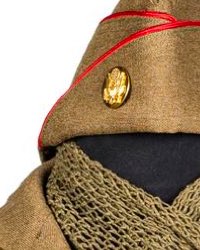
Germany - Cavalry - Military equipment - 1902


06
days
20
hours
24
minutes
53
seconds

 | €3 | |
|---|---|---|
 | €2 |
Catawiki Buyer Protection
Your payment’s safe with us until you receive your object.View details
Trustpilot 4.4 | 145455 reviews
Rated Excellent on Trustpilot.
This original German cavalry piece dates from 1902, is made of horn, wood and porcelain, and measures 155 cm in total; the ochre-coloured horse is missing its hooves and tail.
AI-assisted summary
Description from the seller
Leonhard Schwarz
Nuremberg Fürth (Fürth is part of the municipality of Nuremberg)
1902–1905
Special feature: the Bismarck helmet
• The unit: The Chevaulegers (French for “light horse”) were a renowned light cavalry unit in the Bavarian Army.
• Garrison city of Nuremberg: The regiment had been permanently stationed in Nuremberg since 1856. In 1902, the riders and their horses were housed in the purpose-built Cavalry Barracks in the Bärenschanze district.
• The connection with the Russian Tsar: From 1894 until the outbreak of the First World War in 1914, the unit bore the name of its ceremonial patron (the Regimentsinhaber): Russian Tsar Nicholas II. This gave it a unique historical and ceremonial status in the city.
• Weapons and equipment: In 1902, the riders still wore their characteristic dark green uniforms with a distinctive helmet (the Raupenhelm, or later the Pickelhaube). Their primary weapons in combat at the time were still the cavalry saber (sword) and a carbine (short rifle) for fighting at a distance.
Total length 1 m 55 cm
Head height 16 cm
Shaft belonging to the head
The ochre-colored horse is missing its hooves and tail: see the photos
Flexible section in good condition
Condition of the head — see the photos
Shipping by registered mail (carefully packed and insured)
From my private tobacconalia collection
Details
Era
1900-2000
Army unit
Cavalry
Country of origin
Germany
Year of manufacture
1902
Material
horn wood porcelain
Condition
Good condition
Authenticity
Original/official
Height
155 cm
Comes with certificate of authenticity
No