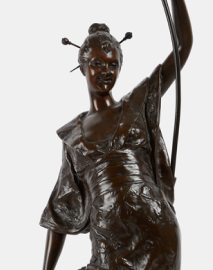
según Albert-Ernest Carrier-Belleuse - Statue, Pareja de bronces de músico y bailarín napolitanos - 50 cm - Bronze


04
days
07
hours
07
minutes
46
seconds
Starting bid
€ 1
Reserve price not met

Expert
Selected by Paul Wullems
He accumulated 18 years' experience, worked as junior specialist at Sotheby’s and managed Kunsthandel Jacques Fijnaut.
Estimate € 2,400 - € 3,000
No bids placed
Catawiki Buyer Protection
Your payment’s safe with us until you receive your object.View details
Trustpilot 4.4 | 144426 reviews
Rated Excellent on Trustpilot.
Description from the seller
Naples-born musician and dancer pair of bronze figures, Albert-Ernest Carrier-Belleuse, French Romanticism, 19th century - France
Material: Bronze with patina
Author: Albert-Ernest Carrier-Belleuse
Style: French Romanticism
Period: Mid-19th century
Country of origin: France
Good condition considering its age and use
Figure dimensions (without plinth): 38 cm
Total dimensions: 50 x 18 cm
Magnificent patinated bronze pair executed by the artist Albert-Ernest Carrier-Belleuse. The pair consists of two musicians, a troubadour and a Neapolitan dancer.
The sense of movement conveyed by the figures stands out, as if frozen mid-performance, with arms and legs raised. Both have the same structure, a very similar face, with strong features expressing happiness, the torso bare with defined muscles, short pants; in the case of the troubadour with carved striped fabric in bronze and in the case of the dancer with very pronounced folds.
The troubadour figure wears a wide-brimmed hat with rich texture made up of small, fine lines, as well as an ornament with flowers on one side. What stands out most in this piece is the meticulous rendering of the lute he holds in his left hand, full of detail—from the strap to the soundbox. From top to bottom the instrument has four pegs with four strings made from copper strips; on the neck the frets are perfectly marked and bronze-recessed, and finally a mouthpiece with a flower design inscribed in two circles. Additionally, the troubadour has his right arm raised and wears a small pick in his hand to play the instrument.
The dancer figure has a Phrygian cap, widely used in representations of French Romanticism (as in Eugène Delacroix’s Liberty Leading the People), which also features a texture made from small crescents engraved in the bronze. Moreover, both arms are raised in the midst of a step, and in his hands he holds castanets to accompany the dance.
The two figures are placed on a circular plinth, with a rough texture on the top where the artist’s signature appears. Additionally, the figure with the lute has a polished brass/bronze plate with the word “Trovador” engraved on it.
Albert-Ernest Carrier-Belleuse (1824–1887)
Albert-Ernest Carrier-Belleuse was a renowned French sculptor and painter. He entered the École des Beaux-Arts in Paris in 1840, where he studied under David d’Angers. Ten years later he moved to London, where he worked for Minton China Works for five more years. Upon returning to France he began creating and exhibiting his most significant works and earned the sponsorship of Napoleon III, who entrusted him with several monumental bronze sculptures. In 1876 he was named art director of the Manufacture nationale de Sèvres, where he incorporated several of his own models.
He greatly admired late French Baroque sculptors, so artists such as Jean-Baptiste Pigalle, Augustin Pajou, Jean-Antoine Houdon and Claude Michel “Clodion” were his main sources of inspiration. Auguste Rodin worked as a marble cutter in his workshop in the 1860s. Subsequently, he created a bust of his master and fellow artist.
Shipping terms
The shipment of the product will be paid by the buyer according to the dimensions, weight and destination. The shipping costs include professional, tailor-made packaging; and the personalized shipment, with tracking number and warranty.
The buyer will be responsible for paying import duties and related taxes in the destination country, if any. Please note the seller’s disclaimer of liability regarding possible customs charges, as they are charged in the destination country and the amount to pay is determined by that country’s customs duties. If an export permit is required, the costs are borne by the buyer. The cost depends progressively on the value of the work to be exported.
Seller's Story
- ABOUT US - Fragonard Interiors is a company with experience for more than 30 years, with a team of experts specialized in antiques, design pieces, works of art and interior design projects.
We always seek excellence and originality in each of the pieces, chasing as much customer satisfaction as possible.
By giving a new life to the pieces and works of art, we manage to perpetuate their soul and activate a circular economy of objects.
FOLLOW US ON INSTAGRAM: fragonard_interiors
The packaging is professional and adapted to each piece, with tracking number and shipping insurance. 100% AUTHENTICITY AND QUALITY CONTROL. Each item sold is analyzed, studied and authenticated by experts.
WORLD DELIVERY We ship to all countries served by international courier service providers such as DHL, UPS ...
You can also arrange for yourself to pick up at our physical location.
Translated by Google TranslateNaples-born musician and dancer pair of bronze figures, Albert-Ernest Carrier-Belleuse, French Romanticism, 19th century - France
Material: Bronze with patina
Author: Albert-Ernest Carrier-Belleuse
Style: French Romanticism
Period: Mid-19th century
Country of origin: France
Good condition considering its age and use
Figure dimensions (without plinth): 38 cm
Total dimensions: 50 x 18 cm
Magnificent patinated bronze pair executed by the artist Albert-Ernest Carrier-Belleuse. The pair consists of two musicians, a troubadour and a Neapolitan dancer.
The sense of movement conveyed by the figures stands out, as if frozen mid-performance, with arms and legs raised. Both have the same structure, a very similar face, with strong features expressing happiness, the torso bare with defined muscles, short pants; in the case of the troubadour with carved striped fabric in bronze and in the case of the dancer with very pronounced folds.
The troubadour figure wears a wide-brimmed hat with rich texture made up of small, fine lines, as well as an ornament with flowers on one side. What stands out most in this piece is the meticulous rendering of the lute he holds in his left hand, full of detail—from the strap to the soundbox. From top to bottom the instrument has four pegs with four strings made from copper strips; on the neck the frets are perfectly marked and bronze-recessed, and finally a mouthpiece with a flower design inscribed in two circles. Additionally, the troubadour has his right arm raised and wears a small pick in his hand to play the instrument.
The dancer figure has a Phrygian cap, widely used in representations of French Romanticism (as in Eugène Delacroix’s Liberty Leading the People), which also features a texture made from small crescents engraved in the bronze. Moreover, both arms are raised in the midst of a step, and in his hands he holds castanets to accompany the dance.
The two figures are placed on a circular plinth, with a rough texture on the top where the artist’s signature appears. Additionally, the figure with the lute has a polished brass/bronze plate with the word “Trovador” engraved on it.
Albert-Ernest Carrier-Belleuse (1824–1887)
Albert-Ernest Carrier-Belleuse was a renowned French sculptor and painter. He entered the École des Beaux-Arts in Paris in 1840, where he studied under David d’Angers. Ten years later he moved to London, where he worked for Minton China Works for five more years. Upon returning to France he began creating and exhibiting his most significant works and earned the sponsorship of Napoleon III, who entrusted him with several monumental bronze sculptures. In 1876 he was named art director of the Manufacture nationale de Sèvres, where he incorporated several of his own models.
He greatly admired late French Baroque sculptors, so artists such as Jean-Baptiste Pigalle, Augustin Pajou, Jean-Antoine Houdon and Claude Michel “Clodion” were his main sources of inspiration. Auguste Rodin worked as a marble cutter in his workshop in the 1860s. Subsequently, he created a bust of his master and fellow artist.
Shipping terms
The shipment of the product will be paid by the buyer according to the dimensions, weight and destination. The shipping costs include professional, tailor-made packaging; and the personalized shipment, with tracking number and warranty.
The buyer will be responsible for paying import duties and related taxes in the destination country, if any. Please note the seller’s disclaimer of liability regarding possible customs charges, as they are charged in the destination country and the amount to pay is determined by that country’s customs duties. If an export permit is required, the costs are borne by the buyer. The cost depends progressively on the value of the work to be exported.
Seller's Story
- ABOUT US - Fragonard Interiors is a company with experience for more than 30 years, with a team of experts specialized in antiques, design pieces, works of art and interior design projects.
We always seek excellence and originality in each of the pieces, chasing as much customer satisfaction as possible.
By giving a new life to the pieces and works of art, we manage to perpetuate their soul and activate a circular economy of objects.
FOLLOW US ON INSTAGRAM: fragonard_interiors
The packaging is professional and adapted to each piece, with tracking number and shipping insurance. 100% AUTHENTICITY AND QUALITY CONTROL. Each item sold is analyzed, studied and authenticated by experts.
WORLD DELIVERY We ship to all countries served by international courier service providers such as DHL, UPS ...
You can also arrange for yourself to pick up at our physical location.
Translated by Google TranslateDetails
Era
1900-2000
Country of origin
France
Style
Antique
Material
Bronze
Artist
según Albert-Ernest Carrier-Belleuse
Title of artwork
Pareja de bronces de músico y bailarín napolitanos
Signature
Signed
Colour
Bronze
Condition
Good condition
Height
50 cm
Width
18 cm
Depth
18 cm
Weight
15 kg
Sold by