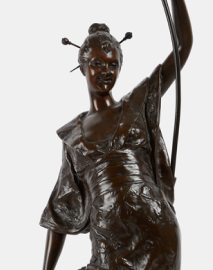
según Clodion - Sculpture, Niño con cabrita - 18 cm - Patinated bronze


00
days
17
hours
58
minutes
08
seconds
Current bid
€ 300
Reserve price not met

Expert
Selected by Paul Wullems
He accumulated 18 years' experience, worked as junior specialist at Sotheby’s and managed Kunsthandel Jacques Fijnaut.
Estimate € 700 - € 800
 | €300 | |
|---|---|---|
 | €2 | |
| €1 |
Catawiki Buyer Protection
Your payment’s safe with us until you receive your object.View details
Trustpilot 4.4 | 145414 reviews
Rated Excellent on Trustpilot.
Description from the seller
Exquisite bronze figure signed CLODION (Claude Michel). It depicts a child playing with a little goat.
• Born in Nancy in 1738 into the celebrated Adam family dynasty of sculptors.
• Early training: He moved to Paris in 1755 to study with his uncle Lambert-Sigisbert Adam and later with the renowned sculptor Jean-Baptiste Pigalle.
• Recognition: His talent was quickly established when he won the Académie Royale’s grand prize for sculpture in 1759.
Success in Rome (1762–1771)
• Time in Italy: He won the coveted Prix de Rome and moved to Italy in 1762, where he remained for nearly a decade.
• International clientele: His studio in Rome was extremely busy, receiving commissions from local nobility and collectors throughout Europe (including Catherine the Great of Russia).
Maturity and the French Revolution (1771–1814)
• Return to Paris: He returned to France in 1771, where he became one of the most sought-after decorative sculptors of the Rococo and early Neoclassical styles.
• Political impact: The outbreak of the French Revolution in 1789 temporarily brought demand for his aristocratic and sensual-themed works to a halt.
• Later years: He adapted to the changing times by creating monumental reliefs for the Arc de Triomphe du Carrousel and died in Paris in 1814.
Details
Era
1400-1900
Bronze type
Patinated bronze
Over 200 years old
Yes
Country of origin
France
Material
Bronze
Artist
según Clodion
Title of artwork
Niño con cabrita
Signature
Signed
Colour
Bronze
Condition
Excellent condition
Height
18 cm
Width
16 cm
Depth
10 cm
Sold by